
Title
The Simple Art of Voting: The Cognitive Shortcuts of Italian Voters,Used
Sold by Ergodebooks, an authorized reseller.
Returns accepted within 30 days | support@ergodebooks.com
Shipping Information
- Free Standard Shipping — United States only
- Processing Time: 3–5 business days
- Estimated Delivery: 6–10 business days after dispatch
- Double-boxed, fully insured & discreetly packaged
- Tracking number sent via email once dispatched
Returns & Refund
Returns accepted within 30 days of delivery.
Damaged or Defective Item
Free return shipping + replacement or full refund
Wrong Item Received
Free return shipping + replacement or full refund
Change of Mind
Return shipping at customer's expense · 25% restocking fee applies
Payment Option

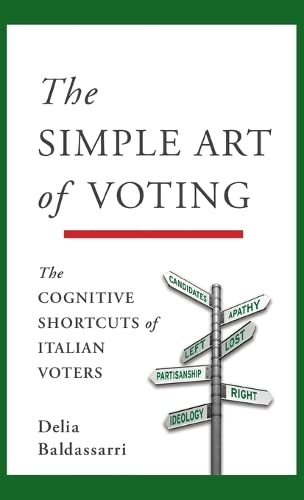
Voting distills a complex decision into a deceptively simple action. During campaign seasons, the electorate faces a messy tangle of parties, leaders, and issues. How is it possible for voters to unravel it all? How do they perceive and evaluate the political landscape? How, in short, do voters choose?Not only is voting a complex choice, but voters themselves also vary widely in their degree of interest, and involvement in politics. Too often, though, scholars have ignored this variety by focusing on a mythic "average voter." In The Simple Art of Voting, Delia Baldassarri provides a new understanding of how voting works by focusing on how choices are made given the cognitive limitations of the human mind and the environment in which decisionmaking takes place. Drawing on recent advances in the study of cognitive psychology, decisionmaking, and political cognition, Baldassarri provides a careful empirical examination of the strategies voters actually use to manage the complexity of political choice.Expressly rejecting the prevailing onesizefitsall, "what a rational voter should do" approach, she distinguishes voters based on the cognitive shortcuts, or heuristics, they use to simplify the decisionmaking process. Drawing on survey data from the 1990s Italian national general elections, the book identifies four types of voters, classified not by economic interest, partisanship, or demographics, but by how they perceive and organize the political debatefrom those who capably rely on nuanced ideological categories to those who, skeptical about allthingspolitical, prove easy prey for television broadcasters. The typology allows political scientists and sociologists to grasp the actual differences in political sophistication among citizens and to understand which factorsparties, leaders, ideology, the mediaare most important to different types of voters.Proving that there is no "average" voter, The Simple Art of Voting helps us make sense of the various ways in which citizens themselves make sense of and make "simple" the complex world of politics.
⚠️ WARNING (California Proposition 65):
This product may contain chemicals known to the State of California to cause cancer, birth defects, or other reproductive harm.
For more information, please visit www.P65Warnings.ca.gov.