If you have any questions, you are always welcome to contact us. We'll get back to you as soon as possible, withing 24 hours on weekdays.
Customer service
All questions about your order, return and delivery must be sent to our customer service team by e-mail at yourstore@yourdomain.com
Sale & Press
If you are interested in selling our products, need more information about our brand or wish to make a collaboration, please contact us at press@yourdomain.com
Help
If you have any questions, you are always welcome to contact us. We'll get back to you as soon as possible, withing 24 hours on weekdays.
Customer service
All questions about your order, return and delivery must be sent to our customer service team by e-mail at yourstore@yourdomain.com
Sale & Press
If you are interested in selling our products, need more information about our brand or wish to make a collaboration, please contact us at press@yourdomain.com
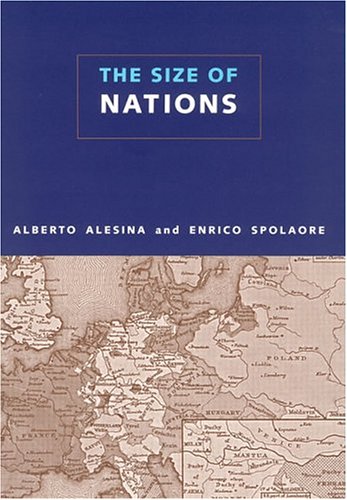
The authors of this timely and provocative book use the tools of economic analysis to examine the formation and change of political borders. They argue that while these issues have always been at the core of historical analysis, international economists have tended to regard the size of a country as exogenous, or no more subject to explanation than the location of a mountain range or the course of a river. Alesina and Spolaore consider a country's borders to be subject to the same analysis as any other manmade institution. In The Size of Nations, they argue that the optimal size of a country is determined by a costbenefit tradeoff between the benefits of size and the costs of heterogeneity. In a large country, per capita costs may be low, but the heterogeneous preferences of a large population make it hard to deliver services and formulate policy. Smaller countries may find it easier to respond to citizen preferences in a democratic way. Alesina and Spolaore substantiate their analysis with simple analytical models that show how the patterns of globalization, international conflict, and democratization of the last two hundred years can explain patterns of state formation. Their aim is not only normative but also positivethat is, not only to compute the optimal size of a state in theory but also to explain the phenomenon of country size in reality. They argue that the complexity of real world conditions does not preclude a systematic analysis, and that such an analysis, synthesizing economics, political science, and history, can help us understand real world events.
⚠️ WARNING (California Proposition 65):
This product may contain chemicals known to the State of California to cause cancer,
birth defects, or other reproductive harm.
For MAP (Minimum Advertised Price) violations and Intellectual Property (IP) or Trademark concerns, please contact:
support@ergodebooks.com
⚠️ California Proposition 65 Warning: Some products sold on this website may expose you to chemicals known to the State of California to cause cancer, birth defects, or other reproductive harm. For more information, visit www.P65Warnings.ca.gov.