
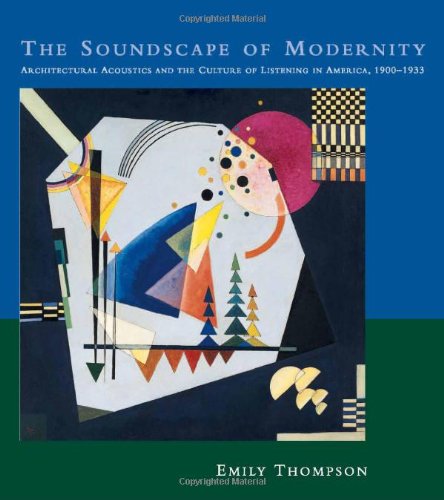
Title
The Soundscape of Modernity: Architectural Acoustics and the Culture of Listening in America, 19001933,Used
Sold by Ergodebooks, an authorized reseller.
Returns accepted within 30 days | support@ergodebooks.com
Shipping Information
- Free Standard Shipping — United States only
- Processing Time: 3–5 business days
- Estimated Delivery: 6–10 business days after dispatch
- Double-boxed, fully insured & discreetly packaged
- Tracking number sent via email once dispatched
Returns & Refund
Returns accepted within 30 days of delivery.
Damaged or Defective Item
Free return shipping + replacement or full refund
Wrong Item Received
Free return shipping + replacement or full refund
Change of Mind
Return shipping at customer's expense · 25% restocking fee applies
Payment Option

In this history of aural culture in earlytwentiethcentury America, Emily Thompsoncharts dramatic transformations in what people heard and how they listened. What they heard was anew kind of sound that was the product of modern technology. They listened as newly criticalconsumers of aural commodities. By examining the technologies that produced this sound, as well asthe culture that enthusiastically consumed it, Thompson recovers a lost dimension of the Machine Ageand deepens our understanding of the experience of change that characterized the era.Reverberationequations, sound meters, microphones, and acoustical tiles were deployed in places as varied asBoston's Symphony Hall, New York's office skyscrapers, and the soundstages of Hollywood. The controlprovided by these technologies, however, was applied in ways that denied the particularity of place,and the diverse spaces of modern America began to sound alike as a universal new sound predominated.Although this soundclear, direct, efficient, and nonreverberanthad little to say about thephysical spaces in which it was produced, it speaks volumes about the culture that created it. Bylistening to it, Thompson constructs a compelling new account of the experience of modernity inAmerica.
⚠️ WARNING (California Proposition 65):
This product may contain chemicals known to the State of California to cause cancer, birth defects, or other reproductive harm.
For more information, please visit www.P65Warnings.ca.gov.
- Q: What is the page count of this book? A: This book contains five hundred pages. It provides a comprehensive exploration of architectural acoustics and cultural listening.
- Q: What are the dimensions of this book? A: The book measures eight point seventy-five inches in length, one point five inches in width, and nine point five inches in height. These dimensions make it a suitable size for easy reading.
- Q: What type of binding does this book have? A: This book is bound in hardcover. Hardcover binding ensures durability and a professional appearance on your bookshelf.
- Q: Who is the author of this book? A: The author of this book is Emily Ann Thompson. She offers a deep dive into the history of sound in early-twentieth-century America.
- Q: What genre does this book belong to? A: This book belongs to the Music genre. It specifically addresses the intersection of architecture, acoustics, and cultural history.
- Q: Is this book suitable for academic study? A: Yes, this book is suitable for academic study. It provides valuable insights into architectural acoustics and cultural history, making it a good resource for students and researchers.
- Q: How does this book explore sound technology? A: This book examines the technologies that produced new sounds in modern America. It details how innovations like microphones and acoustical tiles influenced listening experiences.
- Q: Can this book be used for a music history course? A: Yes, this book can be used for a music history course. It discusses the cultural impact of sound from the early twentieth century, making it relevant for such studies.
- Q: What themes are explored in this book? A: The book explores themes of modernity, sound technology, and cultural consumption. It highlights how these elements shaped listening practices in America.
- Q: Is there a specific audience for this book? A: Yes, the book is aimed at readers interested in music, history, and architecture. It appeals to both general readers and scholars.
- Q: How should this book be stored? A: This book should be stored upright on a shelf. Keeping it upright helps maintain its condition and prevents damage to the spine.
- Q: What is the recommended care for this book? A: The recommended care is to keep it away from direct sunlight and moisture. This helps preserve the integrity of the hardcover and pages.
- Q: What if I receive a damaged copy of this book? A: If you receive a damaged copy, you should contact the seller for a return or exchange. Most sellers have policies in place for damaged items.
- Q: Can this book be a gift for someone interested in architecture? A: Yes, this book makes an excellent gift for someone interested in architecture. It combines elements of sound technology and cultural history.
- Q: Is this book appropriate for young readers? A: No, this book is not specifically designed for young readers. It is more suited for adults and older students due to its complex themes.
- Q: Does this book include illustrations or diagrams? A: No, this book does not specify the inclusion of illustrations or diagrams. It focuses primarily on text to convey its historical narrative.