If you have any questions, you are always welcome to contact us. We'll get back to you as soon as possible, withing 24 hours on weekdays.
Customer service
All questions about your order, return and delivery must be sent to our customer service team by e-mail at yourstore@yourdomain.com
Sale & Press
If you are interested in selling our products, need more information about our brand or wish to make a collaboration, please contact us at press@yourdomain.com
Help
If you have any questions, you are always welcome to contact us. We'll get back to you as soon as possible, withing 24 hours on weekdays.
Customer service
All questions about your order, return and delivery must be sent to our customer service team by e-mail at yourstore@yourdomain.com
Sale & Press
If you are interested in selling our products, need more information about our brand or wish to make a collaboration, please contact us at press@yourdomain.com
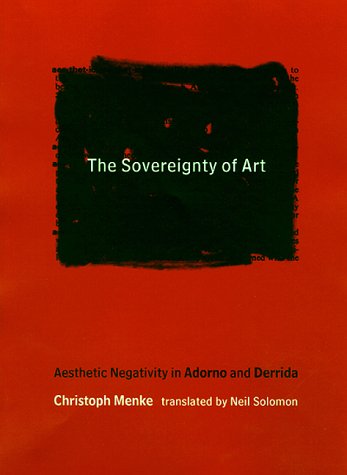
Recent discussions of aesthetics, whether in the hermeneutic or the analytic tradition, understand the place of art and aesthetic experience according to a model of "autonomy"as just one among the many modes of experience that make up the realm of reason, situated beside the other "spheres of value." In contrast, Thedor Adorno and Jacques Derrida view art and aesthetic experience as a medium for the dissolution of nonaesthetic reason, an experientially enacted critique of reason. Art is not only autonomous, following its own law, different from nonaesthetic reason, but sovereign: it subverts the rule of reason.In this book, Christoph Menke attempts to explain art's sovereign power to subvert reason without falling into an error common to Adorno's negative dialectics and Derrida's deconstruction. The error, which already appeared in romanticism, is to conceive of the sovereignty of art, as reflecting the superiority of its knowledge. For art entails no knowledge and its negativity toward reason cannot be articulated as an insight into the nature of reason. Rather, art is the medium of an experience that confronts reason from the outside with an insurmountable, neverending crisis. Art is sovereign not despite, but because of, its autonomy. Its power to subvert reason depends on upholding its difference from reason. Menke brings to his arguments a firm grounding in both philosophy and literary studies, as well as familiarity with German, French, and American sources.
⚠️ WARNING (California Proposition 65):
This product may contain chemicals known to the State of California to cause cancer,
birth defects, or other reproductive harm.
For MAP (Minimum Advertised Price) violations and Intellectual Property (IP) or Trademark concerns, please contact:
support@ergodebooks.com
⚠️ California Proposition 65 Warning: Some products sold on this website may expose you to chemicals known to the State of California to cause cancer, birth defects, or other reproductive harm. For more information, visit www.P65Warnings.ca.gov.