
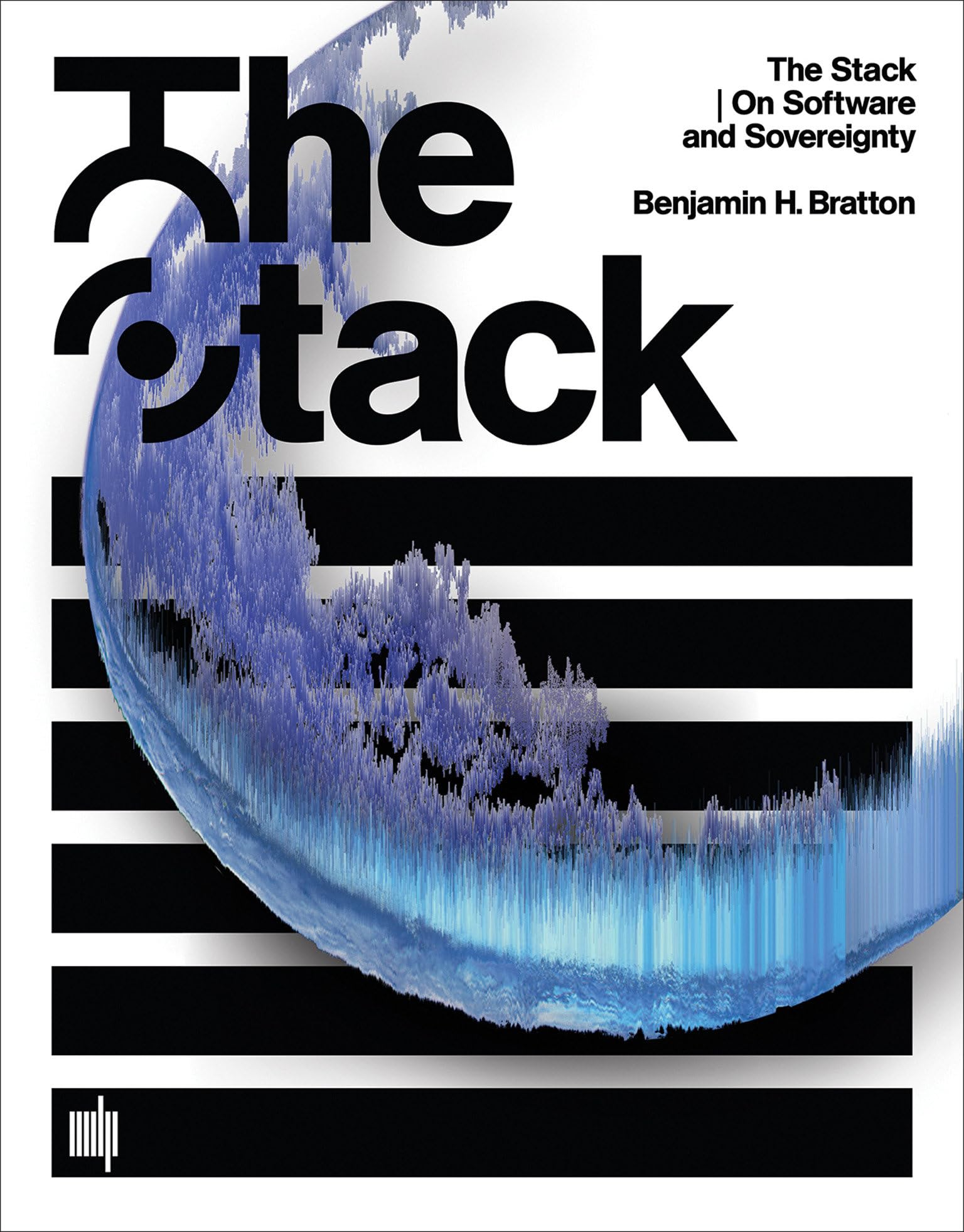
Title
The Stack: On Software and Sovereignty (Software Studies),New
Sold by Ergodebooks, an authorized reseller.
Returns accepted within 30 days | support@ergodebooks.com
Shipping Information
- Free Standard Shipping — United States only
- Processing Time: 3–5 business days
- Estimated Delivery: 6–10 business days after dispatch
- Double-boxed, fully insured & discreetly packaged
- Tracking number sent via email once dispatched
Returns & Refund
Returns accepted within 30 days of delivery.
Damaged or Defective Item
Free return shipping + replacement or full refund
Wrong Item Received
Free return shipping + replacement or full refund
Change of Mind
Return shipping at customer's expense · 25% restocking fee applies
Payment Option

A comprehensive political and design theory of planetaryscale computation proposing that The Stackan accidental megastructureis both a technological apparatus and a model for a new geopolitical architecture.What has planetaryscale computation done to our geopolitical realities? It takes different forms at different scalesfrom energy and mineral sourcing and subterranean cloud infrastructure to urban software and massive universal addressing systems; from interfaces drawn by the augmentation of the hand and eye to users identified by selfquantification and the arrival of legions of sensors, algorithms, and robots. Together, how do these distort and deform modern political geographies and produce new territories in their own image?In The Stack, Benjamin Bratton proposes that these different genres of computationsmart grids, cloud platforms, mobile apps, smart cities, the Internet of Things, automationcan be seen not as so many species evolving on their own, but as forming a coherent whole: an accidental megastructure called The Stack that is both a computational apparatus and a new governing architecture. We are inside The Stack and it is inside of us.In an account that is both theoretical and technical, drawing on political philosophy, architectural theory, and software studies, Bratton explores six layers of The Stack: Earth, Cloud, City, Address, Interface, User. Each is mapped on its own terms and understood as a component within the larger whole built from hard and soft systems interminglingnot only computational forms but also social, human, and physical forces. This model, informed by the logic of the multilayered structure of protocol stacks, in which network technologies operate within a modular and vertical order, offers a comprehensive image of our emerging infrastructure and a platform for its ongoing reinvention.The Stack is an interdisciplinary design brief for a new geopolitics that works with and for planetaryscale computation. Interweaving the continental, urban, and perceptual scales, it shows how we can better build, dwell within, communicate with, and govern our worlds.thestack.org
⚠️ WARNING (California Proposition 65):
This product may contain chemicals known to the State of California to cause cancer, birth defects, or other reproductive harm.
For more information, please visit www.P65Warnings.ca.gov.
- Q: What is the main topic of 'The Stack: On Software and Sovereignty'? A: The book explores a political and design theory of planetary-scale computation, focusing on how The Stack acts as both a technological apparatus and a model for a new geopolitical architecture.
- Q: Who is the author of 'The Stack'? A: The author of 'The Stack: On Software and Sovereignty' is Benjamin H. Bratton.
- Q: What are the main themes discussed in the book? A: The book discusses themes such as the impact of planetary-scale computation on geopolitical realities, the concept of The Stack, and its six layers: Earth, Cloud, City, Address, Interface, and User.
- Q: What is the publication date of 'The Stack'? A: The book was published on February 19, 2016.
- Q: What is the format of 'The Stack'? A: The book is available in hardcover format.
- Q: How many pages does 'The Stack' have? A: The book contains 528 pages.
- Q: What type of audience would benefit from reading 'The Stack'? A: The book is suitable for readers interested in political philosophy, architectural theory, software studies, and those looking to understand the interplay between technology and geopolitics.
- Q: Is 'The Stack' suitable for academic study? A: Yes, 'The Stack' serves as an interdisciplinary design brief that can be useful for academic study in fields such as technology, politics, and architecture.
- Q: What is the significance of The Stack according to the author? A: According to Bratton, The Stack represents a coherent whole of various computational forms that together shape modern political geographies and new territories.
- Q: Where can I find more information about 'The Stack'? A: More information about the book can be found on its official website, thestack.org.