
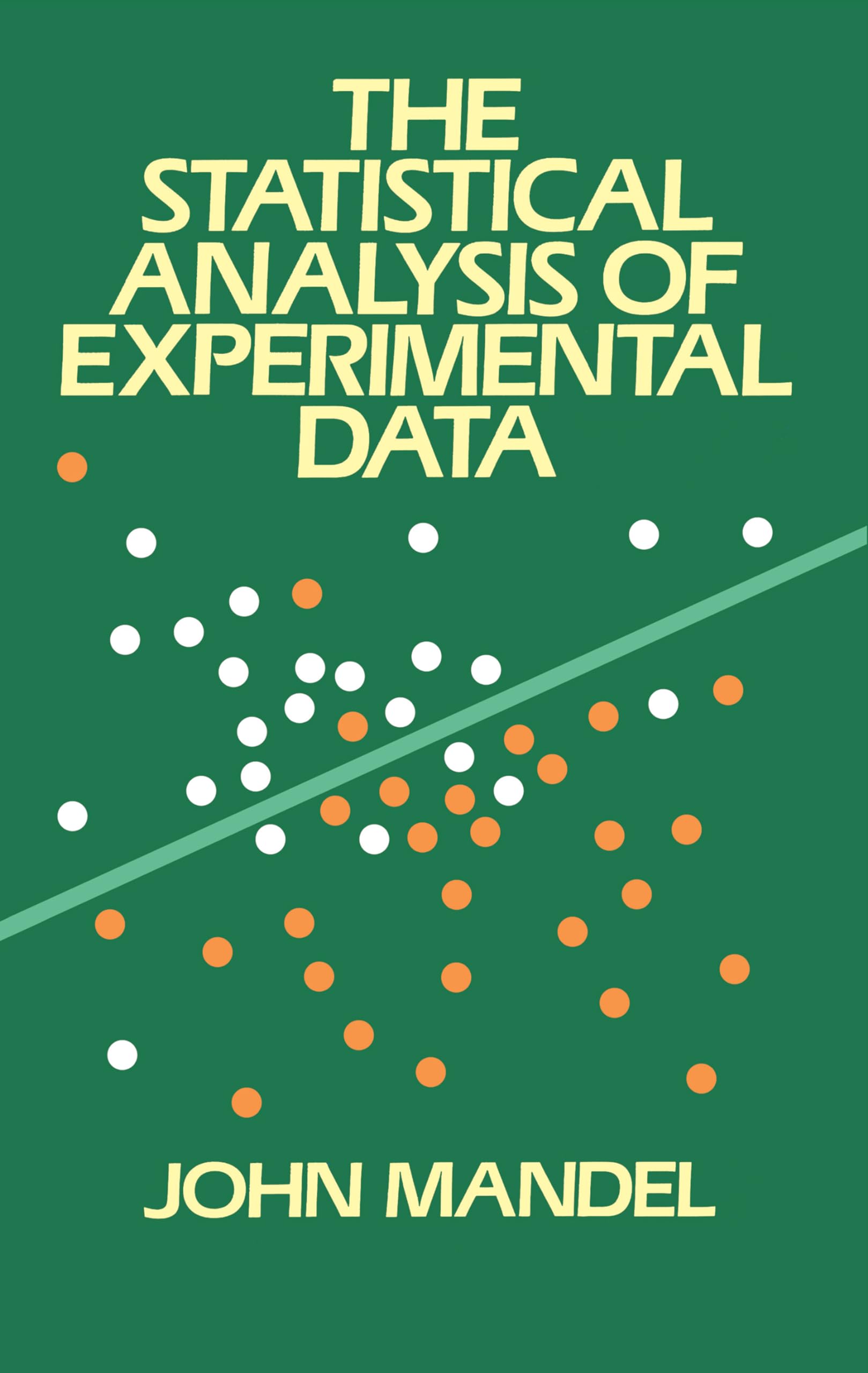
Title
The Statistical Analysis Of Experimental Data (Dover Books On Mathematics)
Sold by Ergodebooks, an authorized reseller.
Returns accepted within 30 days | support@ergodebooks.com
Shipping Information
- Free Standard Shipping — United States only
- Processing Time: 3–5 business days
- Estimated Delivery: 6–10 business days after dispatch
- Double-boxed, fully insured & discreetly packaged
- Tracking number sent via email once dispatched
Returns & Refund
Returns accepted within 30 days of delivery.
Damaged or Defective Item
Free return shipping + replacement or full refund
Wrong Item Received
Free return shipping + replacement or full refund
Change of Mind
Return shipping at customer's expense · 25% restocking fee applies
Payment Option

The Increasing Importance In Laboratory Situations Of Minutely Precise Measurements Presents The Chemist And Physicist With Numerous Problems In Data Analysis. National Bureau Of Standards Statistics Consultant John Mandel Here Draws A Clear And Fascinating Blueprint For A Systematic Science Of Statistical Analysis Geared To The Particular Needs Of The Physical Scientist, With Approach And Examples Aimed Specifically At The Statistical Problems He Is Likely To Confront.The First Third Of The Statistical Analysis Of Experimental Data Comprises A Thorough Grounding In The Fundamental Mathematical Definitions, Concepts, And Facts Underlying Modern Statistical Theory Math Knowledge Beyond Basic Algebra, Calculus, And Analytic Geometry Is Not Required. Remaining Chapters Deal With Statistics As An Interpretative Tool That Can Enable The Laboratory Researcher To Determine His Most Effective Methodology. You'Ll Find Lucid, Concise Coverage Of Over 130 Topics, Including Elements Of Measurement; Nature Of Statistical Analysis; Design/Analysis Of Experiments; Statistics As Diagnostic Tool; Precision And Accuracy; Testing Statistical Models; Betweenwithin Classifications; Twoway Classifications; Sampling (Principles, Objectives, Methods); Fitting Of Nonlinear Models; Measurement Of Processes; Components Of Variance; Nested Designs; The Sensitivity Ratio, And Much More.Also Included Are Many Examples, Each Worked In Stepbystep Fashion; Nearly 200 Helpful Figures And Tables; And Concluding Chapter Summaries Followed By References For Further Study.Mandel Argues That, When Backed By An Understanding Of Its Theoretic Framework, Statistics Offers Researchers Not Only A Powerful Tool For The Interpretation Of Experiments But Also A Task Of Real Intellectual Gratification. The Statistical Analysis Of Experimental Data Provides The Physical Scientist With The Explanations And Models He Requires To Impress This Invaluable Tool Into Service.
⚠️ WARNING (California Proposition 65):
This product may contain chemicals known to the State of California to cause cancer, birth defects, or other reproductive harm.
For more information, please visit www.P65Warnings.ca.gov.
- Q: How many pages does the book have? A: This book has four hundred thirty-two pages. It contains detailed statistics and methodologies for data analysis.
- Q: What is the binding type of this book? A: The book is available in paperback binding. This makes it lightweight and easy to handle for reading.
- Q: What are the dimensions of the book? A: The dimensions are five point five one inches in length, one inch in width, and eight point five inches in height. These dimensions make it convenient for bookshelf storage.
- Q: Who is the author of this book? A: The author is John Mandel. He provides expert insights into statistical analysis geared for scientists.
- Q: Is this book suitable for beginners? A: Yes, this book is suitable for beginners. It covers fundamental concepts without requiring advanced math knowledge.
- Q: What topics are covered in the book? A: The book covers over one hundred thirty topics, including statistical models, precision, and experimental design. Each topic is explained in a clear manner.
- Q: How should I store this book? A: Store this book in a cool, dry place away from direct sunlight. This will help maintain its condition over time.
- Q: Can I use this book for research purposes? A: Yes, this book is ideal for research purposes. It provides systematic approaches to data analysis that are applicable in laboratory settings.
- Q: Is there a glossary or references included in the book? A: Yes, the book includes concluding chapter summaries followed by references for further study. This aids in deepening understanding.
- Q: What types of experiments does this book discuss? A: The book discusses various types of experiments, including design and analysis. It helps researchers determine effective methodologies.
- Q: Does this book include illustrations or figures? A: Yes, the book contains nearly two hundred helpful figures and tables. These visuals enhance understanding of complex statistical concepts.
- Q: Is this book appropriate for physicists? A: Yes, the book is particularly geared towards physicists and chemists. It addresses the statistical problems they are likely to encounter.
- Q: What is the main focus of this book? A: The main focus is on statistical analysis in experimental data. It aims to provide researchers with effective tools for data interpretation.
- Q: How can I best utilize the information in this book? A: To utilize the information effectively, read through the chapters sequentially and apply the examples to your own data analysis tasks.
- Q: Does the book discuss non-linear models? A: Yes, the book includes a section on fitting non-linear models. This is crucial for advanced statistical analysis.
- Q: Are there step-by-step examples provided? A: Yes, the book includes many examples worked in a step-by-step fashion. This approach facilitates easier comprehension of statistical methods.