
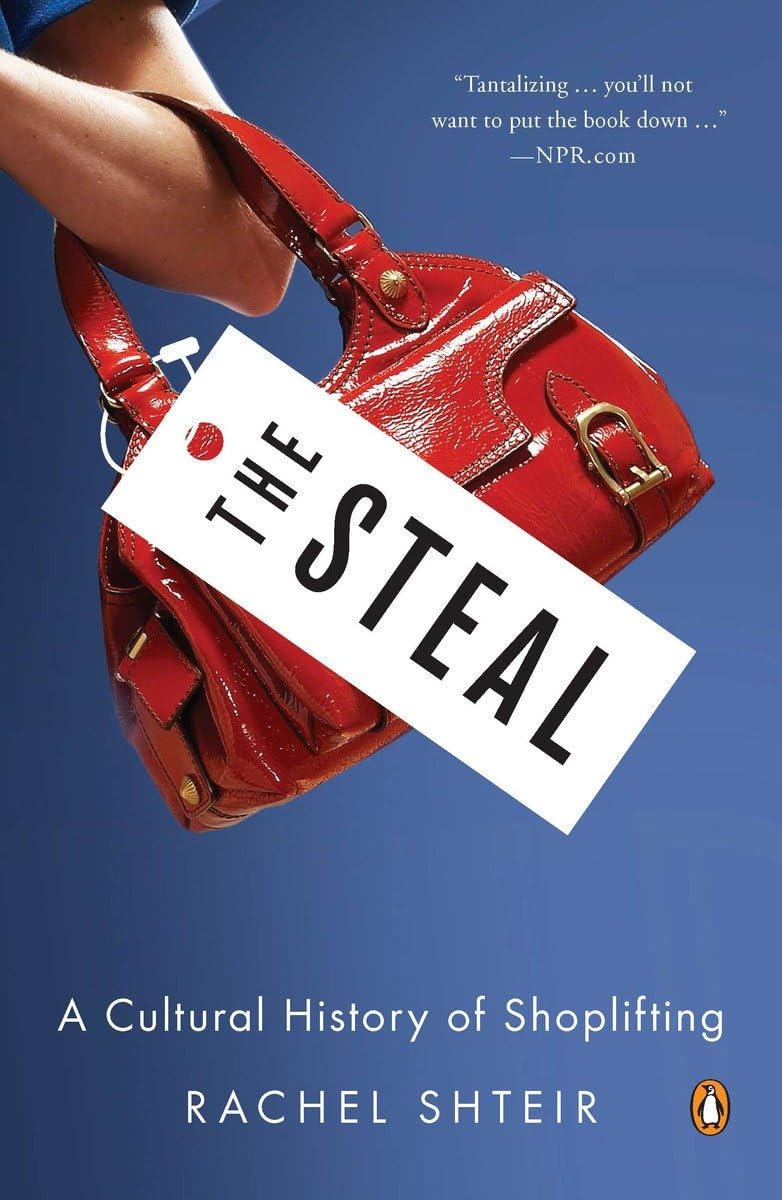
Title
The Steal: A Cultural History of Shoplifting,Used
Sold by Ergodebooks, an authorized reseller.
Returns accepted within 30 days | support@ergodebooks.com
Shipping Information
- Free Standard Shipping — United States only
- Processing Time: 3–5 business days
- Estimated Delivery: 6–10 business days after dispatch
- Double-boxed, fully insured & discreetly packaged
- Tracking number sent via email once dispatched
Returns & Refund
Returns accepted within 30 days of delivery.
Damaged or Defective Item
Free return shipping + replacement or full refund
Wrong Item Received
Free return shipping + replacement or full refund
Change of Mind
Return shipping at customer's expense · 25% restocking fee applies
Payment Option

Rachel Shteirs The Steal is the first serious study of shoplifting, looking to history to reveal the roots of our modern dilemma. Dismissed by academia and the mainstream media and largely misunderstood, shoplifting has become the territory of moralists, mischievous teenagers, tabloid television, and selfhelp gurus. But shoplifting incurs remarkable reallife costs for retailers and consumers. The crime taxthe amount every American family loses to shopliftingrelated price inflationis more than $400 a year. Shoplifting cost American retailers $11.7 billion in 2009. The theft of one $5.00 item from Whole Foods can require sales of hundreds of dollars to break even.The Steal begins when shoplifting entered the modern record as urbanization and consumerism made London into Europes busiest mercantile capital. Crossing the channel to nineteenthcentury Paris, Shteir tracks the rise of the department store and the pathologizing of shoplifting as kleptomania. In 1960s America, shoplifting becomes asymbol of resistance when the publication of Abbie Hoffmans Steal This Book popularizes shoplifting as an antiestablishment act. Some contemporary analysts see our current epidemic as a response to a culture of hyperconsumerism; others questionwhether its upticks can be tied to economic downturns at all. Few provide convincing theories about why it goes up or down.Just as experts cant agree on why people shoplift, they cant agree on how to stop it. Shoplifting has been punished by death, discouraged by shame tactics, and protected against by hightech surveillance. Shoplifters have been treated by psychoanalysis, medicated with pharmaceuticals, and enforced by law to attend rehabilitationgroups. While a few individuals have abandoned their stickyfingered habits, shoplifting shows no signs of slowing.In The Steal, Shteir guides us through a remarkable tour of all things shopliftingwe visit the Woodbury Commons Outlet Mall, where boosters run rampant, watch the surveillance footage from Winona Ryders famed shopping trip, and learn the history of antitheft technology. A groundbreaking study, The Steal shows us that shoplifting inits many guisescrime, disease, protestis best understood as a reflection of our society, ourselves.
⚠️ WARNING (California Proposition 65):
This product may contain chemicals known to the State of California to cause cancer, birth defects, or other reproductive harm.
For more information, please visit www.P65Warnings.ca.gov.