If you have any questions, you are always welcome to contact us. We'll get back to you as soon as possible, withing 24 hours on weekdays.
Customer service
All questions about your order, return and delivery must be sent to our customer service team by e-mail at yourstore@yourdomain.com
Sale & Press
If you are interested in selling our products, need more information about our brand or wish to make a collaboration, please contact us at press@yourdomain.com
Help
If you have any questions, you are always welcome to contact us. We'll get back to you as soon as possible, withing 24 hours on weekdays.
Customer service
All questions about your order, return and delivery must be sent to our customer service team by e-mail at yourstore@yourdomain.com
Sale & Press
If you are interested in selling our products, need more information about our brand or wish to make a collaboration, please contact us at press@yourdomain.com
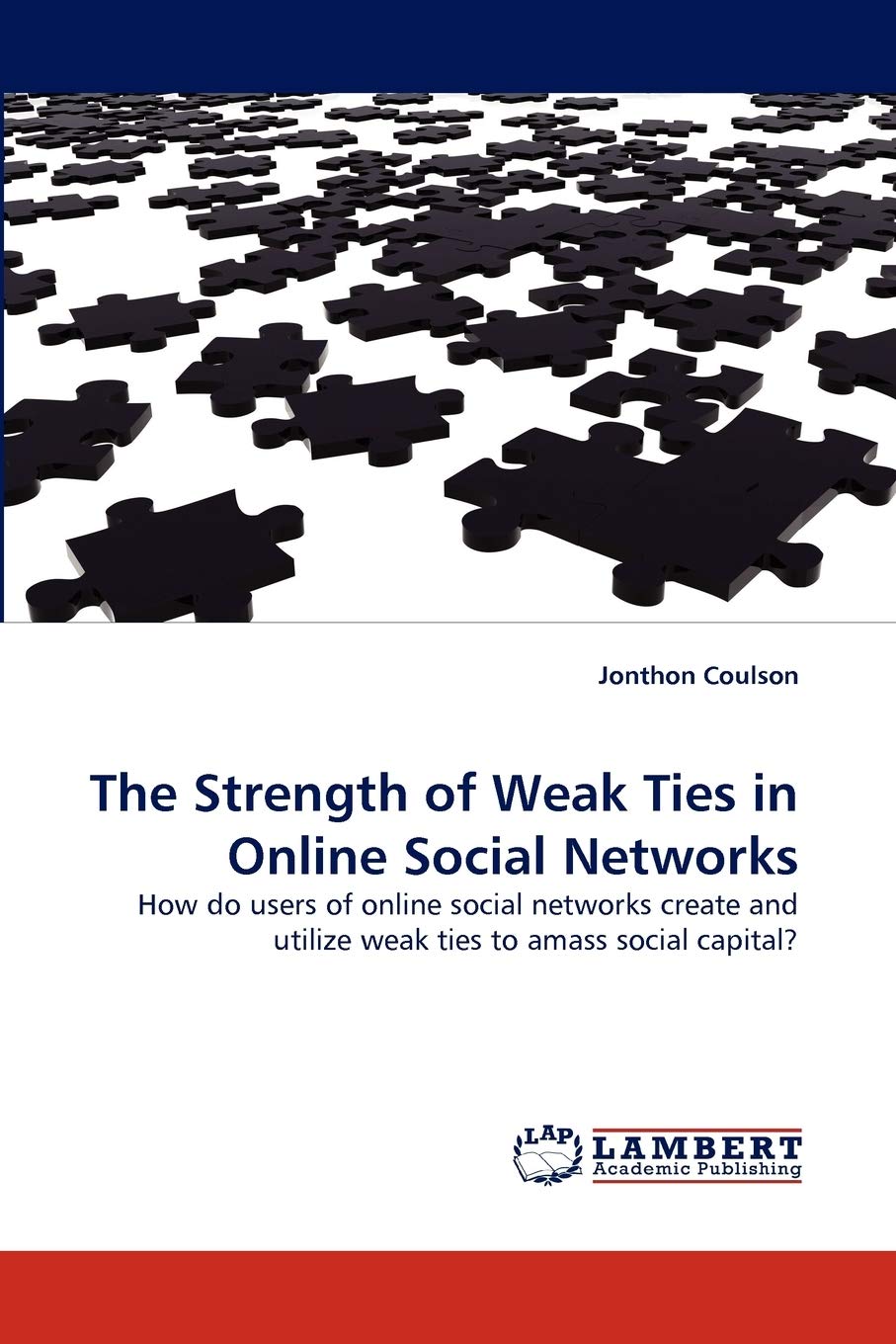
The use of online social networks such as Facebook.com are hypothesized to be affecting Robert Putnam?s (1995) theory of social capital. The research method is modeled after Dhavan Shah?s (2005) Information>Communication>Participation model. This study found that users of these sites tend to have an equal or greater likelihood of engaging in citizen communication or civic participation if they use social networks for informational purposes. Qualitative data indicates that users of online social networks communicate over greater temporal and geographic distances to maintain what Mark Granovetter (1973) calls weak ties. This study gives insight on how information is being shared between digital natives in online social networks, and how such information dissemination leads to the generation of social capital. Future studies focusing on specific features of online social networks that enable communication and civic participation are recommended, as is a comparison between levels of social capital creation between users and nonusers of online social networks.
⚠️ WARNING (California Proposition 65):
This product may contain chemicals known to the State of California to cause cancer,
birth defects, or other reproductive harm.
For MAP (Minimum Advertised Price) violations and Intellectual Property (IP) or Trademark concerns, please contact:
support@ergodebooks.com
⚠️ California Proposition 65 Warning: Some products sold on this website may expose you to chemicals known to the State of California to cause cancer, birth defects, or other reproductive harm. For more information, visit www.P65Warnings.ca.gov.