If you have any questions, you are always welcome to contact us. We'll get back to you as soon as possible, withing 24 hours on weekdays.
Customer service
All questions about your order, return and delivery must be sent to our customer service team by e-mail at yourstore@yourdomain.com
Sale & Press
If you are interested in selling our products, need more information about our brand or wish to make a collaboration, please contact us at press@yourdomain.com
Help
If you have any questions, you are always welcome to contact us. We'll get back to you as soon as possible, withing 24 hours on weekdays.
Customer service
All questions about your order, return and delivery must be sent to our customer service team by e-mail at yourstore@yourdomain.com
Sale & Press
If you are interested in selling our products, need more information about our brand or wish to make a collaboration, please contact us at press@yourdomain.com
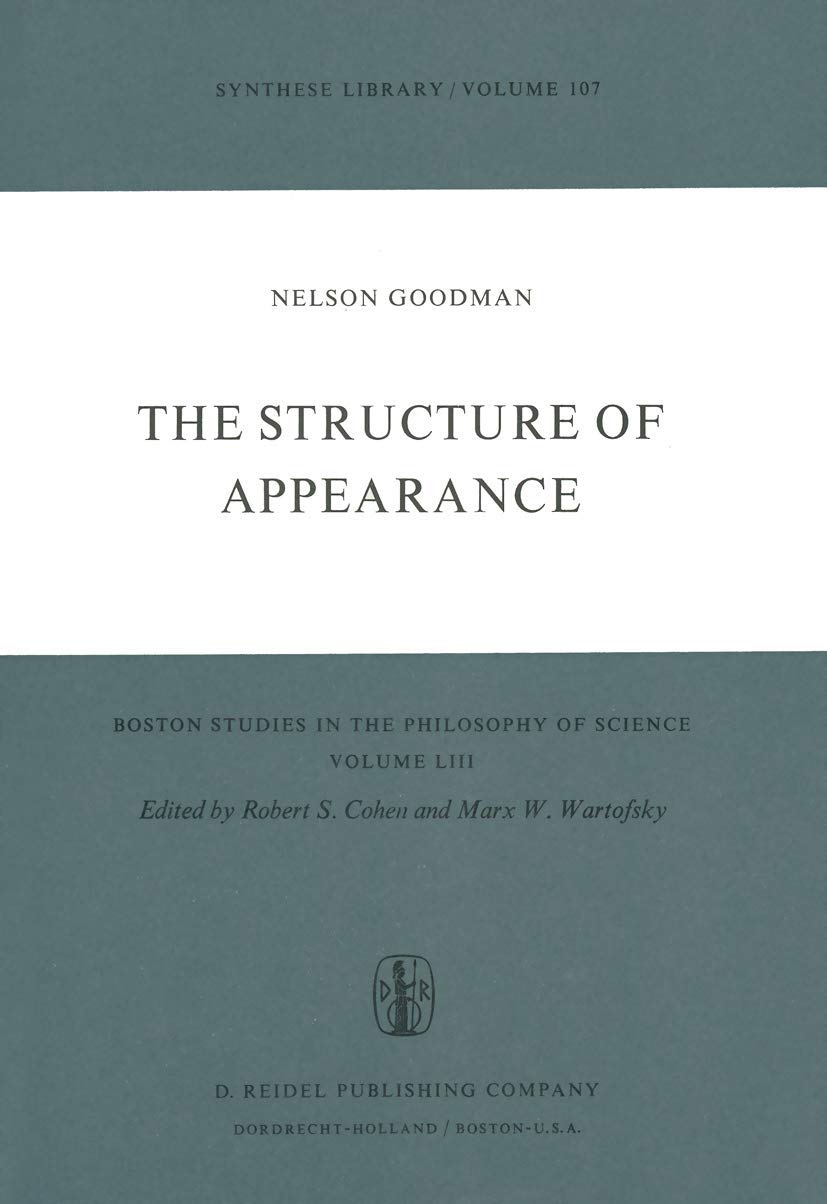
With this third edition of Nelson Goodman's The Structure of Appear ance, we are pleased to make available once more one of the most in fluential and important works in the philosophy of our times. Professor Geoffrey Hellman's introduction gives a sustained analysis and appreciation of the major themes and the thrust of the book, as well as an account of the ways in which many of Goodman's problems and projects have been picked up and developed by others. Hellman also suggests how The Structure of Appearance introduces issues which Goodman later continues in his essays and in the Languages of Art. There remains the task of understanding Good man's project as a whole; to see the deep continuities of his thought, as it ranges from logic to epistemology, to science and art; to see it therefore as a complex yet coherent theory of human cognition and practice. What we can only hope to suggest, in this note, is the b. road Significance of Goodman's apparently technical work for philosophers, scientists and humanists. One may say of Nelson Goodman that his bite is worse than his bark. Behind what appears as a cool and methodical analysis of the conditions of the construction of systems, there lurks a radical and disturbing thesis: that the world is, in itself, no more one way than another, nor are we. It depends on the ways in which we take it, and on what we do.
⚠️ WARNING (California Proposition 65):
This product may contain chemicals known to the State of California to cause cancer,
birth defects, or other reproductive harm.
For MAP (Minimum Advertised Price) violations and Intellectual Property (IP) or Trademark concerns, please contact:
support@ergodebooks.com
⚠️ California Proposition 65 Warning: Some products sold on this website may expose you to chemicals known to the State of California to cause cancer, birth defects, or other reproductive harm. For more information, visit www.P65Warnings.ca.gov.