
Title
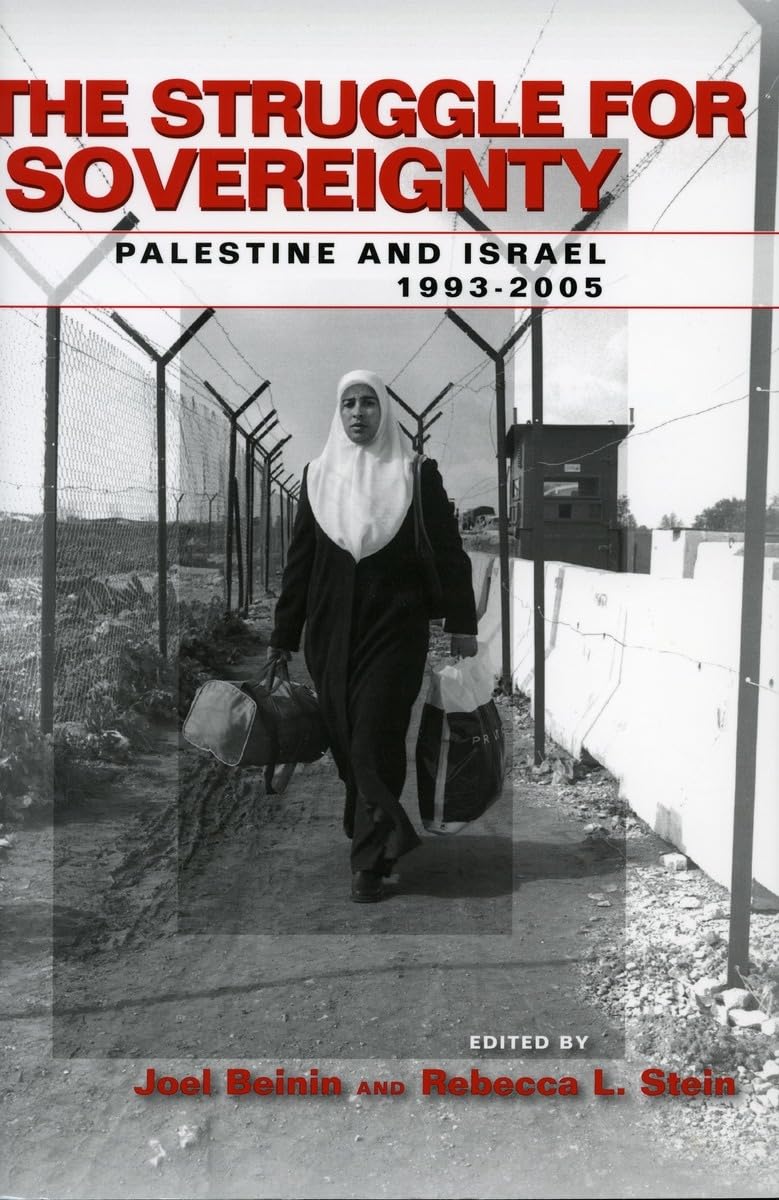
The Struggle for Sovereignty: Palestine and Israel, 19932005 (Stanford Studies in Middle Eastern and Islamic Societies and Cult,New
Sold by Ergodebooks, an authorized reseller.
Returns accepted within 30 days | support@ergodebooks.com
Shipping Information
- Free Standard Shipping — United States only
- Processing Time: 3–5 business days
- Estimated Delivery: 6–10 business days after dispatch
- Double-boxed, fully insured & discreetly packaged
- Tracking number sent via email once dispatched
Returns & Refund
Returns accepted within 30 days of delivery.
Damaged or Defective Item
Free return shipping + replacement or full refund
Wrong Item Received
Free return shipping + replacement or full refund
Change of Mind
Return shipping at customer's expense · 25% restocking fee applies
Payment Option

After the 1993 Oslo Accords people across the world anticipated the onset of peace and an end to the PalestinianIsraeli conflict. For Israelis, the Accords generated massive economic growth and a sense of security. For Palestinians in the West Bank and the Gaza Strip, they led to a dramatic rise in poverty and unemployment due to a complex array of closures, militarized checkpoints, and bypass roads, and a vast expansion of the settlement project that fractured Palestinian territories and communities. In 2000 popular Palestinian rage with the new shape of the Israeli occupation erupted in a second uprising or intifada. In this volume, prominent scholars and journalists examine the dramatic political changes in Palestine and Israel from the Oslo Accords through the second intifada and the death of Yasser Arafat. Their essays address the political economy of the Oslo process, social and political changes in Palestine and Israel, United States foreign policy, social movements and political activism, and the interplay between cultural and politicaleconomic processes. The volume also includes documents, maps, poetry, and graphic art. Contributors: Ammiel Alcalay, Lori A. Allen, Marwan Barghouti, Joel Beinin, Robert Blecher, Elliott Colla, Catherine Cook, Jonathan Cook, Richard Falk, Khaled Furani, Rita Giacaman, Lisa Hajjar, Jeff Halper, Rema Hammami, Sari Hanafi, Adam Hanieh, Islah Jad, Penny Johnson, Rela Mazali, Emma C. Murphy, Issam Nassar, Ilan Papp, Yoav Peled, Mouin Rabbani, Shira Robinson, Sara Roy, Rosemary Sayigh, Charmaine Seitz, Adam Shatz, Rebecca L. Stein, Gary Sussman, Salim Tamari, David Tartakover, Graham Usher, Sharif Waked, and Oren Yiftachel
⚠️ WARNING (California Proposition 65):
This product may contain chemicals known to the State of California to cause cancer, birth defects, or other reproductive harm.
For more information, please visit www.P65Warnings.ca.gov.
- Q: How many pages does the book have? A: This book has four hundred sixteen pages. It provides a comprehensive analysis of the Palestinian-Israeli conflict from 1993 to 2005.
- Q: What is the binding type of this book? A: The binding type is paperback. This makes it lightweight and flexible for easy reading.
- Q: What are the dimensions of the book? A: The book measures six inches in length, one point zero four inches in width, and nine point zero two inches in height.
- Q: Who is the author of this book? A: The author is Joel Beinin. He is a prominent scholar in Middle Eastern studies.
- Q: What topics are covered in the book? A: The book covers political economy, social movements, and the impact of U.S. foreign policy on the Israeli-Palestinian conflict.
- Q: Is this book suitable for academic use? A: Yes, this book is suitable for academic use. It includes essays from prominent scholars and journalists, making it a valuable resource.
- Q: How can I use this book in a research project? A: You can use this book as a reference for topics related to the Israeli-Palestinian conflict, particularly the Oslo Accords and subsequent events.
- Q: Is this book appropriate for high school students? A: Yes, this book can be appropriate for high school students. However, it may require guidance due to its complex themes.
- Q: What is the recommended reading level for this book? A: The recommended reading level is for advanced readers. It is suitable for those with a background in Middle Eastern studies.
- Q: How should I store this book to keep it in good condition? A: Store this book in a cool, dry place away from direct sunlight. This will help preserve the quality of the paperback.
- Q: Can I clean the book if it gets dirty? A: Yes, you can gently wipe the cover with a dry cloth. Avoid using water or cleaning agents that could damage the pages.
- Q: What is the expected lifespan of this book with proper care? A: With proper care, this book can last many years. Avoid bending the spine and keep it away from moisture.
- Q: What should I do if the book arrives damaged? A: If the book arrives damaged, contact the seller for a return or exchange. Most sellers have policies in place for damaged items.
- Q: Is there a return policy for this book? A: Yes, there is typically a return policy. Check with the seller for specific details regarding time frames and conditions.
- Q: How can this book be compared to other histories of the Israeli-Palestinian conflict? A: This book offers unique insights through essays by various contributors, making it a distinct academic resource compared to others.
- Q: Is this book suitable for someone new to the topic? A: While it is informative, this book may be challenging for beginners. It is recommended for readers with some prior knowledge of the conflict.