
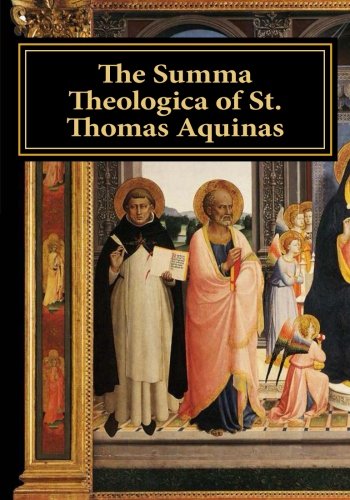
Title
The Summa Theologica of St. Thomas Aquinas: Secundae Secundae QQ I CXXII,Used
Sold by Ergodebooks, an authorized reseller.
Returns accepted within 30 days | support@ergodebooks.com
Shipping Information
- Free Standard Shipping — United States only
- Processing Time: 3–5 business days
- Estimated Delivery: 6–10 business days after dispatch
- Double-boxed, fully insured & discreetly packaged
- Tracking number sent via email once dispatched
Returns & Refund
Returns accepted within 30 days of delivery.
Damaged or Defective Item
Free return shipping + replacement or full refund
Wrong Item Received
Free return shipping + replacement or full refund
Change of Mind
Return shipping at customer's expense · 25% restocking fee applies
Payment Option

The "Summa Theologica" is considered the greatest work of St. Thomas Aquinas. This work immortalized St. Thomas. The author himself modestly considered it simply a manual of Christian doctrine for the use of students. In reality it is a complete scientifically arranged exposition of theology and at the same time a summary of Christian philosophy. In the brief prologue St. Thomas first calls attention to the difficulties experienced by students of sacred doctrine in his day, the causes assigned being: the multiplication of useless questions, articles, and arguments; the lack of scientific order; frequent repetitions, "which beget disgust and confusion in the minds of learners". Then he adds: "Wishing to avoid these and similar drawbacks, we shall endeavour, confiding in the Divine assistance, to treat of these things that pertain to sacred doctrine with brevity and clearness, in so far as the subject to be treated will permit." Eight years were given to the composition of this work, which was begun at Rome, where the First Part and the First of the Second were written (126569). The Second of the Second, begun in Rome, was completed in Paris (1271). In 1272 St. Thomas went to Naples, where the Third Part was written, down to the ninetieth question of the tract On Penance. The work has been completed by the addition of a supplement, drawn from other writings of St. Thomas, attributed by some to Peter of Auvergne, by others to Henry of Gorkum. These attributions are rejected by the editors of the Leonine edition (XI, pp. viii, xiv, xviii). Mandonnet (op. cit., 153) inclines to the very probable opinion that it was compiled by Father Reginald de Piperno, the saints faithful companion and secretary. The entire "Summa" contains 38 Treatises, 612 Questions, subdivided into 3120 articles, in which about 10,000 objections are proposed and answered. So admirably is the promised order preserved that, by reference to the beginning of the Tracts and Questions, one can see at a glance what place it occupies in the general plan, which embraces all that can be known through theology of God, of man, and of their mutual relations . . . "The whole Summa is arranged on a uniform plan. Every subject is introduced as a question, and divided into articles. . . . Each article has also a uniform disposition of parts. The topic is introduced as an inquiry for discussion, under the term Utrum, whether e.g. Utrum Deus sit? The objections against the proposed thesis are then stated. These are generally three or four in number, but sometimes extend to seven or more. The conclusion adopted is then introduced by the words, Respondeo dicendum. At the end of the thesis expounded the objections are answered, under the forms, ad primum, ad secundum, etc." . . . . The "Summa" is Christian doctrine in scientific form; it is human reason rendering its highest service in defence and explanation of the truths of the Christian religion. It is the answer of the matured and saintly doctor to the question of his youth: What is God? Revelation, made known in the Scriptures and by tradition; reason and its best results; soundness and fulness of doctrine, order, conciseness and clearness of expression, effacement of self, the love of truth alone, hence a remarkable fairness towards adversaries and calmness in combating their errors; soberness and soundness of judgment, together with a charmingly tender and enlightened piety these are all found in this "Summa" more than in his other writings, more than in the writings of his contemporaries, for "among the Scholastic doctors, the chief and master of all, towers Thomas Aquinas, who, as Cajetan observes (In 2am 2ae, Q. 148, a. 4) because he most venerated the ancient doctors of the Church in a certain way seems to have inherited the intellect of all" (Encyclical, "Aeterni Patris", of Leo XIII).
⚠️ WARNING (California Proposition 65):
This product may contain chemicals known to the State of California to cause cancer, birth defects, or other reproductive harm.
For more information, please visit www.P65Warnings.ca.gov.
- Q: What is the page count of The Summa Theologica? A: The book contains seven hundred twenty-eight pages. This extensive work provides a comprehensive exploration of Christian doctrine and philosophy.
- Q: What are the dimensions of The Summa Theologica? A: The book measures seven point zero one inches in length, one point six five inches in width, and ten inches in height. These dimensions make it a manageable size for reading.
- Q: What binding type does The Summa Theologica have? A: The book is available in paperback binding. This makes it more flexible and easier to handle compared to hardcover options.
- Q: How do I read The Summa Theologica? A: You can read it sequentially or by exploring specific questions that interest you. The book is structured to allow for both in-depth study and casual exploration.
- Q: Is The Summa Theologica suitable for beginners? A: Yes, it is suitable for beginners, but some prior knowledge of Christian philosophy may enhance understanding. The structured format helps readers navigate complex theological concepts.
- Q: What is the reading level for The Summa Theologica? A: The reading level is generally suitable for high school students and adults. It requires critical thinking and some background in philosophy.
- Q: How should I store The Summa Theologica? A: Store the book in a cool, dry place to prevent damage. Keeping it upright on a shelf will help maintain its shape and condition.
- Q: Can The Summa Theologica be cleaned? A: Yes, you can clean it by gently wiping the cover with a soft, dry cloth. Avoid using liquids that could damage the pages.
- Q: What if my copy of The Summa Theologica arrives damaged? A: If it arrives damaged, you should contact the seller for a return or replacement. Most sellers have policies in place for such situations.
- Q: What is the warranty for The Summa Theologica? A: Typically, there is no warranty for books like The Summa Theologica. However, return policies may vary by retailer.
- Q: Is The Summa Theologica appropriate for children? A: No, it is not generally appropriate for children. The content is complex and geared towards adult readers.
- Q: How does The Summa Theologica compare to other theological texts? A: The Summa Theologica is one of the most comprehensive works in Christian theology, often recognized for its systematic approach and depth compared to other texts.
- Q: What themes are explored in The Summa Theologica? A: The book explores themes such as the nature of God, morality, virtue, and the relationship between faith and reason. These themes are central to Christian philosophy.
- Q: Who is the author of The Summa Theologica? A: The author is St. Thomas Aquinas, a prominent theologian and philosopher of the thirteenth century. His work significantly influenced Christian doctrine.
- Q: Is The Summa Theologica available in other formats? A: Yes, it may be available in digital formats, such as e-books, in addition to the paperback version. Check with retailers for availability.