
Title
The Symmetry of Chaos,Used
Sold by Ergodebooks, an authorized reseller.
Returns accepted within 30 days | support@ergodebooks.com
Shipping Information
- Free Standard Shipping — United States only
- Processing Time: 3–5 business days
- Estimated Delivery: 6–10 business days after dispatch
- Double-boxed, fully insured & discreetly packaged
- Tracking number sent via email once dispatched
Returns & Refund
Returns accepted within 30 days of delivery.
Damaged or Defective Item
Free return shipping + replacement or full refund
Wrong Item Received
Free return shipping + replacement or full refund
Change of Mind
Return shipping at customer's expense · 25% restocking fee applies
Payment Option

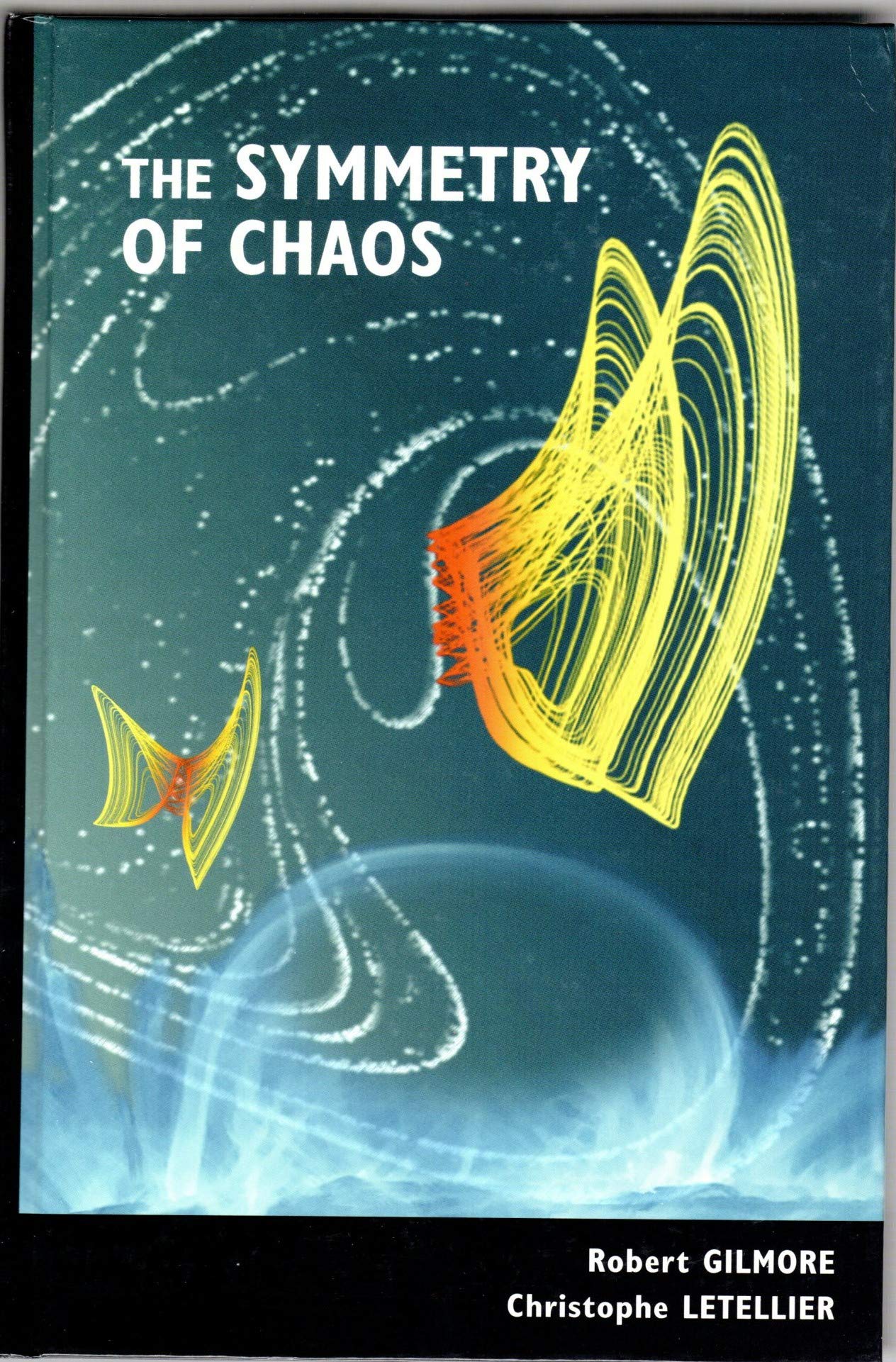
There is a tremendous fascination with chaos and fractals, about which picture books can be found on coffee tables everywhere. Chaos and fractals represent handson mathematics that is alive and changing. One can turn on a personal computer and create stunning mathematical images that no one has ever seen before.Chaos and fractals are part of dynamics, a larger subject that deals with change, with systems that evolve with time. Whether the system in question settles down to equilibrium, keeps repeating in cycles, or does something more complicated, it is dynamics that scientists and mathematicians use to analyze a system's behavior. Chaos is the term used to describe the apparently complex behavior of what we consider to be simple, wellbehaved systems. Chaotic behavior, when looked at casually, looks erratic and almost random. The type of behavior that in the last 20 years has come to be called chaotic arises in very simple systems. In fact, these systems are essentially deterministic; that is, precise knowledge of the conditions of a system allow future behavior of the system to be predicted. The problem of chaos is to reconcile these apparently conflicting notions: randomness and predictability.Why have scientists, engineers, and mathematicians become intrigued by chaos? The answer to that question has two parts: (1) the study of chaos has provided new conceptual tools enabling scientists to categorize and understand complex behavior and (2) chaotic behavior seems to be universal from electrical circuits to nerve cells. Chaos is about predictability in even the most unstable systems, and symmetry is a pattern of predictability a conceptual tool to help understand complex behavior. The Symmetry of Chaos treats this interplay between chaos and symmetry. This graduate textbook in physics, applied mathematics, engineering, fluid dynamics, and chemistry is full of exciting new material, illustrated by hundreds of figures. Nonlinear dynamics and chaos are relatively young fields, and in addition to serving textbook markets, there is a strong interest among researchers in new results in the field.The authors are the foremost experts in this field, and this book should give a definitive account of this branch of dynamical systems theory.
⚠️ WARNING (California Proposition 65):
This product may contain chemicals known to the State of California to cause cancer, birth defects, or other reproductive harm.
For more information, please visit www.P65Warnings.ca.gov.