If you have any questions, you are always welcome to contact us. We'll get back to you as soon as possible, withing 24 hours on weekdays.
Customer service
All questions about your order, return and delivery must be sent to our customer service team by e-mail at yourstore@yourdomain.com
Sale & Press
If you are interested in selling our products, need more information about our brand or wish to make a collaboration, please contact us at press@yourdomain.com
Help
If you have any questions, you are always welcome to contact us. We'll get back to you as soon as possible, withing 24 hours on weekdays.
Customer service
All questions about your order, return and delivery must be sent to our customer service team by e-mail at yourstore@yourdomain.com
Sale & Press
If you are interested in selling our products, need more information about our brand or wish to make a collaboration, please contact us at press@yourdomain.com
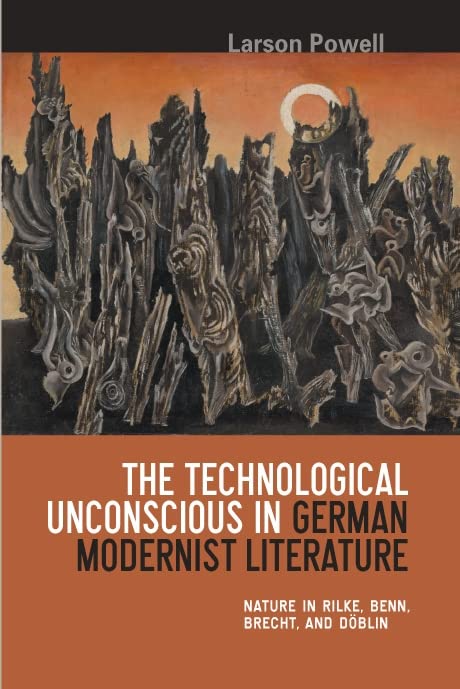
A bold new theoretical analysis of literary modernism and its conception of and relation to nature.Even after the end of modernism and postmodernism, grandiose fantasies of artifice and selfreference still resonate in the "social constructivism" of current literary and cultural theory: in the idea that we can perform or construct "identities" or social roles without external constraint, as if we had consumer choice of self. Larson Powell's book posits nature as a limit to such fantasies, redefining aesthetic modernity's conception of and relation to nature and therefore its relation to reality. Powell's term "the Technological Unconscious" refers both to the intersection between psychoanalysis and theories of modernism and to the philosophical mediation between history and nature, a motif important from Kant to Adorno. The book's four chapters center on the representation of nature in German prose and especially poetry by Rilke, Benn, Brecht, and Dblin from the years 1900 to 1945. In connection with these works, Powell analyzes the conceptions of subject and system in the theories of Adorno, Luhmann, and Lacan and their relation to their complement, nature. The Technological Unconscious is thus an important polemical intervention both in the debates over interdisciplinarity and in those between eclectic "culturalist" theories such as New Historicism and postcolonialism on the one hand and systems theory and psychoanalysis on the other.Larson Powell is Curator's Professor of Film Studies at University of Missouri, Kansas City.
⚠️ WARNING (California Proposition 65):
This product may contain chemicals known to the State of California to cause cancer,
birth defects, or other reproductive harm.
For MAP (Minimum Advertised Price) violations and Intellectual Property (IP) or Trademark concerns, please contact:
support@ergodebooks.com
⚠️ California Proposition 65 Warning: Some products sold on this website may expose you to chemicals known to the State of California to cause cancer, birth defects, or other reproductive harm. For more information, visit www.P65Warnings.ca.gov.