
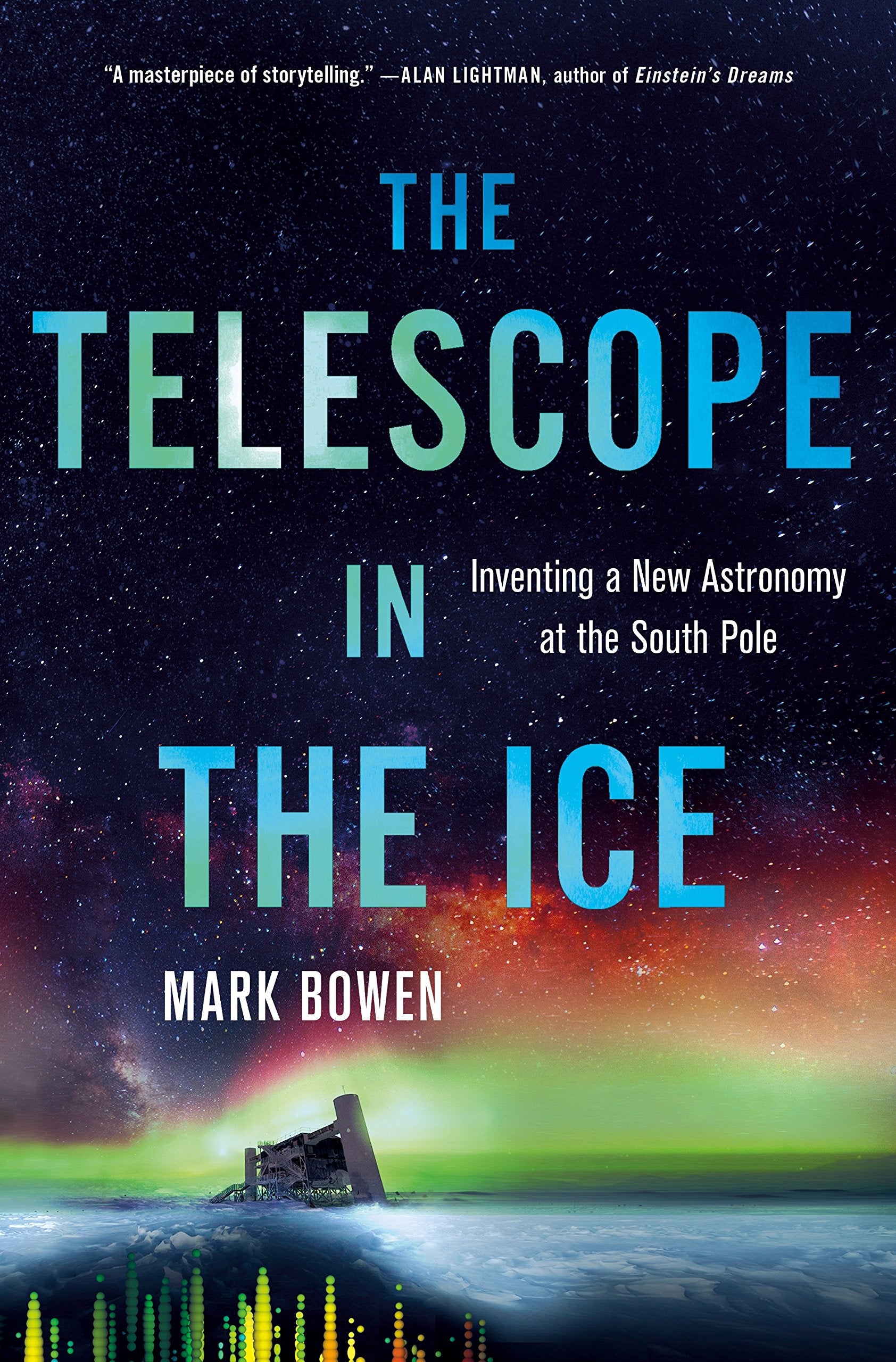
Title
The Telescope In The Ice: Inventing A New Astronomy At The South Pole
Sold by Ergodebooks, an authorized reseller.
Returns accepted within 30 days | support@ergodebooks.com
Shipping Information
- Free Standard Shipping — United States only
- Processing Time: 3–5 business days
- Estimated Delivery: 6–10 business days after dispatch
- Double-boxed, fully insured & discreetly packaged
- Tracking number sent via email once dispatched
Returns & Refund
Returns accepted within 30 days of delivery.
Damaged or Defective Item
Free return shipping + replacement or full refund
Wrong Item Received
Free return shipping + replacement or full refund
Change of Mind
Return shipping at customer's expense · 25% restocking fee applies
Payment Option

Alan Lightman: A Masterpiece Of Storytelling, Bringing To Life In Rich Detail Not Only The World Of Science But Also The Men And Women Who Inhabit That World.George Musser, Author Of Spooky Action At A Distance: If You Want To Know How Science Really Works, This Is Your Book.Sheldon Lee Glashow, 1979 Nobel Laureate In Physics: A Pageturning Chronicle Of The Decadeslong Struggle By Hundreds Of Physicists And Engineers To Create A Frontier Laboratory For The Pursuit Of The New Discipline Of Neutrino Astronomy.The Telescope In The Ice Is About The Building Of Icecube, Which Scientific American Has Called The Weirdest Of The Seven Wonders Of Modern Astronomy. It'S The Inside Story Of The People Who Built The Instrument, The Mistakes They Made, The Blind Alleys They Went Down, The Solutions They Found, Their Conflicts, And Their Teamwork. It'S A Success Story.Located At The U. S. Amundsenscott Research Station At The Geographic South Pole, Icecube Is Unlike Most Telescopes In That It Is Not Designed To Detect Light. It Employs A Cubic Kilometer Of Diamondclear Ice, More Than A Mile Beneath The Surface, To Detect An Elementary Particle Known As The Neutrino. In 2010, It Detected The First Extraterrestrial Highenergy Neutrinos And Thus Gave Birth To A New Field Of Astronomy.Aside From Being A Telescope, Icecube Is The Largest Particle Physics Detector Ever Built. Its Scientific Goals Span Not Only Astrophysics And Cosmology But Also Pure Particle Physics. And Since The Neutrino Is One Of The Strangest And Least Understood Of The Known Elementary Particles, This Is Fertile Ground. Neutrino Physics Is Perhaps The Most Active Field In Particle Physics Today, And Icecube Is At This Forefront.This Book Is Mainly About People And The Thrill Of The Chase: The Struggle To Understand The Neutrino Ever Since It Was Invented By The Extraordinary Wolfgang Pauli In 1930, The Early Researchers Who Helped Understand It, The Strange Things It Taught Them About The Nature Of Space And Time, And The Pioneers And Inventors Of Neutrino Astronomy.
⚠️ WARNING (California Proposition 65):
This product may contain chemicals known to the State of California to cause cancer, birth defects, or other reproductive harm.
For more information, please visit www.P65Warnings.ca.gov.
- Q: What is the binding type of the book? A: The binding type is hardcover. This durable format provides longevity and protection for the pages inside.
- Q: How many pages does the book have? A: The book contains four hundred thirty-two pages. This length allows for an in-depth exploration of neutrino astronomy.
- Q: What are the dimensions of the book? A: The book measures six point four seven inches in length, one point three eight inches in width, and nine point six one inches in height. These dimensions make it a manageable size for reading.
- Q: Who is the author of the book? A: The author is Mark Bowen. He is known for his engaging storytelling and expertise in scientific topics.
- Q: What is the main theme of the book? A: The main theme revolves around the development of the IceCube project and neutrino astronomy. It details the scientific challenges and triumphs faced by researchers.
- Q: Is this book suitable for beginners in astronomy? A: Yes, the book is suitable for beginners. It provides a clear narrative that explains complex scientific concepts in an accessible manner.
- Q: What genre does the book belong to? A: The book falls under the genre of astronomy. It combines science with storytelling to engage readers.
- Q: How can I use this book effectively? A: You can use this book for educational purposes, leisure reading, or as a reference for understanding neutrino physics. It’s designed for those interested in science and astronomy.
- Q: What age group is the book appropriate for? A: The book is appropriate for adults and older teens. Its content is complex and aimed at readers interested in scientific themes.
- Q: How should I store the book? A: Store the book in a cool, dry place to prevent damage. Keep it upright on a shelf or lay it flat to maintain its shape.
- Q: Is there any specific care needed for the book? A: No special care is needed for the book. Just avoid exposing it to excessive moisture or direct sunlight.
- Q: What should I do if the book arrives damaged? A: If the book arrives damaged, contact the retailer for return instructions. Most retailers offer a satisfaction guarantee.
- Q: Can I return the book if I'm not satisfied? A: Yes, you can typically return the book if you are not satisfied. Check the retailer's return policy for specific details.
- Q: Is there a warranty for this book? A: No, there is no warranty for books. However, you can often return it if it arrives in poor condition.
- Q: How does this book compare to other astronomy books? A: This book offers a unique perspective by focusing on the human stories behind scientific discoveries. It stands out from typical textbooks.
- Q: Is this book recommended for professional astronomers? A: Yes, it is recommended for professional astronomers. It provides insights into the history and development of neutrino astronomy.