
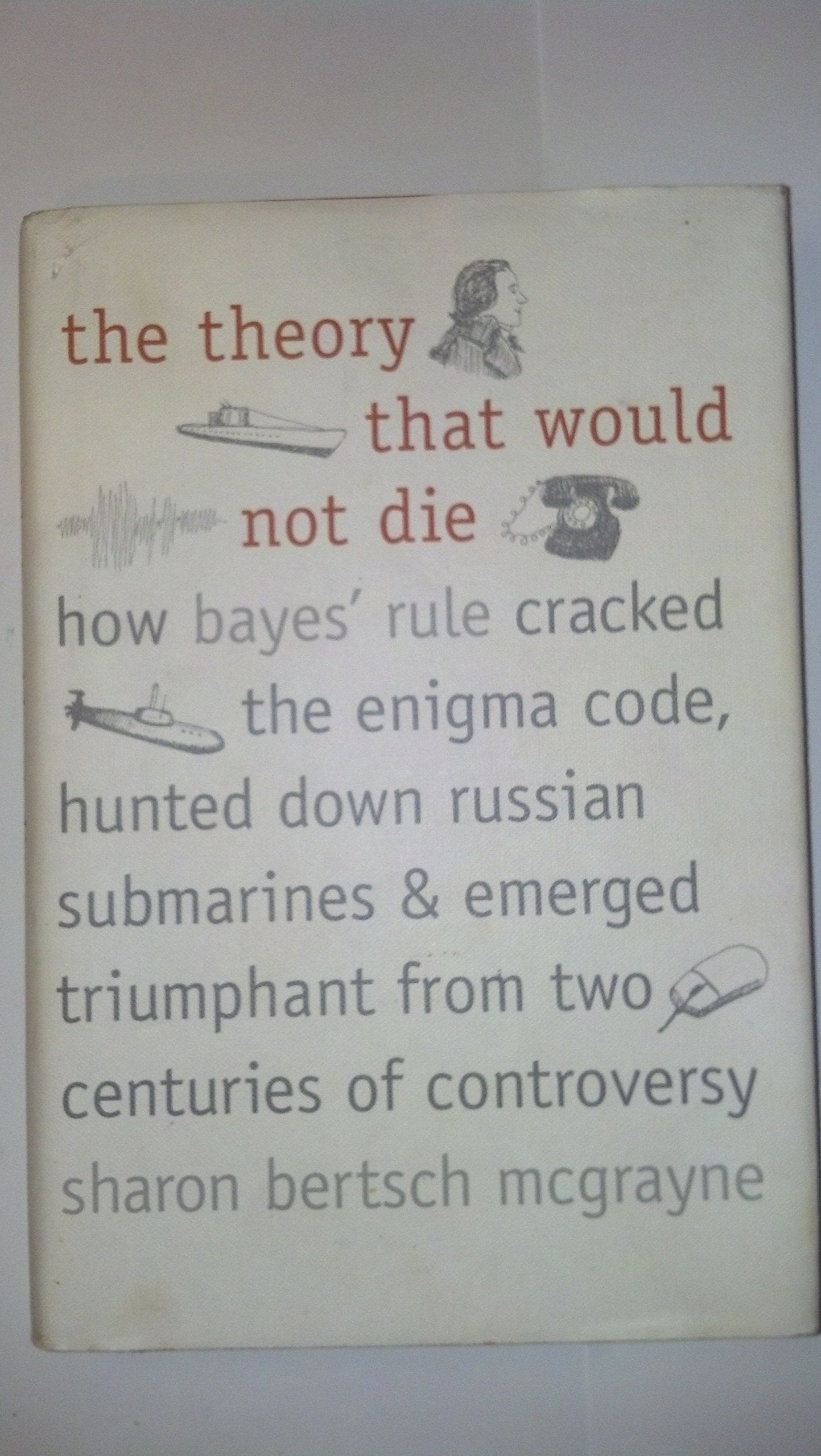
Title
The Theory That Would Not Die: How Bayes Rule Cracked The Enigma Code, Hunted Down Russian Submarines, And Emerged Triumphant Fr,New
Sold by Ergodebooks, an authorized reseller.
Returns accepted within 30 days | support@ergodebooks.com
Shipping Information
- Free Standard Shipping — United States only
- Processing Time: 3–5 business days
- Estimated Delivery: 6–10 business days after dispatch
- Double-boxed, fully insured & discreetly packaged
- Tracking number sent via email once dispatched
Returns & Refund
Returns accepted within 30 days of delivery.
Damaged or Defective Item
Free return shipping + replacement or full refund
Wrong Item Received
Free return shipping + replacement or full refund
Change of Mind
Return shipping at customer's expense · 25% restocking fee applies
Payment Option

Bayes Rule Appears To Be A Straightforward, Oneline Theorem: By Updating Our Initial Beliefs With Objective New Information, We Get A New And Improved Belief. To Its Adherents, It Is An Elegant Statement About Learning From Experience. To Its Opponents, It Is Subjectivity Run Amok.In The Firstever Account Of Bayes Rule For General Readers, Sharon Bertsch Mcgrayne Explores This Controversial Theorem And The Human Obsessions Surrounding It. She Traces Its Discovery By An Amateur Mathematician In The 1740S Through Its Development Into Roughly Its Modern Form By French Scientist Pierre Simon Laplace. She Reveals Why Respected Statisticians Rendered It Professionally Taboo For 150 Yearsat The Same Time That Practitioners Relied On It To Solve Crises Involving Great Uncertainty And Scanty Information (Alan Turings Role In Breaking Germanys Enigma Code During World War Ii), And Explains How The Advent Of Offtheshelf Computer Technology In The 1980S Proved To Be A Gamechanger. Today, Bayes Rule Is Used Everywhere From Dna Decoding To Homeland Security.Drawing On Primary Source Material And Interviews With Statisticians And Other Scientists, The Theory That Would Not Die Is The Riveting Account Of How A Seemingly Simple Theorem Ignited One Of The Greatest Controversies Of All Time.
⚠️ WARNING (California Proposition 65):
This product may contain chemicals known to the State of California to cause cancer, birth defects, or other reproductive harm.
For more information, please visit www.P65Warnings.ca.gov.
- Q: What is the page count of this book? A: This book has three hundred thirty-six pages. It provides a comprehensive exploration of Bayes' rule and its historical significance.
- Q: What are the dimensions of the book? A: The book measures six point fourteen inches in length, one point fourteen inches in width, and nine point twenty-five inches in height. These dimensions make it a standard hardcover book size.
- Q: What type of binding does this book have? A: This book features a hardcover binding. This type of binding is durable and suitable for long-term use.
- Q: What age group is this book suitable for? A: This book is suitable for adults and older teens. It delves into complex statistical concepts that may require a certain level of maturity to fully understand.
- Q: Is there a recommended reading level for this book? A: The recommended reading level for this book is higher education or advanced high school. It covers intricate mathematical and philosophical themes.
- Q: Can I read this book if I have no background in mathematics? A: Yes, you can read this book without a math background. The author presents the concepts in an accessible manner for general readers.
- Q: How should I store this book to keep it in good condition? A: Store this book upright on a shelf in a cool, dry place. Avoid direct sunlight to prevent fading of the cover and pages.
- Q: Is this book safe for young children? A: No, this book is not recommended for young children. It contains complex ideas that may not be appropriate for younger audiences.
- Q: How do I clean the cover of this book? A: To clean the cover, use a soft, dry cloth. Avoid using water or cleaning solutions as they can damage the material.
- Q: What if the book arrives damaged? A: If the book arrives damaged, contact customer support for a return or exchange. Most retailers have policies in place to address such issues.
- Q: Is there a warranty on this book? A: Typically, books do not come with a warranty. However, check the retailer's return policy for any guarantees on condition.
- Q: How does this book compare to other history books? A: This book stands out for its focus on a specific mathematical theorem with historical implications. It blends history and philosophy uniquely.
- Q: Is this book a good choice for someone interested in statistics? A: Yes, this book is an excellent choice for someone interested in statistics. It provides insights into Bayes' rule and its applications.
- Q: How does this book address controversies surrounding Bayes' rule? A: The book explores various perspectives on Bayes' rule, detailing the debates and criticisms it has faced throughout history.
- Q: Can I find this book in libraries? A: Yes, many libraries carry this book due to its academic relevance and popular interest. Check your local library's catalog.
- Q: Is this book part of a series? A: No, this book is a standalone title. It provides a comprehensive overview of its subject without being part of a series.