
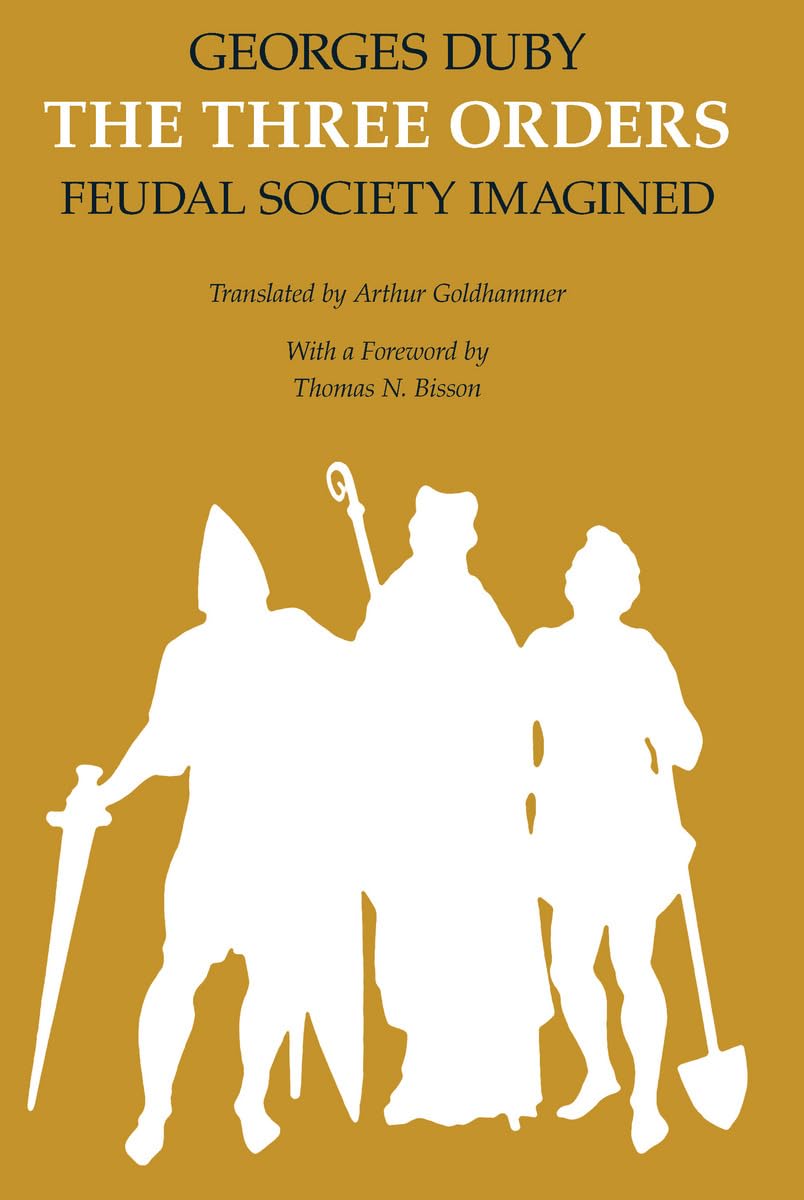
Title
The Three Orders: Feudal Society Imagined
Sold by Ergodebooks, an authorized reseller.
Returns accepted within 30 days | support@ergodebooks.com
Shipping Information
- Free Standard Shipping — United States only
- Processing Time: 3–5 business days
- Estimated Delivery: 6–10 business days after dispatch
- Double-boxed, fully insured & discreetly packaged
- Tracking number sent via email once dispatched
Returns & Refund
Returns accepted within 30 days of delivery.
Damaged or Defective Item
Free return shipping + replacement or full refund
Wrong Item Received
Free return shipping + replacement or full refund
Change of Mind
Return shipping at customer's expense · 25% restocking fee applies
Payment Option

In The Three Orders, Prominent Annales Historian Georges Duby Offers A Tripartite Construct Of Medieval French Society, A Construct Which Depicts Men Separating Themselves Hierarchically Into Those Who Pray, Those Who Fight, And Those Who Work. He Considers How This Medieval Theory Of Orders Originated, Discusses Its Complex History, And Shows How Different Interestscultural, Political, And Economicwere Involved In Its Creation And Use. The Three Orders Shows How The Tripartite Schema Come To Occupy A Central Position In Social Thought And Clarifies The Manner In Which Feudal Society Viewed Itself.The Book Begins With A Brief Examination Of A Popular Early Seventhcentury Treatise On The Three Estates Of France. Duby Then Jumps Abruptly Back To The Period In Which The Notion That French Society Was Divided Into Three Estates Was Born. It Was The Bishops Of A Tottering Capetian State Who Drew Upon Older Imaginings Of Hierarchical Order To Project A New Rationale For Royal Power And Peasant Subservience; Their Ternary Scheme Collapsed With The Monarchy Itself, To Be Resuscitated In The Twelfth Century, When The Maturing Of Feudalvassalic Institutions And The Conflict Between Capetians And Plantagenets Contributed To A Definitive Restoration Of Monarchical Trifunctionality. In Tracing The Fortunes Of The Three Orders, Duby Shows How The Tripartite Schema Came To Occupy A Central Position In Social Thought And Clarifies The Manner In Which Feudal Society Viewed Itself.Praise For The Three Orders:The Three Orders Is A Brilliant Book, Superbly Reflecting The Author'S Special Scholarly Style And Remarkableintellectual Power....To The Best Of My Knowledge, There Is No Scholarly Work Which, Taken As A Whole, Even Remotely Resembles It. Professor Robert Benson, Ucla
⚠️ WARNING (California Proposition 65):
This product may contain chemicals known to the State of California to cause cancer, birth defects, or other reproductive harm.
For more information, please visit www.P65Warnings.ca.gov.
- Q: What is the main theme of 'The Three Orders'? A: 'The Three Orders' explores the tripartite structure of medieval French society, categorizing individuals into those who pray, fight, and work, and examines how this classification shaped social thought.
- Q: Who is the author of 'The Three Orders'? A: The book is authored by Georges Duby, a prominent historian known for his contributions to the understanding of medieval society.
- Q: What is the publication date of 'The Three Orders'? A: 'The Three Orders' was published on December 15, 1982.
- Q: How many pages does 'The Three Orders' have? A: The book contains 392 pages.
- Q: What format is 'The Three Orders' available in? A: 'The Three Orders' is available in paperback format.
- Q: What historical period does 'The Three Orders' focus on? A: 'The Three Orders' focuses on the medieval period, specifically the evolution of social order in medieval France.
- Q: What kind of insights does Georges Duby provide in this book? A: Georges Duby provides insights into the origins and historical significance of the tripartite schema in medieval society, discussing its cultural, political, and economic implications.
- Q: Is there any praise or notable reviews for 'The Three Orders'? A: Yes, 'The Three Orders' has received praise for its scholarly depth, with Professor Robert Benson from UCLA describing it as a brilliant work reflecting the author's intellectual power.
- Q: What is the edition of 'The Three Orders'? A: 'The Three Orders' is a reprint edition.
- Q: Does 'The Three Orders' discuss the influence of the Capetian monarchy? A: Yes, the book discusses how the Capetian monarchy and the bishops influenced the creation and use of the tripartite social order in France.