
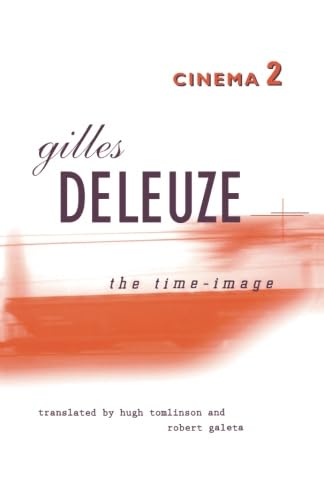
Title

The TimeImage (Cinema),New
Sold by Ergodebooks, an authorized reseller.
Returns accepted within 30 days | support@ergodebooks.com
Shipping Information
- Free Standard Shipping — United States only
- Processing Time: 3–5 business days
- Estimated Delivery: 6–10 business days after dispatch
- Double-boxed, fully insured & discreetly packaged
- Tracking number sent via email once dispatched
Returns & Refund
Returns accepted within 30 days of delivery.
Damaged or Defective Item
Free return shipping + replacement or full refund
Wrong Item Received
Free return shipping + replacement or full refund
Change of Mind
Return shipping at customer's expense · 25% restocking fee applies
Payment Option

Cinema 2: The TimeImage brings to completion Gilles Deleuzes work on the theoretical implications of the cinematographic image. In Cinema 1: The MovementImage, Deleuze proposed a new way to understand narrative cinema, based on Henri Bergsons notion of the movementimage and C. S. Peirces classification of images and signs. In Cinema 2, he explains why, since World War II, time has come to dominate film: the fragment or solitary image, in supplanting narrative cinemas rational development of events, illustrates this new significance of time.Deleuze ascribes this shift to the condition of postwar Europe: the situations and spaces we no longer know how to describebuildings deserted but inhabited, cities undergoing demolition or reconstructionand the new race of characters who emerged from this rubble, mutants, who saw rather than acted. Deleuze discusses the films of Rossellini, De Sica, Fellini, Godard, Resnais, Antonioni, Pasolini, Rohmer, Ophuls, and many others, suggesting that contemporary cinema, far from being dead, is only beginning to find new ways to capture time in the image.
⚠️ WARNING (California Proposition 65):
This product may contain chemicals known to the State of California to cause cancer, birth defects, or other reproductive harm.
For more information, please visit www.P65Warnings.ca.gov.
- Q: What is 'The Time-Image' about? A: 'The Time-Image' by Gilles Deleuze explores the evolution of cinema, particularly how the representation of time has transformed post-World War II. Deleuze discusses how contemporary films have moved away from traditional narrative structures to depict fragmented images that emphasize time.
- Q: Who is the author of 'The Time-Image'? A: The book is authored by Gilles Deleuze, a prominent French philosopher known for his work on film theory and aesthetics.
- Q: What is the publication date of 'The Time-Image'? A: 'The Time-Image' was published on August 1, 1989, and is considered a significant work in film theory.
- Q: What is the item condition of this book? A: The item condition of 'The Time-Image' is classified as 'New', ensuring that it is in perfect condition for readers.
- Q: How many pages are in 'The Time-Image'? A: 'The Time-Image' contains 362 pages, providing an in-depth exploration of its themes.
- Q: What type of binding does 'The Time-Image' have? A: This edition of 'The Time-Image' is available in paperback binding, making it a flexible and lightweight option for readers.
- Q: Is 'The Time-Image' suitable for students of film studies? A: Yes, 'The Time-Image' is an essential read for students of film studies, as it provides critical insights into film theory and the philosophical implications of cinematic images.
- Q: What edition of 'The Time-Image' is available? A: The available edition is the 'First Edition', which introduced Deleuze’s groundbreaking concepts to the field of cinema studies.
- Q: What category does 'The Time-Image' fall under? A: 'The Time-Image' is categorized under 'Performing Arts', reflecting its focus on cinema and its theoretical aspects.
- Q: Can I find discussions of specific filmmakers in 'The Time-Image'? A: Yes, Deleuze discusses various influential filmmakers such as Rossellini, De Sica, Fellini, and Godard, analyzing their contributions to the evolution of cinematic imagery.