If you have any questions, you are always welcome to contact us. We'll get back to you as soon as possible, withing 24 hours on weekdays.
Customer service
All questions about your order, return and delivery must be sent to our customer service team by e-mail at yourstore@yourdomain.com
Sale & Press
If you are interested in selling our products, need more information about our brand or wish to make a collaboration, please contact us at press@yourdomain.com
Help
If you have any questions, you are always welcome to contact us. We'll get back to you as soon as possible, withing 24 hours on weekdays.
Customer service
All questions about your order, return and delivery must be sent to our customer service team by e-mail at yourstore@yourdomain.com
Sale & Press
If you are interested in selling our products, need more information about our brand or wish to make a collaboration, please contact us at press@yourdomain.com
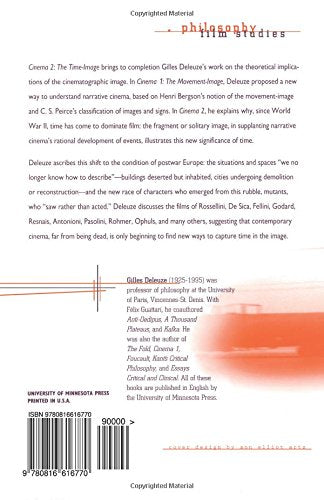
Cinema 2: The TimeImage brings to completion Gilles Deleuzes work on the theoretical implications of the cinematographic image. In Cinema 1: The MovementImage, Deleuze proposed a new way to understand narrative cinema, based on Henri Bergsons notion of the movementimage and C. S. Peirces classification of images and signs. In Cinema 2, he explains why, since World War II, time has come to dominate film: the fragment or solitary image, in supplanting narrative cinemas rational development of events, illustrates this new significance of time.Deleuze ascribes this shift to the condition of postwar Europe: the situations and spaces we no longer know how to describebuildings deserted but inhabited, cities undergoing demolition or reconstructionand the new race of characters who emerged from this rubble, mutants, who saw rather than acted. Deleuze discusses the films of Rossellini, De Sica, Fellini, Godard, Resnais, Antonioni, Pasolini, Rohmer, Ophuls, and many others, suggesting that contemporary cinema, far from being dead, is only beginning to find new ways to capture time in the image.
⚠️ WARNING (California Proposition 65):
This product may contain chemicals known to the State of California to cause cancer,
birth defects, or other reproductive harm.
For MAP (Minimum Advertised Price) violations and Intellectual Property (IP) or Trademark concerns, please contact:
support@ergodebooks.com
⚠️ California Proposition 65 Warning: Some products sold on this website may expose you to chemicals known to the State of California to cause cancer, birth defects, or other reproductive harm. For more information, visit www.P65Warnings.ca.gov.