If you have any questions, you are always welcome to contact us. We'll get back to you as soon as possible, withing 24 hours on weekdays.
Customer service
All questions about your order, return and delivery must be sent to our customer service team by e-mail at yourstore@yourdomain.com
Sale & Press
If you are interested in selling our products, need more information about our brand or wish to make a collaboration, please contact us at press@yourdomain.com
Help
If you have any questions, you are always welcome to contact us. We'll get back to you as soon as possible, withing 24 hours on weekdays.
Customer service
All questions about your order, return and delivery must be sent to our customer service team by e-mail at yourstore@yourdomain.com
Sale & Press
If you are interested in selling our products, need more information about our brand or wish to make a collaboration, please contact us at press@yourdomain.com
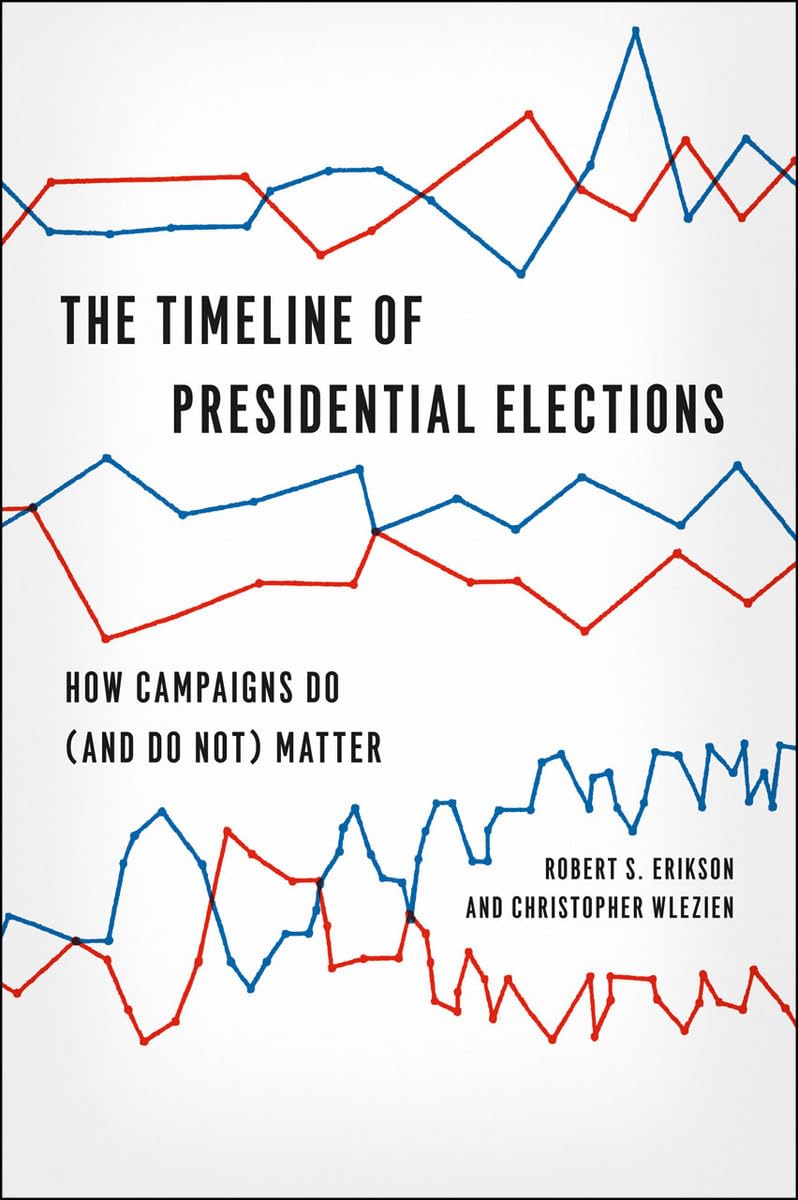
In presidential elections, do voters cast their ballots for the candidates whose platform and positions best match their own? Or is the race for president of the United States come down largely to who runs the most effective campaign? Its a question those who study elections have been considering for years with no clear resolution. In The Timeline of Presidential Elections, Robert S. Erikson and Christopher Wlezien reveal for the first time how both factors come into play.Erikson and Wlezien have amassed data from close to two thousand national polls covering every presidential election from 1952 to 2008, allowing them to see how outcomes take shape over the course of an election year. Polls from the beginning of the year, they show, have virtually no predictive power. By midApril, when the candidates have been identified and matched in pollsters trial heats, preferences have come into focusand predicted the winner in eleven of the fifteen elections. But a similar process of forming favorites takes place in the last six months, during which voters intentions change only gradually, with particular eventsincluding presidential debatesrarely resulting in dramatic change.Ultimately, Erikson and Wlezien show that it is through campaigns that voters are made aware ofor not made aware offundamental factors like candidates policy positions that determine which ticket will get their votes. In other words, fundamentals matter, but only because of campaigns. Timely and compelling, this book will force us to rethink our assumptions about presidential elections.
⚠️ WARNING (California Proposition 65):
This product may contain chemicals known to the State of California to cause cancer,
birth defects, or other reproductive harm.
For MAP (Minimum Advertised Price) violations and Intellectual Property (IP) or Trademark concerns, please contact:
support@ergodebooks.com
⚠️ California Proposition 65 Warning: Some products sold on this website may expose you to chemicals known to the State of California to cause cancer, birth defects, or other reproductive harm. For more information, visit www.P65Warnings.ca.gov.