
Title
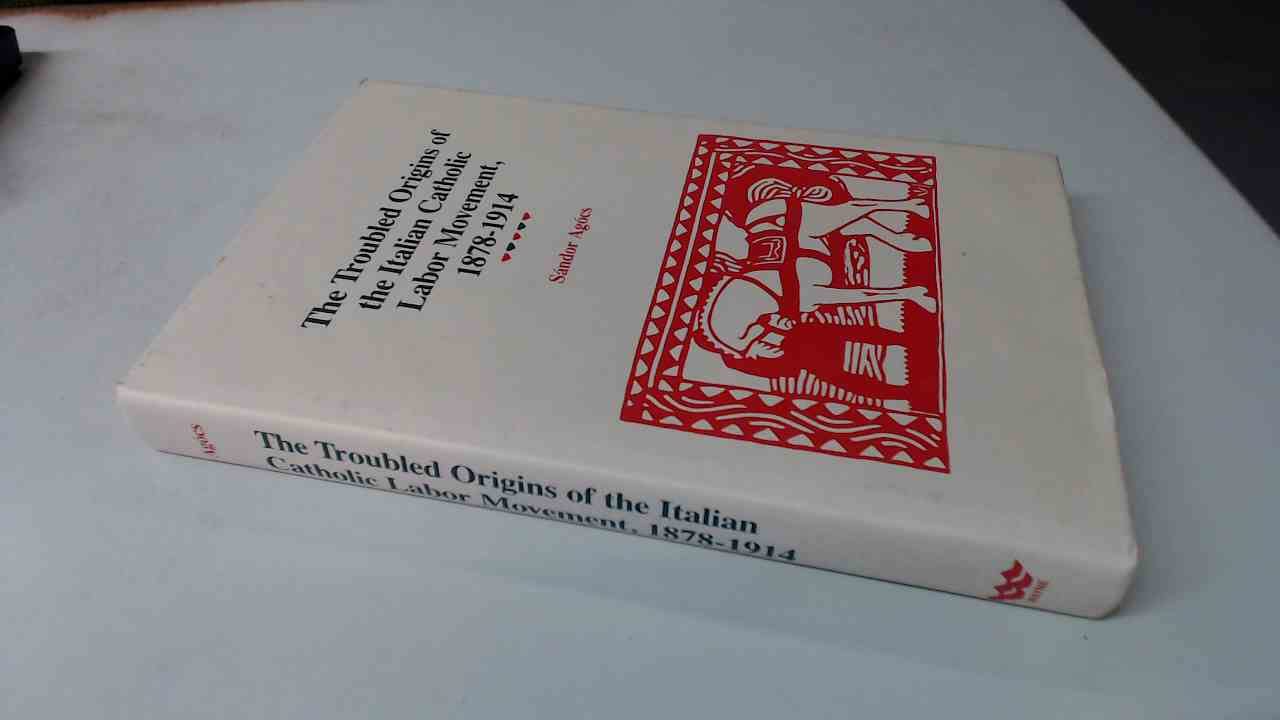
The Troubled Origins Of The Italian Catholic Labor Movement, 18781914 (Title Not In Series),Used
Sold by Ergodebooks, an authorized reseller.
Returns accepted within 30 days | support@ergodebooks.com
Shipping Information
- Free Standard Shipping — United States only
- Processing Time: 3–5 business days
- Estimated Delivery: 6–10 business days after dispatch
- Double-boxed, fully insured & discreetly packaged
- Tracking number sent via email once dispatched
Returns & Refund
Returns accepted within 30 days of delivery.
Damaged or Defective Item
Free return shipping + replacement or full refund
Wrong Item Received
Free return shipping + replacement or full refund
Change of Mind
Return shipping at customer's expense · 25% restocking fee applies
Payment Option

In his book, Sndor Agcs explores the conflicts that accompanied the emergence of the Italian Catholic labor movement. He examines the ideologies that were at work and details the organizational forms they inspired.During the formative years of the Italian labor movement, NeoThomism became the official ideology of the church. Church leadership drew upon the central Thomistic principal of caritas, Christian love, in its response to the social climate in Italy, which had become increasingly charged with class consciousness and conflict. Aquinas's principles ruled out class struggle as contrary to the spirit of Christianity and called for a symbiotic relationship among the various social strata. NeoThomistic philosophy also emphasized the social functions of property, a principle that demanded the paternalistic care and tutelage of the interests of working people by the wealthy.In applying these principles to the nascent labor movement, the church's leadership called for a mixed union (misto), whose membership would include both capitalists and workers. They argued that this type of union best reflected the tenets of NeoThomistic social philosophy. In addition, through its insistence on the misto, the church was also motivated by an obsessive concern with socialism, which it viewed as a threat, and by a fear of the working classes, which it associated with socialism, which it viewed as a threat, and by a fear of the working classes, which it associated with socialism. In pressing for the mixed union, therefore, the church leadership hoped not only to realize NeoThomistic principles, but also to defuse class struggle and prevent the proletariat from becoming a viable social and political force.Catholic activists, who were called upon to put ideas into practice and confronted social realities daily, learned that the 'mixed' unions were a utopian vision that could not be realized. They knew that the age of paternalism was over and that neither the workers not the capitalists were interested in the mixed union. In its stead, the activists urged for the 'simple' union, an organization for workers only. The conflict which ensued pitted the bourgeoisie and the Catholic hierarchy against the young activists.Sndor Agcs reveals precisely in what way Catholic social thought was inadequate to deal with the realities of unionization and why Catholics were unable to present a reasonable alternative.
⚠️ WARNING (California Proposition 65):
This product may contain chemicals known to the State of California to cause cancer, birth defects, or other reproductive harm.
For more information, please visit www.P65Warnings.ca.gov.