
Title
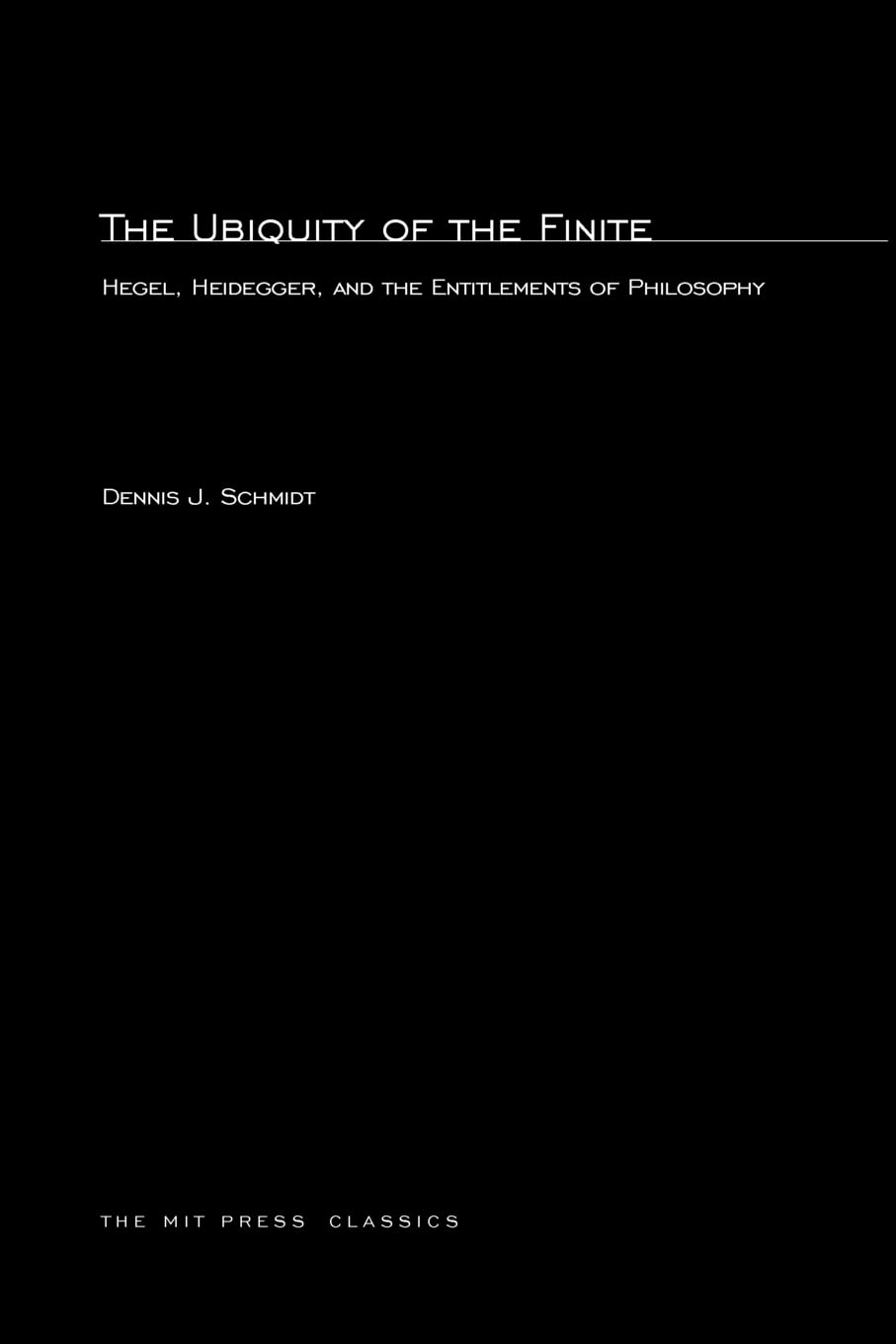
The Ubiquity of the Finite: Hegel, Heidegger, and the Entitlements of Philosophy (Studies in Contemporary German Social Thought),Used
Sold by Ergodebooks, an authorized reseller.
Returns accepted within 30 days | support@ergodebooks.com
Shipping Information
- Free Standard Shipping — United States only
- Processing Time: 3–5 business days
- Estimated Delivery: 6–10 business days after dispatch
- Double-boxed, fully insured & discreetly packaged
- Tracking number sent via email once dispatched
Returns & Refund
Returns accepted within 30 days of delivery.
Damaged or Defective Item
Free return shipping + replacement or full refund
Wrong Item Received
Free return shipping + replacement or full refund
Change of Mind
Return shipping at customer's expense · 25% restocking fee applies
Payment Option

What are the assumptions and tasks hidden in contemporary calls to overcome the metaphysical tradition? Reflecting upon the internal contradictions of the notions of tradition and finiteness, Dennis J. Schmidt offers novel insights into how philosophy must relate to its traditions if it is to retain a vital sense of the plurality of edges that constitute its finiteness. He does this through a close examination of issues found in the work of Hegel and Heidegger, two philosophers who made the ideas of both tradition and finiteness the center of their concern. Schmidt begins by asking how Heidegger can claim to have destroyed metaphysics despite Hegel's claim to have perfected its possibilities. Systematically following the development of Heidegger's critique of Hegel, Schmidt generates a dialogue between them. The topic of that dialogue is the nature of finiteness as it is articulated in time, nothing, the dialectical and hermeneutical circles, and in the notions of experience, work, technology, history, and preSocratic thought.Beginning with Heidegger's critique of Hegel in Being and Time, Schmidt's strategy is to disclose the complexities of philosophical discourse about the finite by drawing out the proximities between Hegel and Heidegger. The dialogue that results presents novel portraits of both philosophers. It also reveals that Heidegger's early, unacknowledged failure to separate himself from the Hegelian dialectic is the motive behind many of the turns and decisions of his later career. In concluding, Schmidt offers an interpretation of the wider significance of the results of that dialogue, and connects his study to other contemporary discussions of postmodernism. He expands upon the idea of the plurality of edges opened by finiteness, arguing that philosophy only understands its own past and future once it recognizes the meaning of its own finiteness.The Ubiquity of the Finite is included in the series Studies in Contemporary German Social Thought, edited by Thomas McCarthy.
⚠️ WARNING (California Proposition 65):
This product may contain chemicals known to the State of California to cause cancer, birth defects, or other reproductive harm.
For more information, please visit www.P65Warnings.ca.gov.