
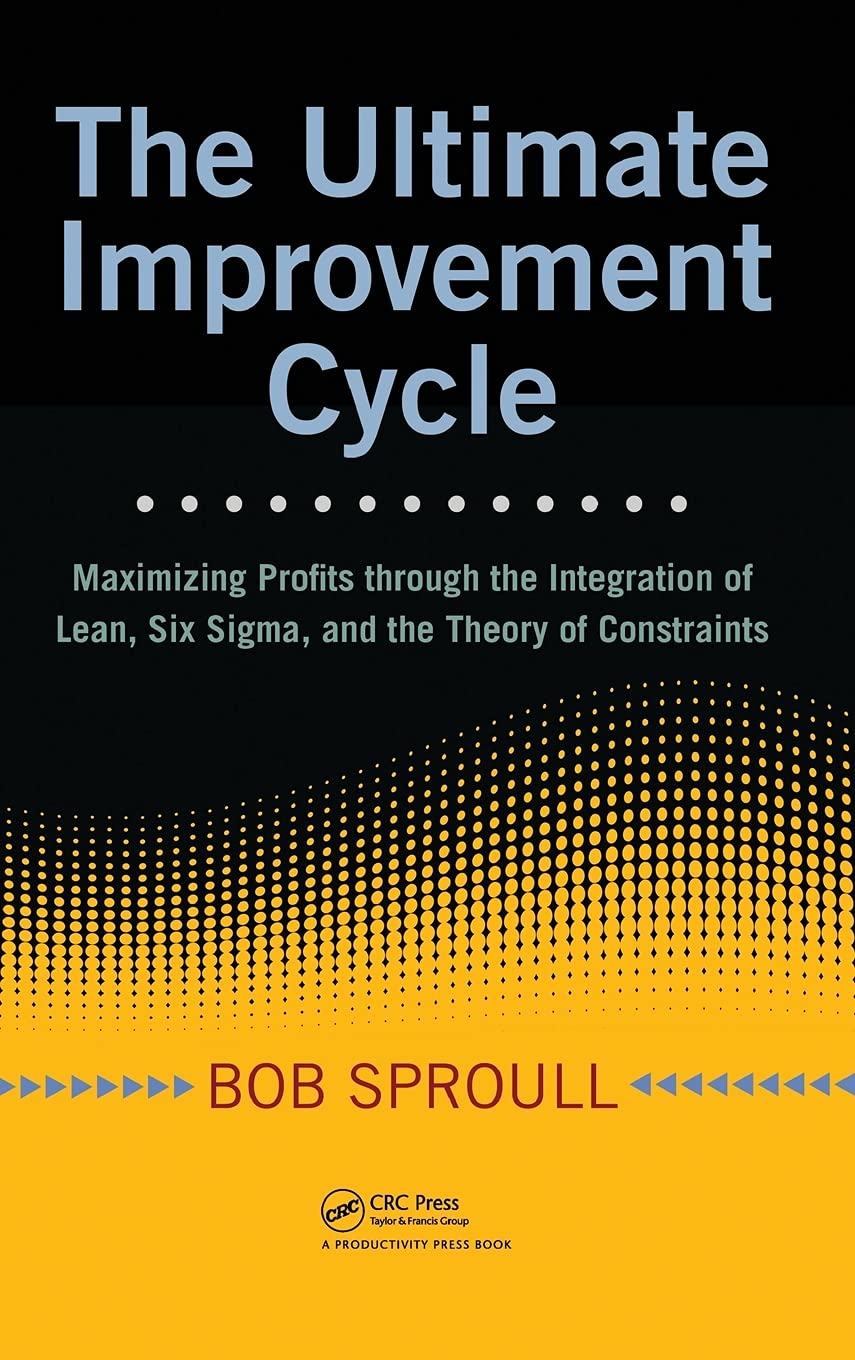
Title
The Ultimate Improvement Cycle: Maximizing Profits through the Integration of Lean, Six Sigma, and the Theory of Constraints,Used
Sold by Ergodebooks, an authorized reseller.
Returns accepted within 30 days | support@ergodebooks.com
Shipping Information
- Free Standard Shipping — United States only
- Processing Time: 3–5 business days
- Estimated Delivery: 6–10 business days after dispatch
- Double-boxed, fully insured & discreetly packaged
- Tracking number sent via email once dispatched
Returns & Refund
Returns accepted within 30 days of delivery.
Damaged or Defective Item
Free return shipping + replacement or full refund
Wrong Item Received
Free return shipping + replacement or full refund
Change of Mind
Return shipping at customer's expense · 25% restocking fee applies
Payment Option

Recognizing the need to implement quality and eliminate waste, companies embrace Lean, Six Sigma, or a combination of the two, typically taking a broad approach that seeks to remediate every process, critical or not. When this happens, efforts become distracted, improvements indefinitely delayed, and results mediocre at best.The Ultimate Improvement Cycle (UIC) integrates Lean, Six Sigma, and the Theory of Constraints into a combined strategy that will help you immediately focus your efforts on those areas that will make the greatest difference. The book presents basic laws of factory physics that show why the UIC delivers significant bottomline improvement while other initiatives so often fail. It explains to you why focusing your efforts on apparent problems rather than systemic concerns is wasted effort.Focus on key areas and take improvement to the next levelThe Ultimate Improvement Cycle: Maximizing Profits through the Integration of Lean, Six Sigma, and the Theory of Constraints show you how to draw the best from Lean and Six Sigma by employing principles drawn from the Theory of Constraints. This approach will ensure that your effort is focused in the right place, at the right time, using the right tools, and the right amount of resources. This multipronged approach addresses cost accounting, variation, waste, and performance measurements. But most importantly, it focuses your organization on the right areas to optimize.Applying years of handson work in many environments, Bob Sproull has developed a unique proven method that capitalizes on a timerelease formula for evoking the key tools that improvement requires. He shows you how to take advantage of the cyclical nature of improvement to implement change that is perpetually effective, and his approach does not require more resources than you have on hand. Although originally developed in manufacturing, the UIC works equally well in any environment whether it be manufacturing or serviceoriented, including Maintenance, Repair and Overhaul (MRO) and Critical Chain Project Management (CCPM).
⚠️ WARNING (California Proposition 65):
This product may contain chemicals known to the State of California to cause cancer, birth defects, or other reproductive harm.
For more information, please visit www.P65Warnings.ca.gov.
- Q: What is 'The Ultimate Improvement Cycle' about? A: The book focuses on integrating Lean, Six Sigma, and the Theory of Constraints to improve organizational efficiency and profitability.
- Q: Who is the author of this book? A: The author is Bob Sproull, who has extensive experience in applying improvement methods across various environments.
- Q: What is the main benefit of the Ultimate Improvement Cycle? A: The main benefit is its ability to help organizations focus their improvement efforts on the most impactful areas, leading to significant bottom-line results.
- Q: How many pages does the book contain? A: The book contains 288 pages.
- Q: What is the format of the book? A: The book is available in hardcover format.
- Q: When was the book published? A: The book was published on March 11, 2009.
- Q: Is this book suitable for service-oriented industries? A: Yes, the principles discussed in the book apply equally well to manufacturing and service-oriented environments.
- Q: What condition is the book in? A: The book is listed as being in New condition.
- Q: What edition of the book is available? A: This is the first edition of the book.
- Q: What are the key topics covered in the book? A: Key topics include cost accounting, variation, waste management, performance measurements, and the cyclical nature of improvement.