
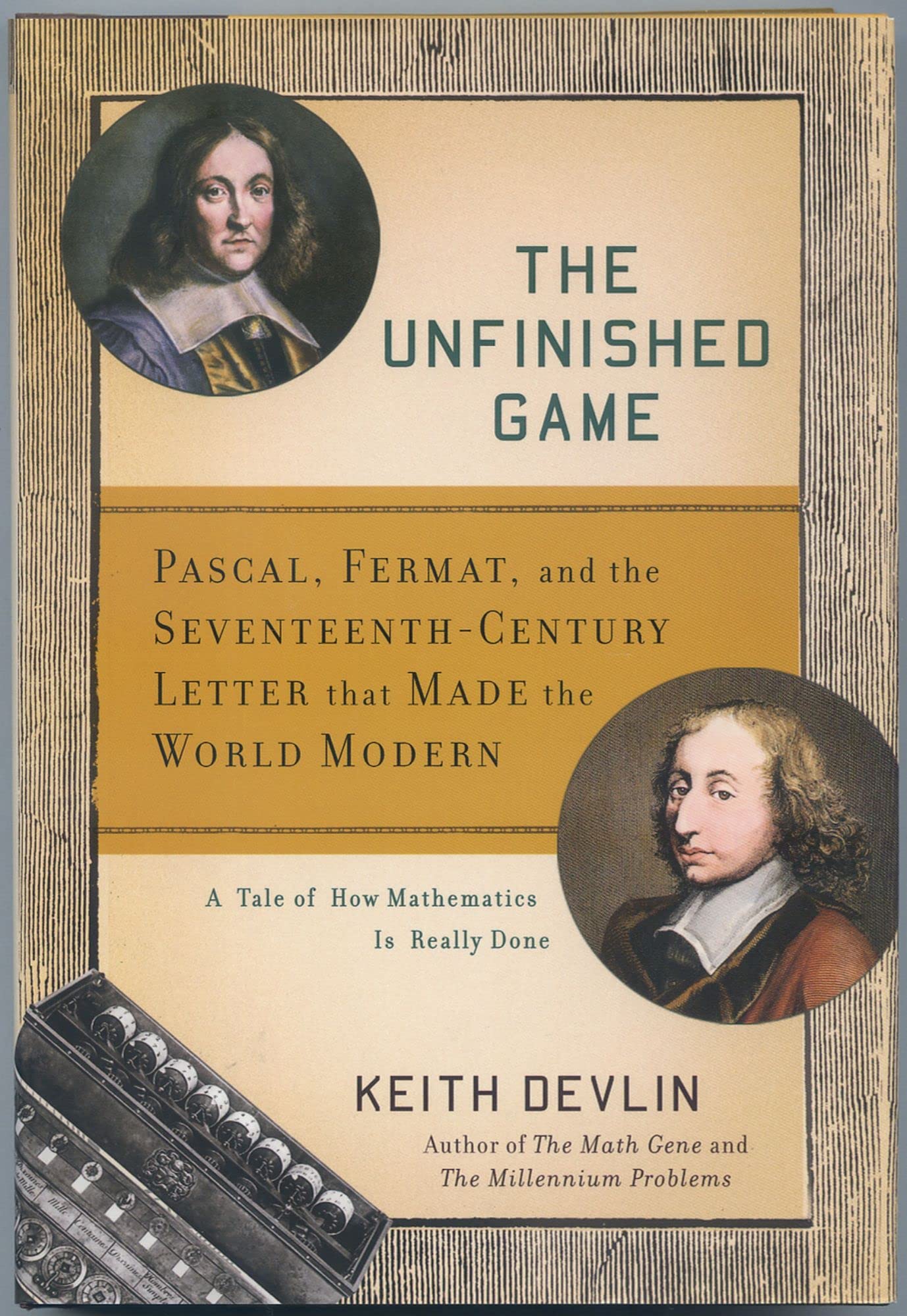
Title
The Unfinished Game: Pascal, Fermat, And The Seventeenthcentury Letter That Made The World Modern,New
Sold by Ergodebooks, an authorized reseller.
Returns accepted within 30 days | support@ergodebooks.com
Shipping Information
- Free Standard Shipping — United States only
- Processing Time: 3–5 business days
- Estimated Delivery: 6–10 business days after dispatch
- Double-boxed, fully insured & discreetly packaged
- Tracking number sent via email once dispatched
Returns & Refund
Returns accepted within 30 days of delivery.
Damaged or Defective Item
Free return shipping + replacement or full refund
Wrong Item Received
Free return shipping + replacement or full refund
Change of Mind
Return shipping at customer's expense · 25% restocking fee applies
Payment Option

Before The Midseventeenth Century, Scholars Generally Agreed That It Was Impossible To Predict Something By Calculating Mathematical Outcomes. One Simply Could Not Put A Numerical Value On The Likelihood That A Particular Event Would Occur. Even The Outcome Of Something As Simple As A Dice Roll Or The Likelihood Of Showers Instead Of Sunshine Was Thought To Lie In The Realm Of Pure, Unknowable Chance. The Issue Remained Intractable Until Blaise Pascal Wrote To Pierre De Fermat In 1654, Outlining A Solution To The Unfinished Game Problem: How Do You Divide The Pot When Players Are Forced To End A Game Of Dice Before Someone Has Won? The Idea Turned Out To Be Far More Seminal Than Pascal Realized. From It, The Two Men Developed The Method Known Today As Probability Theory. In The Unfinished Game, Mathematician And Npr Commentator Keith Devlin Tells The Story Of This Correspondence And Its Remarkable Impact On The Modern World: From Insurance Rates, To Housi
⚠️ WARNING (California Proposition 65):
This product may contain chemicals known to the State of California to cause cancer, birth defects, or other reproductive harm.
For more information, please visit www.P65Warnings.ca.gov.
- Q: How many pages does the book have? A: The book has two hundred eight pages. This length provides a concise yet detailed exploration of probability theory's origins.
- Q: What is the binding type of this book? A: The book is hardcover. This durable binding ensures longevity and protection for the book's contents.
- Q: What are the dimensions of the book? A: The book measures six inches in length, one point two six inches in width, and eight point five inches in height. These dimensions make it a compact and portable read.
- Q: Who is the author of the book? A: The author is Keith Devlin. He is a mathematician and an NPR commentator known for his engaging writing on mathematics.
- Q: What category does this book fall under? A: The book falls under the History & Philosophy category. It discusses the historical development of probability theory.
- Q: What is the main theme of the book? A: The main theme revolves around the correspondence between Blaise Pascal and Pierre de Fermat. Their exchange laid the groundwork for modern probability theory.
- Q: Can this book be used as a teaching resource? A: Yes, this book can serve as a teaching resource. It offers insights into the foundations of probability, making it suitable for educational settings.
- Q: Is this book suitable for beginners in mathematics? A: Yes, the book is suitable for beginners. It presents complex ideas in an accessible manner, making it easy to understand.
- Q: What age group is this book appropriate for? A: The book is appropriate for young adults and older. Its themes and discussions are aligned with higher education levels.
- Q: How should I store this book? A: Store the book in a cool, dry place. Keeping it upright on a shelf will help maintain its shape and condition.
- Q: How do I care for the book? A: Care for the book by keeping it away from moisture and direct sunlight. Regularly dusting it will also help preserve its appearance.
- Q: Is there a warranty or return policy for this book? A: Typically, books do not come with a warranty. However, return policies may vary by retailer, so check with the seller for details.
- Q: What if the book arrives damaged? A: If the book arrives damaged, contact the seller immediately. Most retailers will offer a replacement or refund.
- Q: How does this book compare to other books on probability? A: This book provides a historical perspective, unlike many textbooks. It focuses on the origins of probability theory rather than just mathematical formulas.
- Q: Is this book recommended for advanced mathematics students? A: Yes, the book is recommended for advanced students. It provides context that enriches the understanding of probability beyond just calculations.
- Q: Does the book include illustrations or diagrams? A: No, the book does not include illustrations or diagrams. It relies on narrative and historical context to convey its themes.