
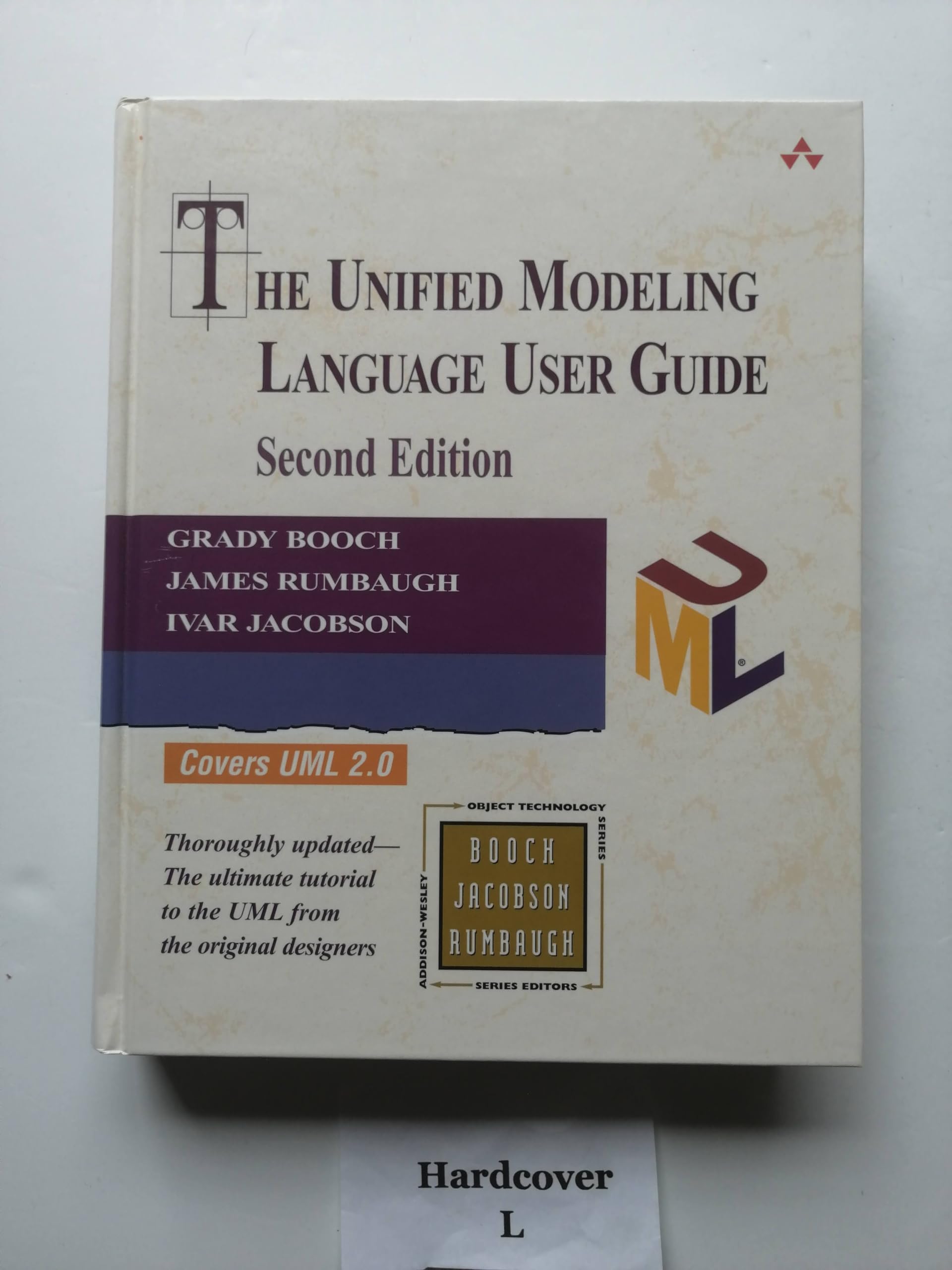
Title
The Unified Modeling Language User Guide,Used
Sold by Ergodebooks, an authorized reseller.
Returns accepted within 30 days | support@ergodebooks.com
Shipping Information
- Free Standard Shipping — United States only
- Processing Time: 3–5 business days
- Estimated Delivery: 6–10 business days after dispatch
- Double-boxed, fully insured & discreetly packaged
- Tracking number sent via email once dispatched
Returns & Refund
Returns accepted within 30 days of delivery.
Damaged or Defective Item
Free return shipping + replacement or full refund
Wrong Item Received
Free return shipping + replacement or full refund
Change of Mind
Return shipping at customer's expense · 25% restocking fee applies
Payment Option

For nearly ten years, the Unified Modeling Language (UML) has been the industry standard for visualizing, specifying, constructing, and documenting the artifacts of a softwareintensive system. As the de facto standard modeling language, the UML facilitates communication and reduces confusion among project stakeholders. The recent standardization of UML 2.0 has further extended the language's scope and viability. Its inherent expressiveness allows users to model everything from enterprise information systems and distributed Webbased applications to realtime embedded systems.In this eagerly anticipated revision of the bestselling and definitive guide to the use of the UML, the creators of the language provide a tutorial to its core aspects in a twocolor format designed to facilitate learning. Starting with an overview of the UML, the book explains the language gradually by introducing a few concepts and notations in each chapter. It also illustrates the application of the UML to complex modeling problems across a variety of application domains. The indepth coverage and exampledriven approach that made the first edition of The Unified Modeling Language User Guide an indispensable resource remain unchanged. However, content has been thoroughly updated to reflect changes to notation and usage required by UML 2.0.Highlights include: A new chapter on components and internal structure, including significant new capabilities for building encapsulated designs New details and updated coverage of provided and required interfaces, collaborations, and UML profiles Additions and changes to discussions of sequence diagrams, activity diagrams, and more Coverage of many other changes introduced by the UML 2.0 specificationWith this essential guide, you will quickly get up to speed on the latest features of the industry standard modeling language and be able to apply them to your next software project.
⚠️ WARNING (California Proposition 65):
This product may contain chemicals known to the State of California to cause cancer, birth defects, or other reproductive harm.
For more information, please visit www.P65Warnings.ca.gov.