
Title
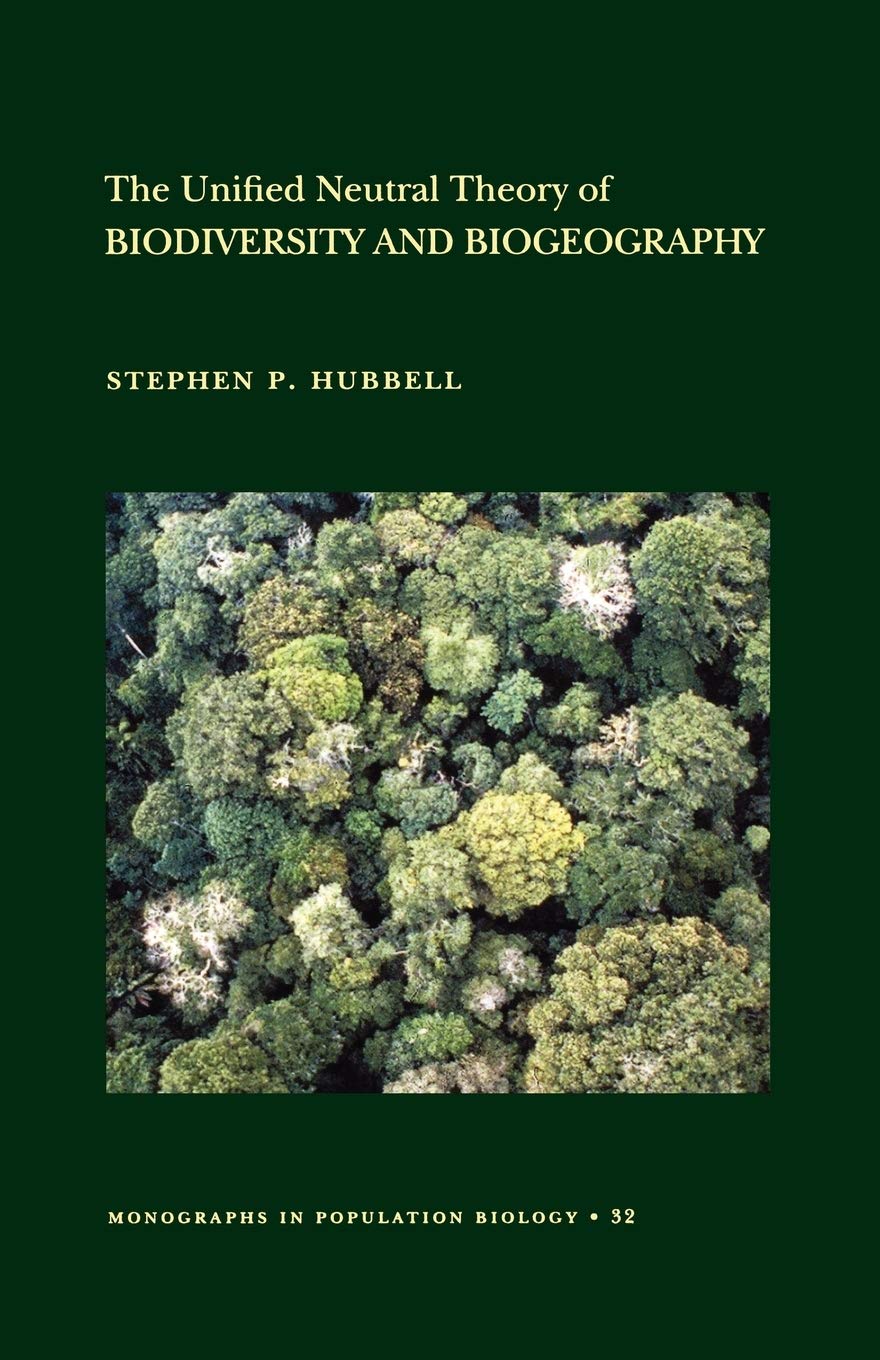
The Unified Neutral Theory of Biodiversity and Biogeography (Monographs in Population Biology, 32),Used
Sold by Ergodebooks, an authorized reseller.
Returns accepted within 30 days | support@ergodebooks.com
Shipping Information
- Free Standard Shipping — United States only
- Processing Time: 3–5 business days
- Estimated Delivery: 6–10 business days after dispatch
- Double-boxed, fully insured & discreetly packaged
- Tracking number sent via email once dispatched
Returns & Refund
Returns accepted within 30 days of delivery.
Damaged or Defective Item
Free return shipping + replacement or full refund
Wrong Item Received
Free return shipping + replacement or full refund
Change of Mind
Return shipping at customer's expense · 25% restocking fee applies
Payment Option

Despite its supreme importance and the threat of its global crash, biodiversity remains poorly understood both empirically and theoretically. This ambitious book presents a new, general neutral theory to explain the origin, maintenance, and loss of biodiversity in a biogeographic context.Until now biogeography (the study of the geographic distribution of species) and biodiversity (the study of species richness and relative species abundance) have had largely disjunct intellectual histories. In this book, Stephen Hubbell develops a formal mathematical theory that unifies these two fields. When a speciation process is incorporated into Robert H. MacArthur and Edward O. Wilson's now classical theory of island biogeography, the generalized theory predicts the existence of a universal, dimensionless biodiversity number. In the theory, this fundamental biodiversity number, together with the migration or dispersal rate, completely determines the steadystate distribution of species richness and relative species abundance on local to large geographic spatial scales and shortterm to evolutionary time scales.Although neutral, Hubbell's theory is nevertheless able to generate many nonobvious, testable, and remarkably accurate quantitative predictions about biodiversity and biogeography. In many ways Hubbell's theory is the ecological analog to the neutral theory of genetic drift in genetics. The unified neutral theory of biogeography and biodiversity should stimulate research in new theoretical and empirical directions by ecologists, evolutionary biologists, and biogeographers.
⚠️ WARNING (California Proposition 65):
This product may contain chemicals known to the State of California to cause cancer, birth defects, or other reproductive harm.
For more information, please visit www.P65Warnings.ca.gov.