If you have any questions, you are always welcome to contact us. We'll get back to you as soon as possible, withing 24 hours on weekdays.
Customer service
All questions about your order, return and delivery must be sent to our customer service team by e-mail at yourstore@yourdomain.com
Sale & Press
If you are interested in selling our products, need more information about our brand or wish to make a collaboration, please contact us at press@yourdomain.com
Help
If you have any questions, you are always welcome to contact us. We'll get back to you as soon as possible, withing 24 hours on weekdays.
Customer service
All questions about your order, return and delivery must be sent to our customer service team by e-mail at yourstore@yourdomain.com
Sale & Press
If you are interested in selling our products, need more information about our brand or wish to make a collaboration, please contact us at press@yourdomain.com
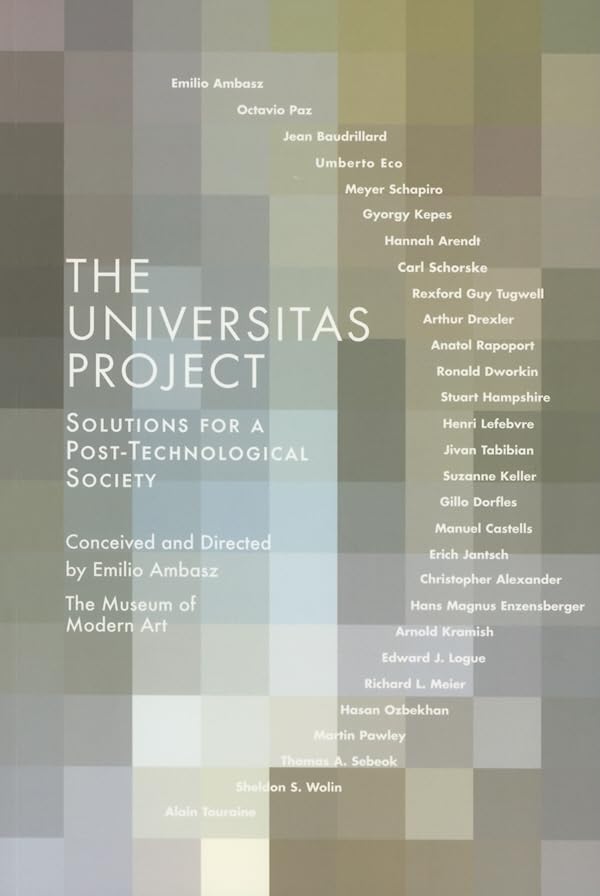
In January of 1972, The Museum of Modern Art hosted "The Universitas Project," a twoday conference sponsored by the Museum's International Council and the Institute for Architecture and Urban Studies. The distinguished participants, from a wide range of scholarly and artistic disciplines, including Jean Baudrillard, Umberto Eco, Gyorgy Kepes, Octavio Paz, Anatol Rapoport, Meyer Schapiro, Carl Schorske and Jivan Tabibian, among many others, engaged in a multidisciplinary debate on the future of design and design institutions in the postindustrial era. The project, conceived and directed by the noted architect and designer Emilio Ambasz, then Curator of Design at the Museum, was originally described as "a critical and prospective inquiry into the relation of man to the natural and the sociocultural environment...specifically planned to explore the possibility of establishing in the United States a new type of institution centered around the task of evaluating and designing the manmade milieu." This important volume publishes in their entirety the various components of the conference: the working papers that set the terms of the debate; the essays submitted by the invitees; the proceedings of the symposia responding to the papers; and the postscripts provided by the participants after the event. It makes this chapter in the intellectual history of the Museum, addressing issues and ideas still relevant today, available for the first time to scholars, the architecture and design community and the general public.
⚠️ WARNING (California Proposition 65):
This product may contain chemicals known to the State of California to cause cancer,
birth defects, or other reproductive harm.
For MAP (Minimum Advertised Price) violations and Intellectual Property (IP) or Trademark concerns, please contact:
support@ergodebooks.com
⚠️ California Proposition 65 Warning: Some products sold on this website may expose you to chemicals known to the State of California to cause cancer, birth defects, or other reproductive harm. For more information, visit www.P65Warnings.ca.gov.