
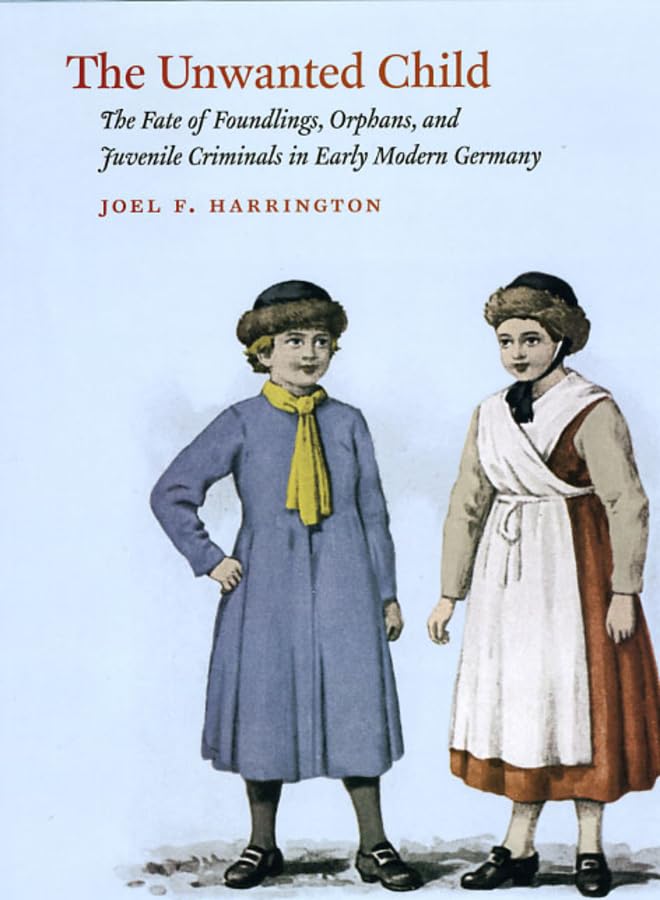
Title
The Unwanted Child: The Fate of Foundlings, Orphans, and Juvenile Criminals in Early Modern Germany,Used
Sold by Ergodebooks, an authorized reseller.
Returns accepted within 30 days | support@ergodebooks.com
Shipping Information
- Free Standard Shipping — United States only
- Processing Time: 3–5 business days
- Estimated Delivery: 6–10 business days after dispatch
- Double-boxed, fully insured & discreetly packaged
- Tracking number sent via email once dispatched
Returns & Refund
Returns accepted within 30 days of delivery.
Damaged or Defective Item
Free return shipping + replacement or full refund
Wrong Item Received
Free return shipping + replacement or full refund
Change of Mind
Return shipping at customer's expense · 25% restocking fee applies
Payment Option

ReviewOnly the best kind of historian can write compellingly about the past without slipping into anachronism. In his superb analysis of unwanted children in early modern Germany, Joel Harrington assembles some truly remarkable charactersthe hapless, the heroic, the deeply cherished, and the neverloved. In telling their stories, he makes a distant time seem immediate and, with great subtlety, prompts readers to consider the fates of the helpless and uncherished today. Joyce Chaplin, Harvard UniversityJoel Harringtons wonderful new study of Nuremberg takes the story of unwanted children beyond the walls of the citys chief charitable institution designed to receive them to the families and larger society that helped determine their fates. The author deconstructs the problem of child abandonment, for example, by highlighting the various conditions that made life in the early modern city so precarious, especially for infants and children. Based on a wide variety of archival sources, the book uses the concept of the circulation of children to explore the many waysboth informal and formalthat family networks and institutions tried to care for unwanted children, in many cases without success. Harrington skillfully uses the biographers and microhistorians tools to explore five examples of the kinds of people who figured prominently in dramas that surrounded unwanted children. He moves well beyond his local case study using his findings to address such topics as infanticide, outof wedlock pregnancy, youth delinquency, and orphanhood in crossnational European perspective. All sorts of poor children and their familiesfrom abandoned infants to teenage street children to absconding fathers and unwed motherscome alive in the pages of The Unwanted Child. Katherine A. Lynch, Carnegie Mellon University'Harrington breaks new ground with this work on children in early modern Nuremberg. . . . [This work] mounts a rich, successful challenge to topdown historical approaches to the subject.' ChoiceHarrington provides a fascinating examination of the problem of abandoned, orphaned, and neglected children in Nuremberg in the sixteenth and seventeenth centuries, offering a convincing reassessment of the impact of the Reformation on early modern child welfare. Journal of Modern HistoryHarrington defines the subject of the book as child circulation. This concept is sufficiently flexible to allow a range of otherwise anachronistically defined phenomena to be examined (e.g., different forms of child abandonment; active and passive infanticides; formal, informal, forced, and voluntary fostering, etc.) and ensures that attention is paid to both institutions and individuals. While the focus of the study is the German city of Nuremberg from the 1550s to the 1670s, the authors detailed knowledge of early modern Germany and the early modern historiography on related subjects enables him to present an analysis that has relevance to the developments across early modern Europe. . . . The Unwanted Child is thoroughly researched and the book engages the reader like a good novel. Harringtons skillful and sensitive approach to the vast source material allows him to present an exceptional book and a series of fascinating observations. This book will benefit any early modernist and scholars who are interested in the history of childhood, youth, and the family. SixteenthCentury JournalProduct DescriptionThe baby abandoned on the doorstep is a phenomenon that has virtually disappeared from our experience, but in the early modern world, unwanted children were a very real problem for parents, government officials, and society. The Unwanted Child skillfully recreates sixteenthcentury Nuremberg to explore what befell abandoned, neglected, abused, or delinquent children in this critical period.Joel F. Harrington tackles this question by focusing on the stories of five individuals. In vivid and poignant detail, he reco
⚠️ WARNING (California Proposition 65):
This product may contain chemicals known to the State of California to cause cancer, birth defects, or other reproductive harm.
For more information, please visit www.P65Warnings.ca.gov.