
Title
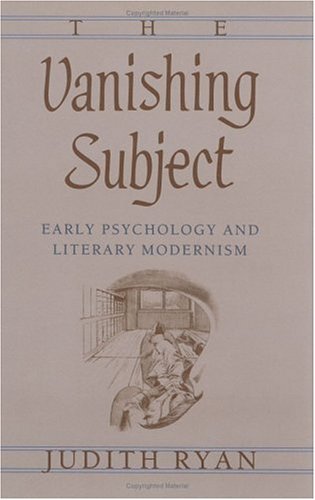
The Vanishing Subject: Early Psychology and Literary Modernism,Used
Sold by Ergodebooks, an authorized reseller.
Returns accepted within 30 days | support@ergodebooks.com
Shipping Information
- Free Standard Shipping — United States only
- Processing Time: 3–5 business days
- Estimated Delivery: 6–10 business days after dispatch
- Double-boxed, fully insured & discreetly packaged
- Tracking number sent via email once dispatched
Returns & Refund
Returns accepted within 30 days of delivery.
Damaged or Defective Item
Free return shipping + replacement or full refund
Wrong Item Received
Free return shipping + replacement or full refund
Change of Mind
Return shipping at customer's expense · 25% restocking fee applies
Payment Option

Is thinking personal? Or should we not rather say, 'it thinks,' just as we say, 'it rains'? In the late nineteenth century a number of psychologies emerged that began to divorce consciousness from the notion of a personal self. They asked whether subject and object are truly distinct, whether consciousness is unified or composed of disparate elements, what grounds exist for regarding today's 'self' as continuous with yesterday's. If the American pragmatist William James declared himself, on balance, in favor of a 'real and verifiable personal identity which we feel,' his Austrian counterpart, the empiricist Ernst Mach, propounded the view that 'the self is unsalvageable.'The Vanishing Subject is the first comprehensive study of the impact of these preFreudian debates on modernist literature. In lucid and engaging prose, Ryan traces a complex set of filiations between writers and thinkers over a sixtyyear period and restores a lost element in the genesis and development of modernism. From writers who see the 'self' as nothing more or less than a bundle of sensory impressions, Ryan moves to others who hesitate between empiricist and Freudian views of subjectivity and consciousness, and to those who wish to salvage the self from its apparent disintegration. Finally, she looks at a group of writers who abandon not only the dualisms of subject and object, but dualistic thinking altogether.Literary impressionism, streamofconsciousness and pointofview narration, and the question of epiphany in literature acquire a new aspect when seen in the context of the 'psychologies without the self.' Rilke's development of a position akin to phenomenology, Henry and Alice James's relation to their psychologist brother, Kafka's place in the modernist movements, Joyce's rewriting of Pater, Proust's engagement with contemporary thought, Woolf's presentation of consciousness, and Musil's projection of a utopian counterreality are problems familiar to readers and critics: The Vanishing Subject radically revises the way we see them.
⚠️ WARNING (California Proposition 65):
This product may contain chemicals known to the State of California to cause cancer, birth defects, or other reproductive harm.
For more information, please visit www.P65Warnings.ca.gov.