
Title
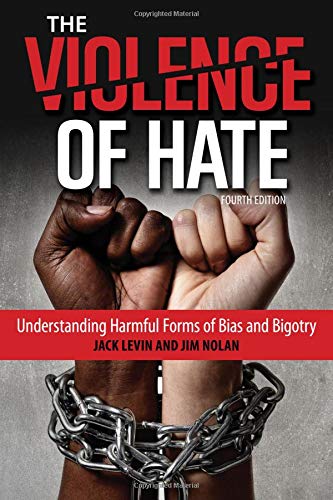
The Violence of Hate: Understanding Harmful Forms of Bias and Bigotry,Used
Sold by Ergodebooks, an authorized reseller.
Returns accepted within 30 days | support@ergodebooks.com
Shipping Information
- Free Standard Shipping — United States only
- Processing Time: 3–5 business days
- Estimated Delivery: 6–10 business days after dispatch
- Double-boxed, fully insured & discreetly packaged
- Tracking number sent via email once dispatched
Returns & Refund
Returns accepted within 30 days of delivery.
Damaged or Defective Item
Free return shipping + replacement or full refund
Wrong Item Received
Free return shipping + replacement or full refund
Change of Mind
Return shipping at customer's expense · 25% restocking fee applies
Payment Option

The Violence of Hate, Fourth Edition presents a systematic introduction to issues related to the sociology and social psychology of hate and violence as they target people who are different in socially significant ways. It offers an integrated perspective on the causes and consequences of hatemotivated violence and the reasons we have not always been effective in stopping it. Not only do the authors address the experiences of racial, ethnic, and religious groups under attack, but also those who are victimized because of their sexual orientation, gender, genderidentity, age, or disability status. In addition, they include a chapter dedicated solely to the exploration of hate crimes, an evolving legal concept and public policy domain, as well as a chapter in which they suggest approaches that may be effectively applied collectively to the reduction of hate violence. As in earlier versions of The Violence of Hate, Levin and Nolan take the position that support for hatemotivated violence originates not in the ranting and raving of a few bigoted extremists at the margins of society but in the tacit approval of ordinary, even decent, people who are located squarely in the mainstream.Updates to the Fourth Edition:Chapter 1: New discussions of structural and cultural factors illustrated by the racial conflicts in Ferguson Missouri, New York City, and Baltimore. New presentation of the recent ADL survey indicating degree of bigotry in more than 100 countries. New discussion of how threatening situations inspire increases in hate violence against a range of vulnerable groups. Chapter 2: New chapter on hate violence around the world involving the experiences of Roma in Europe, sexual orientation and gender identity violence, and antiSemitic and antiIslamic violence in European countries. Includes discussions of violent responses to antiMohammed cartoons in Europe and North America, sectarian violence in Northern Ireland and the Middle East, and police versus the black community in the United States. Chapter 3: Updated discussion of issues related to reporting hate incidents and collecting hate crime data. Expanded presentation of hate crime laws at the federal and state levels. New discussions of the problems associated with policing hate and the role of social media in spreading hate. Chapter 4: New section on mass murder in the name of hate, including the Sikh Temple massacre outside of Milwaukee, the Charleston Black Church massacre, Baumhammers killing spree targeting immigrants, Jews, and nonwhites in the Pittsburgh area, Taylors killing spree targeting whites, and black church burnings in the 1990s and 2015. New discussion of thrill hate crimes against the homeless, people with disabilities, and gays.Features:Uses a single conceptual framework to explore racism in American society, and the historical occurrence of antiSemitism, with special emphasis on Nazi Germany. The experiences of other groups, such as Armenians massacred in 1915 and gay students victimized by violence, are also examined to provide a broad comparative perspective. Shows the economic and psychological benefits of hate, making it an expected, even rational, behavior. Examines the evolution of hate crime legislation in the United States and the impact of this legislation on the institutions of law and criminal justice. Shows how prejudice and hate can be addressed locally, but have an impact globally. The final chapter argues that respect for differences requires rebellious and even deviant behavior.
⚠️ WARNING (California Proposition 65):
This product may contain chemicals known to the State of California to cause cancer, birth defects, or other reproductive harm.
For more information, please visit www.P65Warnings.ca.gov.
- Q: What is the main focus of 'The Violence of Hate'? A: 'The Violence of Hate' primarily explores the sociology and social psychology of hate and violence directed at diverse groups, examining the causes and consequences of hate-motivated actions.
- Q: Who are the authors of this book? A: The book is authored by Jack Levin and his co-author, who collaboratively present their insights on hate and violence.
- Q: What updates are included in the Fourth Edition of this book? A: The Fourth Edition includes new discussions on structural and cultural factors related to hate violence, updated data on hate crimes, and expanded coverage of international hate violence issues.
- Q: Is this book suitable for academic study? A: Yes, 'The Violence of Hate' is suitable for academic study, particularly in criminology, sociology, and social psychology courses, providing a comprehensive examination of bias and bigotry.
- Q: How many pages does the book have? A: 'The Violence of Hate' contains 248 pages, providing extensive coverage of the topics discussed.
- Q: What is the binding type of this book? A: The book is available in paperback binding, making it accessible and easy to handle.
- Q: When was 'The Violence of Hate' published? A: 'The Violence of Hate' was published on July 8, 2016.
- Q: Does the book discuss hate crimes in different countries? A: Yes, the book includes a dedicated chapter on hate violence around the world, discussing various incidents and the experiences of different groups.
- Q: What categories does this book fall under? A: 'The Violence of Hate' is categorized under criminology, making it relevant for those studying crime, justice, and societal issues.
- Q: Can this book help understand the impact of hate crime legislation? A: Yes, the book examines the evolution of hate crime legislation in the United States and its implications for law and criminal justice institutions.