
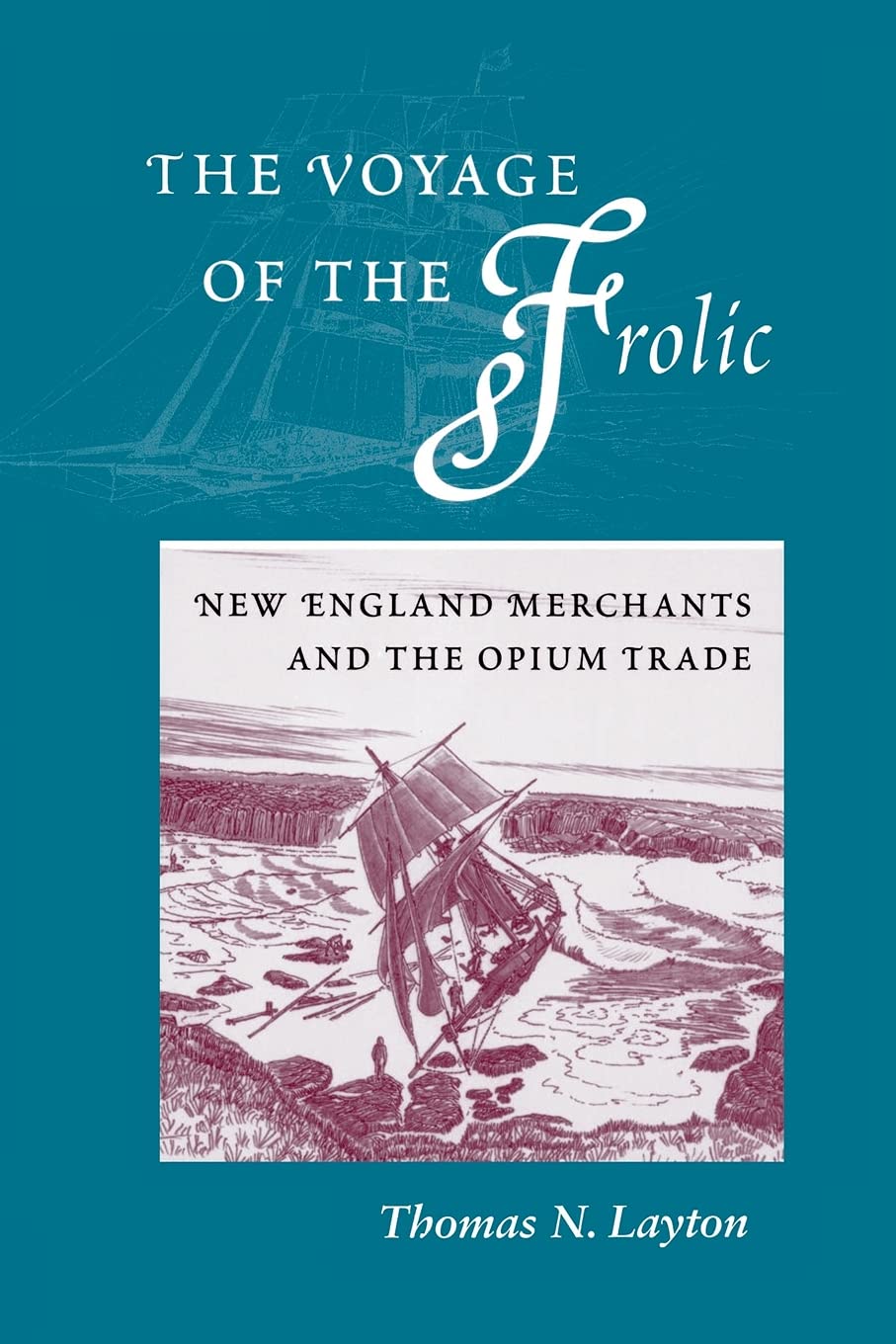
Title
The Voyage Of The Frolic: New England Merchants And The Opium Trade,Used
Sold by Ergodebooks, an authorized reseller.
Returns accepted within 30 days | support@ergodebooks.com
Shipping Information
- Free Standard Shipping — United States only
- Processing Time: 3–5 business days
- Estimated Delivery: 6–10 business days after dispatch
- Double-boxed, fully insured & discreetly packaged
- Tracking number sent via email once dispatched
Returns & Refund
Returns accepted within 30 days of delivery.
Damaged or Defective Item
Free return shipping + replacement or full refund
Wrong Item Received
Free return shipping + replacement or full refund
Change of Mind
Return shipping at customer's expense · 25% restocking fee applies
Payment Option

In the late summer of 1984, the author and a group of his archaeology students excavated fragments of Chinese porcelain at the site of a Pomo Indian village a hundred miles north of San Francisco. How did these ceramics, which were more than a hundred years old, find their way to this remote area? And what could one make of local legend that told of Pomo women wearing Chinese silk shawls in the 1850's? The author determined to find the answers to these questions, never dreaming that his quest would eventually involve the lives of nineteenthcentury Boston merchants, Baltimore shipbuilders, Bombay opium brokers, and newly rich businessmen in gold rush San Francisco.The author soon learned that in 1850 the clipper Frolic, a sailing ship built specifically for the Asian opium trade, had wrecked on the Mendocino coast, a few miles from the Pomo village. He unearthed the business records of its owners, A. Heard & Co., which showed that respectable Bostonians had made their fortunes running opium from India to China. The family histories of the firm's two most influential partners are traced from the American Revolution to their joint decision to order a custombuilt Baltimore clipper for the opium trade. In describing the design, construction, and outfitting of the Frolic, the author was aided by a stroke of lucka slave named Fred Bailey, later known to the world as the abolitionist Frederick Douglass, worked in the Frolic's shipyard in 1836 and wrote detailed descriptions of the building of such ships.The Frolic, under Captain Edward Faucon (who was depicted as the 'good' captain in Richard Henry Dana's Two Years Before the Mast) plied the opium trade from Bombay to China from 1845 to 1850. The author describes the political, financial, and logistical aspects of the profitable enterprise before 1849, when the introduction of steam vessels into the opium trade made the Frolic obsolete as an opium clipper. However, the California gold rush created a lucrative market for Chinese goods, and the Heard firm dispatched the Frolic to San Francisco with a diverse cargo that included silks, porcelain, jewelry, and furniture. When the Frolic wrecked on the Mendocino coast, the Pomo Indians salvaged its cargo, and the vessel's history passed into folk tradition.The subsequent lives of those intimately associated with the Frolic are profiled. The owners' families preferred to forget the source of their fortunes, and prior to her death in 1942, the daughter of the Frolic's captain burned her father's papers to preserve his reputation. She could not know that in 1965 sports divers would discover the remains of her father's opium clipper, and that 134 years after its wreck, the Frolic's story would inspire an archaeologistanthropologist to pursue its colorful history.
⚠️ WARNING (California Proposition 65):
This product may contain chemicals known to the State of California to cause cancer, birth defects, or other reproductive harm.
For more information, please visit www.P65Warnings.ca.gov.
- Q: What is the main subject of 'The Voyage of the Frolic'? A: 'The Voyage of the Frolic' explores the historical connections between New England merchants and the opium trade, focusing on the ship Frolic and its role in transporting goods between India and China.
- Q: Who is the author of this book? A: The author of 'The Voyage of the Frolic' is Thomas Layton, who is an archaeologist and anthropologist.
- Q: What type of book is 'The Voyage of the Frolic'? A: 'The Voyage of the Frolic' is a paperback, non-fiction book that combines archaeology, history, and anthropology.
- Q: How many pages are in this book? A: 'The Voyage of the Frolic' contains 248 pages.
- Q: What condition is the book in? A: The book is listed as 'Used Book in Good Condition', indicating it has been pre-owned but is still in a satisfactory state for reading.
- Q: When was 'The Voyage of the Frolic' published? A: 'The Voyage of the Frolic' was published on August 1, 1999.
- Q: What historical events does the book cover? A: The book covers the opium trade from the mid-19th century, the impact of the California gold rush, and the shipwreck of the Frolic on the Mendocino coast.
- Q: Does the book include any illustrations or images? A: The product details do not specify if the book includes illustrations or images; it primarily focuses on the narrative and historical accounts.
- Q: Is this book suitable for academic research? A: 'The Voyage of the Frolic' provides detailed historical accounts and could be a valuable resource for studies related to trade history, archaeology, and anthropology.
- Q: What are the key themes explored in 'The Voyage of the Frolic'? A: Key themes include the historical opium trade, cultural exchanges between East and West, and the impact of commerce on local communities.