
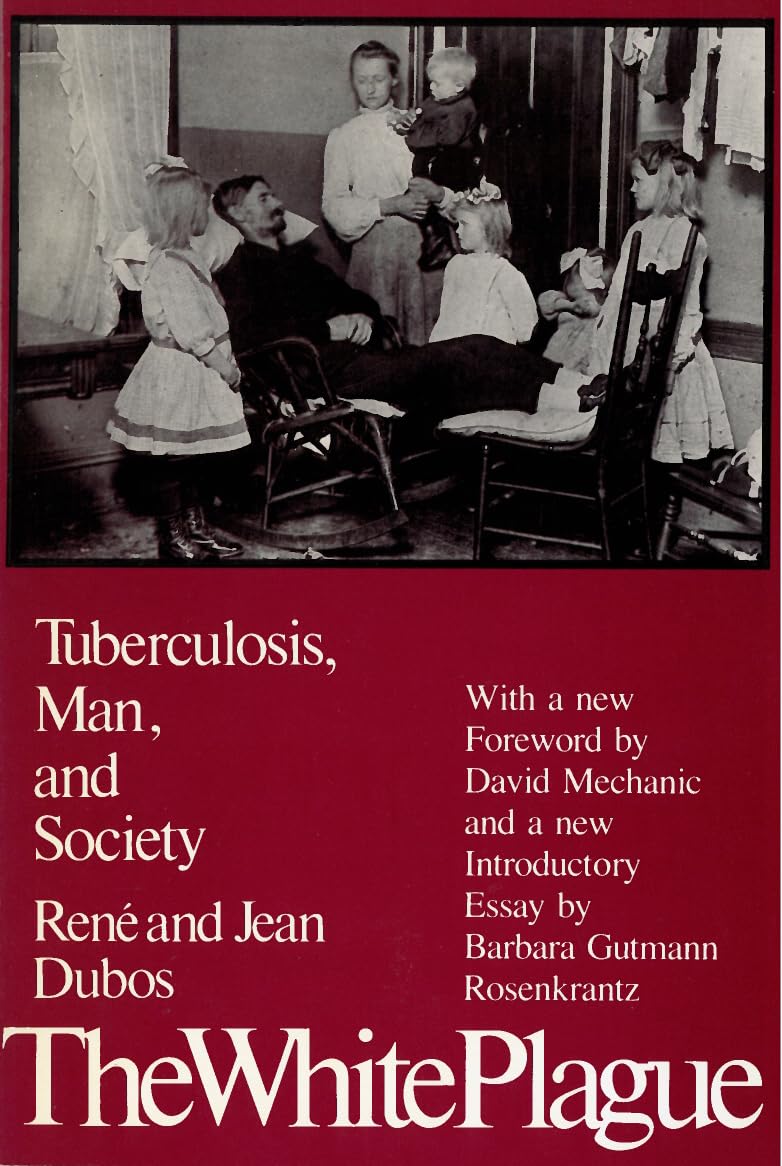
Title
The White Plague: Tuberculosis, Man And Society
Sold by Ergodebooks, an authorized reseller.
Returns accepted within 30 days | support@ergodebooks.com
Shipping Information
- Free Standard Shipping — United States only
- Processing Time: 3–5 business days
- Estimated Delivery: 6–10 business days after dispatch
- Double-boxed, fully insured & discreetly packaged
- Tracking number sent via email once dispatched
Returns & Refund
Returns accepted within 30 days of delivery.
Damaged or Defective Item
Free return shipping + replacement or full refund
Wrong Item Received
Free return shipping + replacement or full refund
Change of Mind
Return shipping at customer's expense · 25% restocking fee applies
Payment Option

In The White Plague, Ren And Jean Dubos Argue That The Great Increase Of Tuberculosis Was Intimately Connected With The Rise Of An Industrial, Urbanized Society Anda Much More Controversial Idea When This Book First Appeared Forty Years Agothat The Progress Of Medical Science Had Very Little To Do With The Marked Decline In Tuberculosis In The Twentieth Century.The White Plague Has Long Been Regarded As A Classic In The Social And Environmental History Of Disease. This Reprint Of The 1952 Edition Features New Introductory Writings By Two Distinguished Practitioners Of The Sociology And History Of Medicine. David Mechanic'S Foreword Describes The Personal And Intellectual Experience That Shaped Ren Dubos'S View Of Tuberculosis. Barbara Gutmann Rosenkrantz'S Historical Introduction Reexamines The White Plague In Light Of Recent Work On The Social History Of Tuberculosis. Her Thoughtprovoking Essay Pays Particular Attention To The Broader Cultural And Medical Assumptions About Sickness And Sick People That Inform A Societys Approach To The Conquest Of Disease.
⚠️ WARNING (California Proposition 65):
This product may contain chemicals known to the State of California to cause cancer, birth defects, or other reproductive harm.
For more information, please visit www.P65Warnings.ca.gov.
- Q: How many pages does 'The White Plague' have? A: This book has two hundred seventy-seven pages. It provides an in-depth exploration of tuberculosis and its societal impacts.
- Q: What is the binding type of 'The White Plague'? A: The book is available in paperback binding. This makes it lightweight and portable for readers.
- Q: What are the dimensions of 'The White Plague'? A: The book measures five and a half inches in length, nine inches in width, and eight and a half inches in height. These dimensions make it easy to store or carry.
- Q: Who is the author of 'The White Plague'? A: The book is authored by Professor Jean Dubos. He is known for his significant contributions to the sociology and history of medicine.
- Q: What is the main subject of 'The White Plague'? A: The book discusses tuberculosis and its connection to societal changes. It examines the relationship between disease and urbanization.
- Q: Is 'The White Plague' suitable for academic studies? A: Yes, the book is highly regarded in academic circles. It is considered a classic in social and environmental history.
- Q: How should I care for 'The White Plague'? A: To keep the book in good condition, store it in a cool, dry place. Avoid exposure to direct sunlight to prevent fading.
- Q: Can I clean 'The White Plague'? A: Yes, you can gently wipe the cover with a soft, dry cloth. Avoid using water or cleaning solutions on the pages.
- Q: Is there a specific way to store 'The White Plague'? A: Store the book upright on a shelf. This helps maintain its shape and prevents bending or creasing.
- Q: What if 'The White Plague' arrives damaged? A: If the book arrives damaged, contact the seller for a return or exchange. Ensure you have your purchase details ready.
- Q: Does 'The White Plague' come with any warranty? A: No, books typically do not come with warranties. However, check with the seller for their return policy.
- Q: Is 'The White Plague' appropriate for all ages? A: Yes, the book is suitable for older teens and adults. It discusses complex social issues related to health.
- Q: How does 'The White Plague' compare to other health history books? A: This book is unique in its focus on tuberculosis and societal factors, unlike many health history books that cover a broader range of topics.
- Q: What makes 'The White Plague' a classic? A: Its insightful analysis of tuberculosis and its societal implications has made it a foundational text in public health discussions.
- Q: Is 'The White Plague' a scholarly resource? A: Yes, it is often used as a scholarly resource in courses related to sociology, medicine, and public health.