
Title
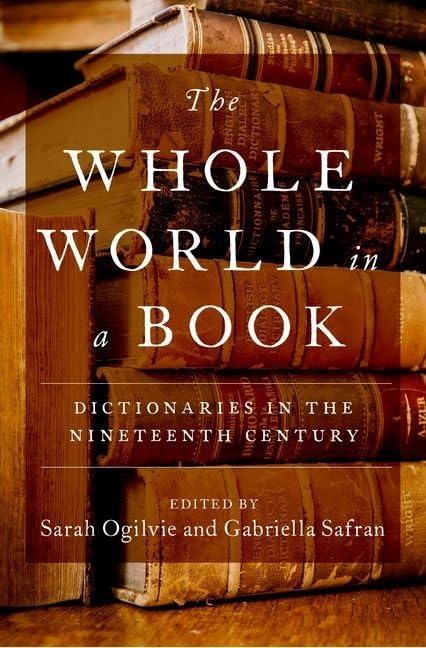
The Whole World in a Book: Dictionaries in the Nineteenth Century,Used
Sold by Ergodebooks, an authorized reseller.
Returns accepted within 30 days | support@ergodebooks.com
Shipping Information
- Free Standard Shipping — United States only
- Processing Time: 3–5 business days
- Estimated Delivery: 6–10 business days after dispatch
- Double-boxed, fully insured & discreetly packaged
- Tracking number sent via email once dispatched
Returns & Refund
Returns accepted within 30 days of delivery.
Damaged or Defective Item
Free return shipping + replacement or full refund
Wrong Item Received
Free return shipping + replacement or full refund
Change of Mind
Return shipping at customer's expense · 25% restocking fee applies
Payment Option

Nineteenthcentury readers had an appetite for books so big they seemed to contain the whole world: immense novels, series of novels, encyclopaedias. Especially in Eurasia and North America, especially among the middle and upper classes, people had the space, time, and energy for very long books. More than other multivolume nineteenthcentury collections, the dictionaries, or their descendants of the same name, remain with us in the twentyfirst century. Online or on paper, people still consult Oxford for British English, Webster for American, Grimm for German, Littr for French, Dahl for Russian. Even in spaces whose literary languages already had long philological and lexicographic traditionsChinese, Japanese, Arabic, Persian, Greek, Latinthe burgeoning imperialisms and nationalisms of the nineteenth century generated new dictionaries.The Whole World in a Book explores a period in which globalization, industrialization, and social mobility were changing language in unimaginable ways. Newly automated technologies and systems of communication expanded the international reach of dictionaries, while rising literacy rates, book consumption, and advertising led to their unprecedented popularization. Dictionaries in the nineteenth century became more than dictionaries: they were battlefields between prestige languages and lowerstatus dialects; national icons celebrating the language and literature of the nationstate; and sites of innovative authorship where middle and lower classes, volunteers, women, colonial subjects, the deaf, and missionaries joined the ranks of educated white men in defining how people communicated and understood the world around them.In this volume, eighteen of the world's leading scholars investigate these lexicographers asking how the world within which they lived supported their projects? What did language itself mean for them? What goals did they try to accomplish in their dictionaries?
⚠️ WARNING (California Proposition 65):
This product may contain chemicals known to the State of California to cause cancer, birth defects, or other reproductive harm.
For more information, please visit www.P65Warnings.ca.gov.