
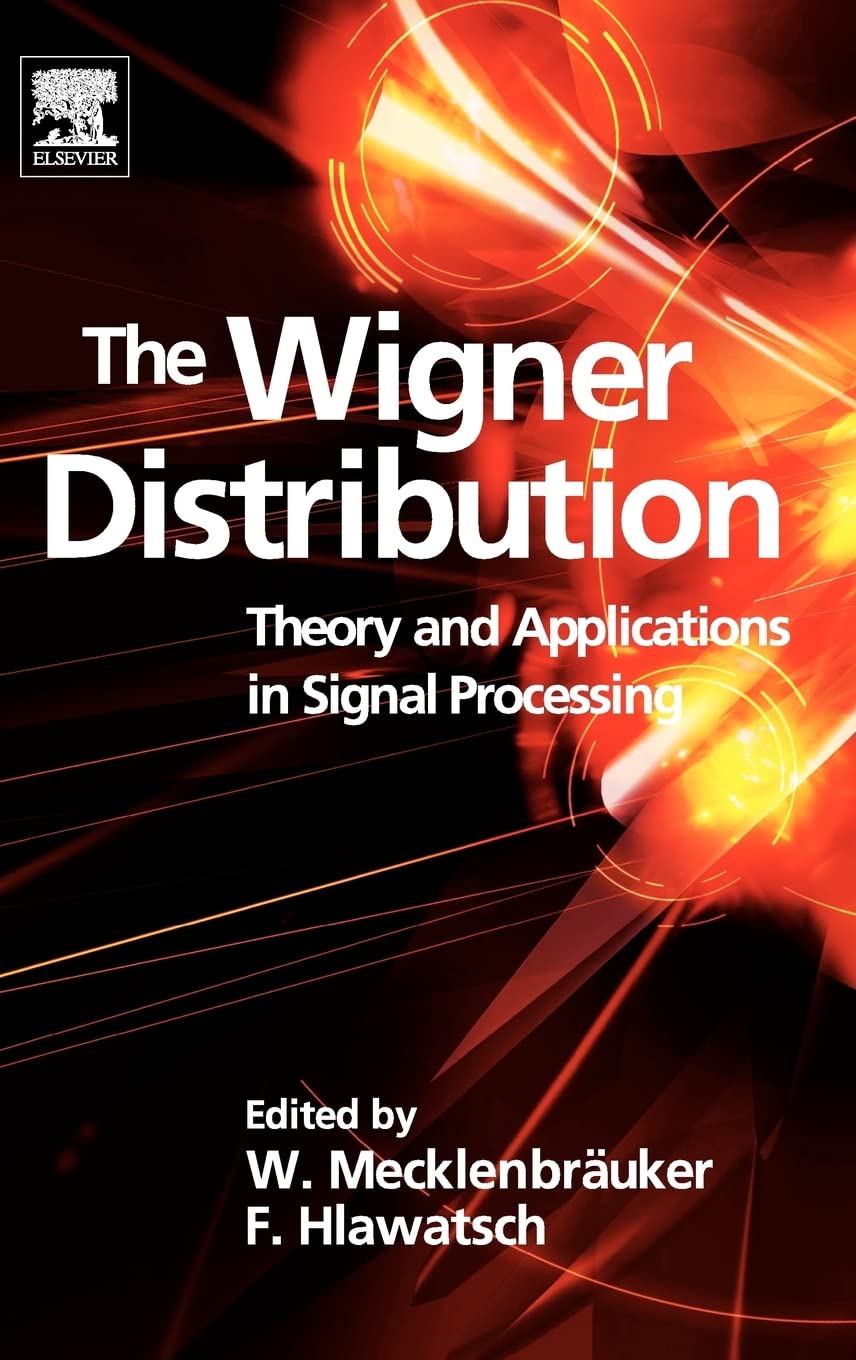
Title
The Wigner Distribution: Theory and Applications in Signal Processing,Used
Sold by Ergodebooks, an authorized reseller.
Returns accepted within 30 days | support@ergodebooks.com
Shipping Information
- Free Standard Shipping — United States only
- Processing Time: 3–5 business days
- Estimated Delivery: 6–10 business days after dispatch
- Double-boxed, fully insured & discreetly packaged
- Tracking number sent via email once dispatched
Returns & Refund
Returns accepted within 30 days of delivery.
Damaged or Defective Item
Free return shipping + replacement or full refund
Wrong Item Received
Free return shipping + replacement or full refund
Change of Mind
Return shipping at customer's expense · 25% restocking fee applies
Payment Option

In the last two decades, the field of timefrequency analysis has evolved into a widely recognized and applied discipline of signal processing. Besides linear timefrequency representations such as the shorttime Fourier transform, the Gabor transform, and the wavelet transform, an important contribution to this development has undoubtedly been the Wigner distribution (WD) which holds an exceptional position within the field of bilinear/quadratic timefrequency representations.The WD was first defined in quantum mechanics as early as 1932 by the later Nobel laureate E. Wigner. In 1948, J. Ville introduced this concept in signal analysis. Based on investigations of its mathematical structure and properties by N.G. de Bruijn in 1967, the WD was brought to the attention of a larger signal processing community in 1980. The WD was soon recognized to be important for two reasons: firstly, it provides a powerful theoretical basis for quadratic timefrequency analysis; secondly, its discretetime form (supplemented by suitable windowing and smoothing) is an eminently practical signal analysis tool.The seven chapters of this book cover a wide range of different aspects of the WD and other linear timefrequency distributions: properties such as positivity, spread, and interference term geometry; signal synthesis methods and their application to signal design, timefrequency filtering, and signal separation; WD based analysis of nonstationary random processes; singular value decompositions and their application to WD based detection and classification; and optical applications of the WD. The size of the chapters has been chosen such that an indepth treatment of the various topics is achieved.
⚠️ WARNING (California Proposition 65):
This product may contain chemicals known to the State of California to cause cancer, birth defects, or other reproductive harm.
For more information, please visit www.P65Warnings.ca.gov.