
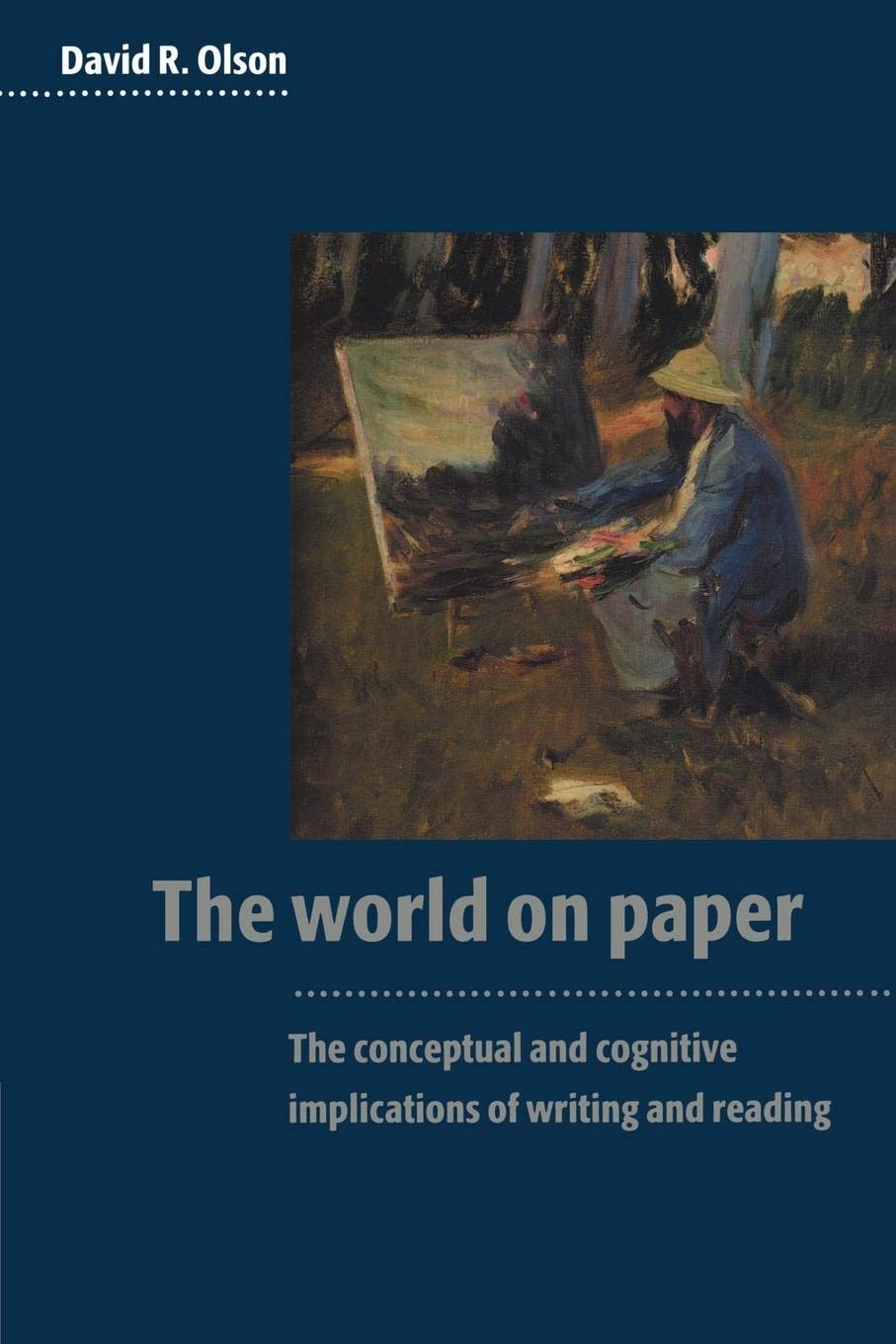
Title
The World on Paper: The Conceptual and Cognitive Implications of Writing and Reading,Used
Sold by Ergodebooks, an authorized reseller.
Returns accepted within 30 days | support@ergodebooks.com
Shipping Information
- Free Standard Shipping — United States only
- Processing Time: 3–5 business days
- Estimated Delivery: 6–10 business days after dispatch
- Double-boxed, fully insured & discreetly packaged
- Tracking number sent via email once dispatched
Returns & Refund
Returns accepted within 30 days of delivery.
Damaged or Defective Item
Free return shipping + replacement or full refund
Wrong Item Received
Free return shipping + replacement or full refund
Change of Mind
Return shipping at customer's expense · 25% restocking fee applies
Payment Option

What role has writing played in the development of our modern understanding of language, nature and ourselves? Drawing on recent advances in history, anthropology, linguistics and psychology, the author offers a bold new perspective on how writing and reading have historically and developmentally altered our understanding of language, mind and nature. These understandings, Olson argues, are byproducts of living in a 'world on paper.'
⚠️ WARNING (California Proposition 65):
This product may contain chemicals known to the State of California to cause cancer, birth defects, or other reproductive harm.
For more information, please visit www.P65Warnings.ca.gov.
- Q: What is the main theme of 'The World on Paper'? A: The main theme of 'The World on Paper' revolves around the role of writing in shaping our understanding of language, nature, and the self, exploring its historical and developmental impact.
- Q: Who is the author of this book? A: The author of 'The World on Paper' is David R. Olson, who draws on insights from various fields including history, anthropology, linguistics, and psychology.
- Q: What topics does the book cover? A: The book covers topics such as the cognitive implications of writing and reading, and how these practices have influenced our comprehension of language and thought.
- Q: Is this book suitable for academic research? A: Yes, 'The World on Paper' is suitable for academic research, particularly in the fields of linguistics, cognitive science, and anthropology, due to its well-researched content.
- Q: What is the condition of the book being sold? A: 'The World on Paper' is offered as a used book in good condition, ensuring that it is still readable and valuable for users.
- Q: How many pages does the book have? A: 'The World on Paper' contains a total of 340 pages, providing a comprehensive exploration of its themes.
- Q: When was 'The World on Paper' published? A: 'The World on Paper' was published on September 13, 1996.
- Q: What type of binding does this book have? A: This edition of 'The World on Paper' is available in paperback binding, making it a portable option for readers.
- Q: Does the book include any illustrations or figures? A: The product details do not specify whether 'The World on Paper' includes illustrations or figures, so it is recommended to check the book directly for this information.
- Q: What audience is this book intended for? A: 'The World on Paper' is intended for readers interested in linguistics, cognitive science, and the philosophical implications of writing and reading.