If you have any questions, you are always welcome to contact us. We'll get back to you as soon as possible, withing 24 hours on weekdays.
Customer service
All questions about your order, return and delivery must be sent to our customer service team by e-mail at yourstore@yourdomain.com
Sale & Press
If you are interested in selling our products, need more information about our brand or wish to make a collaboration, please contact us at press@yourdomain.com
Help
If you have any questions, you are always welcome to contact us. We'll get back to you as soon as possible, withing 24 hours on weekdays.
Customer service
All questions about your order, return and delivery must be sent to our customer service team by e-mail at yourstore@yourdomain.com
Sale & Press
If you are interested in selling our products, need more information about our brand or wish to make a collaboration, please contact us at press@yourdomain.com
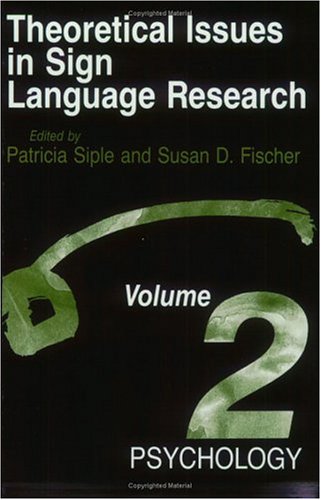
The recent recognition of sign languages as legitimate human languages has opened up new and unique ways for both theoretical and applied psycholinguistics and language acquisition have begun to demonstrate the universality of language acquisition, comprehension, and production processes across a wide variety of modes of communication. As a result, many language practitioners, teachers, and clinicians have begun to examine the role of sign language in the education of the deaf as well as in language intervention for atypical, languagedelayed populations.This collection, edited by Patricia Siple and Susan D. Fischer, brings together theoretically important contributions from both basic research and applied settings. The studies include native sign language acquisition; acquisition and processing of sign language through a single mode under widely varying conditions; acquisition and processing of bimodal (speech and sign) input; and the use of sign language with atypical, autistic, and mentally retarded groups.All the chapters in this collection of stateoftheart research address one or more issues related to universality of language processes, language plasticity, and the relative contributions of biology and input to language acquisition and use.
⚠️ WARNING (California Proposition 65):
This product may contain chemicals known to the State of California to cause cancer,
birth defects, or other reproductive harm.
For MAP (Minimum Advertised Price) violations and Intellectual Property (IP) or Trademark concerns, please contact:
support@ergodebooks.com
⚠️ California Proposition 65 Warning: Some products sold on this website may expose you to chemicals known to the State of California to cause cancer, birth defects, or other reproductive harm. For more information, visit www.P65Warnings.ca.gov.