
Title
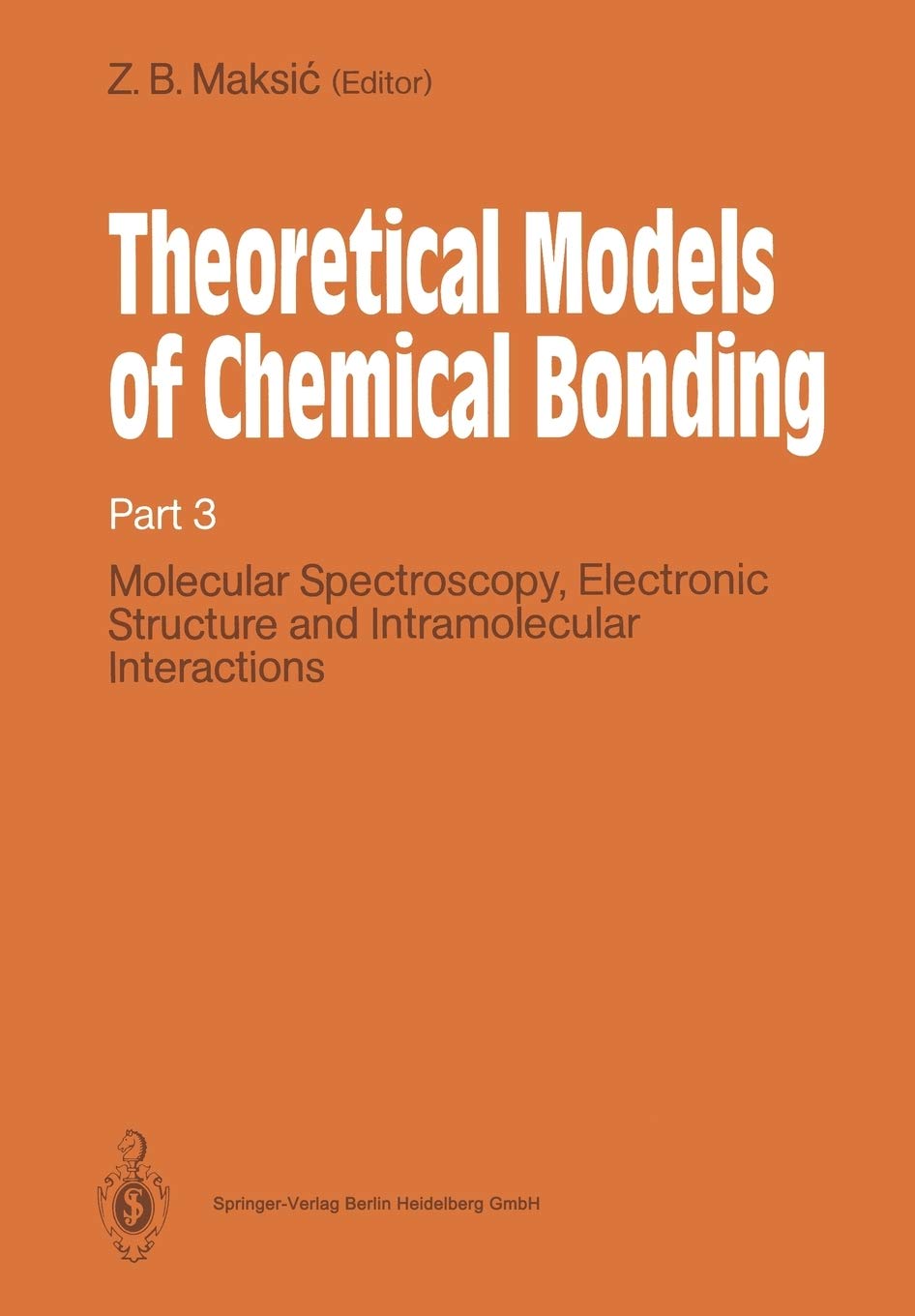
Theoretical Models of Chemical Bonding: Part 3: Molecular Spectroscopy, Electronic Structure and Intramolecular Interactions,Used
Sold by Ergodebooks, an authorized reseller.
Returns accepted within 30 days | support@ergodebooks.com
Shipping Information
- Free Standard Shipping — United States only
- Processing Time: 3–5 business days
- Estimated Delivery: 6–10 business days after dispatch
- Double-boxed, fully insured & discreetly packaged
- Tracking number sent via email once dispatched
Returns & Refund
Returns accepted within 30 days of delivery.
Damaged or Defective Item
Free return shipping + replacement or full refund
Wrong Item Received
Free return shipping + replacement or full refund
Change of Mind
Return shipping at customer's expense · 25% restocking fee applies
Payment Option

The renowned theoretical physicist Victor F. Weisskopf rightly pointed out that a real understanding of natural phenomena implies a clear distinction between the essential and the peripheral. Only when we reach such an understanding that is to say when we are able to separate the relevant from the irrelevant, will the phenomena no longer appear complex, but intelectually transparent. This statement, which is generally valid, reflects the very essence ofmodelling in the quantum theory of matter, on the molecular level in particular. Indeed, without theoretical models one would be swamped by too many details embodied in intricate accurate molecular wavefunctions. Further, physically justified simplificqtions enable studies of the otherwise intractable systems and/or phenomena. Finally, a lack of appropriate models would leave myriads of raw experimental data totally unrelated and incomprehensible. The present series ofbooks dwells on the most important models of chemical bonding and on the variety of its manifestations. In this volume the electronic structure and properties of molecules are considered in depth. Particular attention is focused on the nature of intramolecular interactions which in turn are revealed by various types ofmolecular spectroscopy. Emphasis is put on the conceptual and interpretive aspects of the theory in line with the general philosophy adopted in the series.
⚠️ WARNING (California Proposition 65):
This product may contain chemicals known to the State of California to cause cancer, birth defects, or other reproductive harm.
For more information, please visit www.P65Warnings.ca.gov.