
Title
Theories of Causality: From Antiquity to the Present,Used
Sold by Ergodebooks, an authorized reseller.
Returns accepted within 30 days | support@ergodebooks.com
Shipping Information
- Free Standard Shipping — United States only
- Processing Time: 3–5 business days
- Estimated Delivery: 6–10 business days after dispatch
- Double-boxed, fully insured & discreetly packaged
- Tracking number sent via email once dispatched
Returns & Refund
Returns accepted within 30 days of delivery.
Damaged or Defective Item
Free return shipping + replacement or full refund
Wrong Item Received
Free return shipping + replacement or full refund
Change of Mind
Return shipping at customer's expense · 25% restocking fee applies
Payment Option

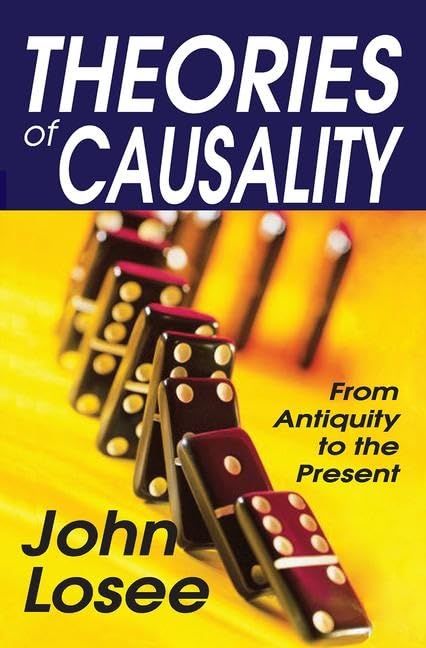
What types of entities qualify as "causes" and "effects"? What is the relationship between cause and effect? How are causal claims to be assessed? The first question deals with the structure of the world; the second is about theories that interpret the relationship of causes to effects; while the third has to do with proper procedure in science and everyday life. This volume is a wideranging history of answers that have been given to these three questions, and their relationship to scientific understanding.Losee presents a number of theories of causality within a historical survey that emphasizes the interrelationship between these theories and developments in science. His analysis displays the strengths and weaknesses of these theories so as to contribute to our present understanding of causal relatedness.Among the positions discussed are those of Aristotle, Hume, Kant, Mill, Salmon, Lewis, and Woodward. Losee's analysis displays the strengths and weaknesses of theories that identify causal relatedness with regularity of sequence, probability increase, energy transfer, exchange of a conserved quantity, counterfactual dependence, and inferability.These theories are judged, in part,by their ability to resolvedifficulties posed by instances of overdetermination,causation by omission, preventive causation, and causation by disconnection. Since applications of the theories to these instances disagree, a strategy of employing multiple concepts of causation is examined.Theories of Causality also describes the particular difficulties for causal analysis posed by quantum mechanics. One such difficulty is the prohibition against combining a causal analysis of a quantum process with a spatiotemporal description of that process.
⚠️ WARNING (California Proposition 65):
This product may contain chemicals known to the State of California to cause cancer, birth defects, or other reproductive harm.
For more information, please visit www.P65Warnings.ca.gov.