If you have any questions, you are always welcome to contact us. We'll get back to you as soon as possible, withing 24 hours on weekdays.
Customer service
All questions about your order, return and delivery must be sent to our customer service team by e-mail at yourstore@yourdomain.com
Sale & Press
If you are interested in selling our products, need more information about our brand or wish to make a collaboration, please contact us at press@yourdomain.com
Help
If you have any questions, you are always welcome to contact us. We'll get back to you as soon as possible, withing 24 hours on weekdays.
Customer service
All questions about your order, return and delivery must be sent to our customer service team by e-mail at yourstore@yourdomain.com
Sale & Press
If you are interested in selling our products, need more information about our brand or wish to make a collaboration, please contact us at press@yourdomain.com
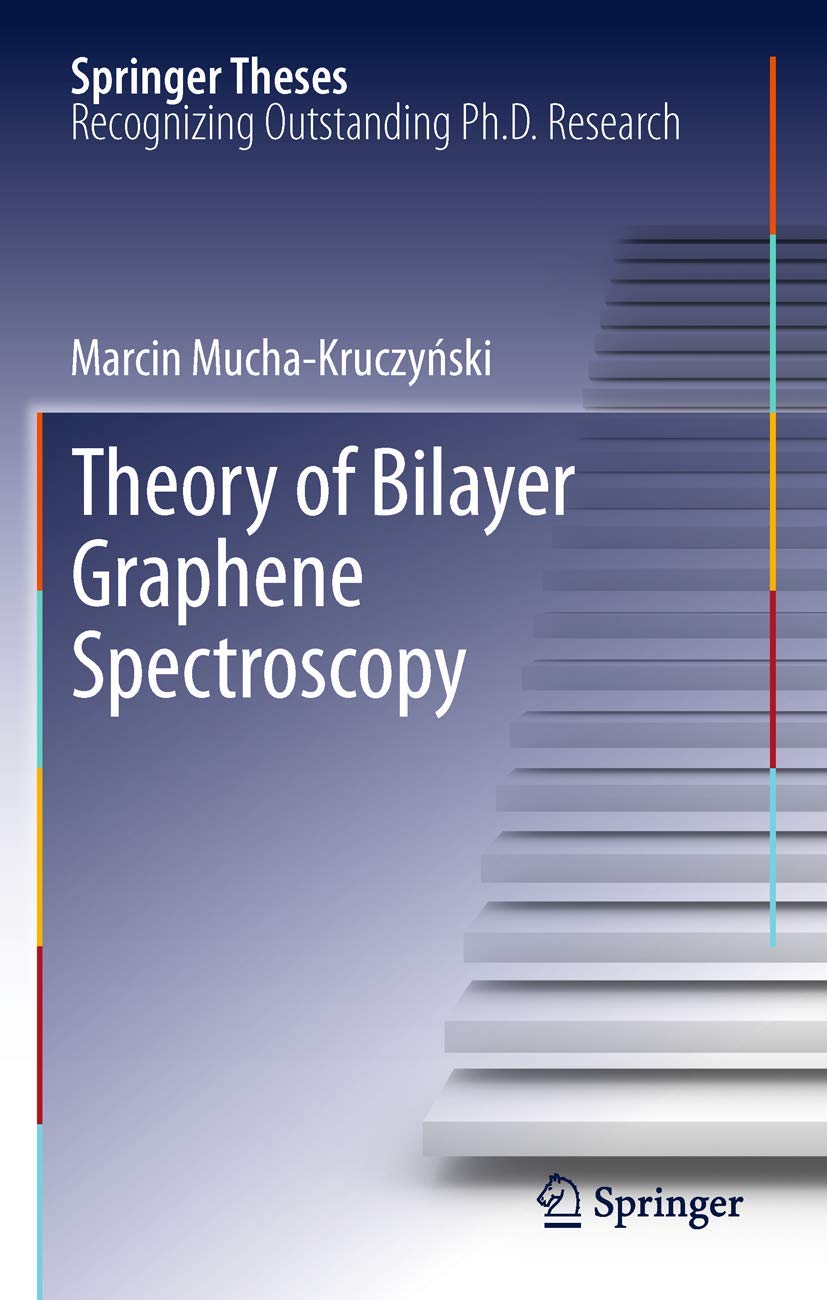
This thesis presents the theory of three key elements of optical spectroscopy of the electronic excitations in bilayer graphene: angleresolved photoemission spectroscopy (ARPES), visible range Raman spectroscopy, and farinfrared (FIR) magnetospectroscopy. Bilayer graphene (BLG) is an atomic twodimensional crystal consisting of two honeycomb monolayers of carbon, arranged according to Bernal stacking. The unperturbed BLG has a unique band structure, which features chiral states of electrons with a characteristic Berry phase of 2$pi$, and it has versatile properties which can be controlled by an externally applied transverse electric field and strain. It is shown in this work how ARPES of BLG can be used to obtain direct information about the chirality of electron states in the crystal. The author goes on to describe the influence of the interlayer asymmetry, which opens a gap in BLG, on ARPES and on FIR spectra in a strong magnetic field. Finally, he presents a comprehensive theory of inelastic Raman scattering resulting in the electronhole excitations in bilayer graphene, at zero and quantizing magnetic fields. This predicts their polarization properties and peculiar selection rules in terms of the interLandaulevel transitions.
⚠️ WARNING (California Proposition 65):
This product may contain chemicals known to the State of California to cause cancer,
birth defects, or other reproductive harm.
For MAP (Minimum Advertised Price) violations and Intellectual Property (IP) or Trademark concerns, please contact:
support@ergodebooks.com
⚠️ California Proposition 65 Warning: Some products sold on this website may expose you to chemicals known to the State of California to cause cancer, birth defects, or other reproductive harm. For more information, visit www.P65Warnings.ca.gov.