If you have any questions, you are always welcome to contact us. We'll get back to you as soon as possible, withing 24 hours on weekdays.
Customer service
All questions about your order, return and delivery must be sent to our customer service team by e-mail at yourstore@yourdomain.com
Sale & Press
If you are interested in selling our products, need more information about our brand or wish to make a collaboration, please contact us at press@yourdomain.com
Help
If you have any questions, you are always welcome to contact us. We'll get back to you as soon as possible, withing 24 hours on weekdays.
Customer service
All questions about your order, return and delivery must be sent to our customer service team by e-mail at yourstore@yourdomain.com
Sale & Press
If you are interested in selling our products, need more information about our brand or wish to make a collaboration, please contact us at press@yourdomain.com
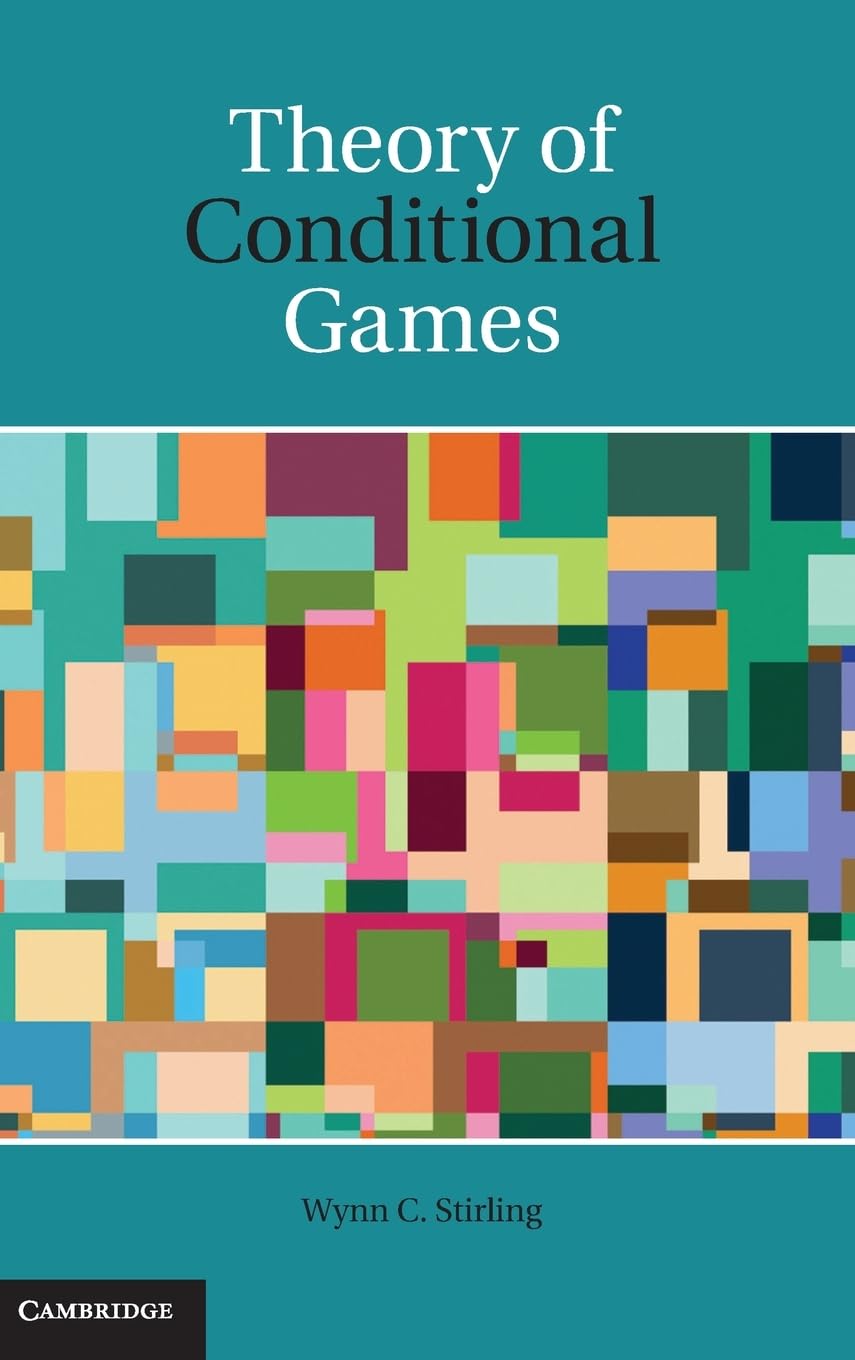
Game theory explains how to make good choices when different decision makers have conflicting interests. The classical approach assumes that decision makers are committed to making the best choices for themselves regardless of the effect on others, but such an approach is less appropriate when cooperation, compromise, and negotiation are important. This book describes conditional games, a form of game theory that accommodates multiple stakeholder decisionmaking scenarios where cooperation and negotiation are significant issues and where notions of concordant group behavior are important. Using classical binary preference relations as a point of departure, the book extends the concept of a preference ordering that permits stakeholders to modulate their preferences as functions of the preferences of others. As these conditional preferences propagate through a group of decision makers, they create social bonds that lead to notions of group concordance. This book is intended for all students and researchers of decision theory and game theory, including students in artificial intelligence (especially multiagent systems and distributed control), economics, management science, psychology, analytic philosophy, and applied mathematics.
⚠️ WARNING (California Proposition 65):
This product may contain chemicals known to the State of California to cause cancer,
birth defects, or other reproductive harm.
For MAP (Minimum Advertised Price) violations and Intellectual Property (IP) or Trademark concerns, please contact:
support@ergodebooks.com
⚠️ California Proposition 65 Warning: Some products sold on this website may expose you to chemicals known to the State of California to cause cancer, birth defects, or other reproductive harm. For more information, visit www.P65Warnings.ca.gov.