
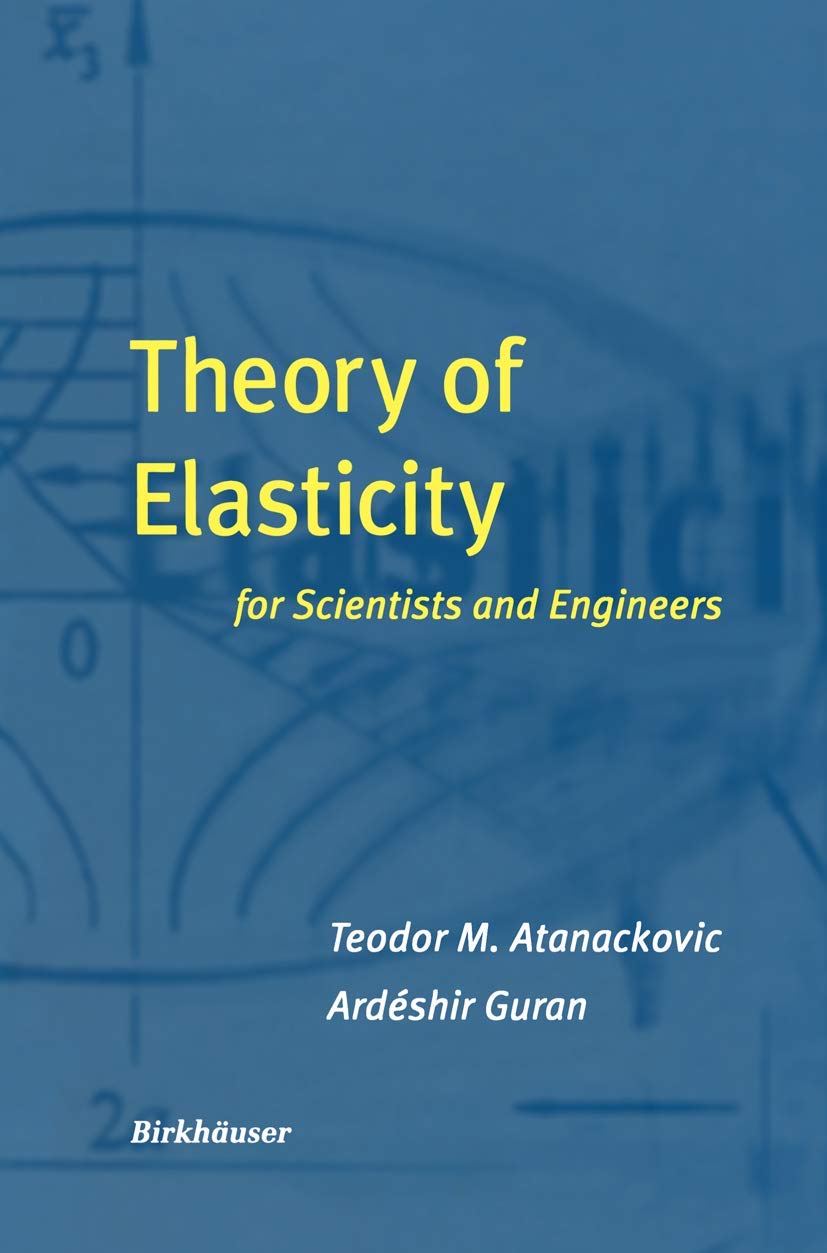
Title
Theory of Elasticity for Scientists and Engineers,Used
Sold by Ergodebooks, an authorized reseller.
Returns accepted within 30 days | support@ergodebooks.com
Shipping Information
- Free Standard Shipping — United States only
- Processing Time: 3–5 business days
- Estimated Delivery: 6–10 business days after dispatch
- Double-boxed, fully insured & discreetly packaged
- Tracking number sent via email once dispatched
Returns & Refund
Returns accepted within 30 days of delivery.
Damaged or Defective Item
Free return shipping + replacement or full refund
Wrong Item Received
Free return shipping + replacement or full refund
Change of Mind
Return shipping at customer's expense · 25% restocking fee applies
Payment Option

This book is intended to be an introduction to elasticity theory. It is as sumed that the student, before reading this book, has had courses in me chanics (statics, dynamics) and strength of materials (mechanics of mate rials). It is written at a level for undergraduate and beginning graduate engineering students in mechanical, civil, or aerospace engineering. As a background in mathematics, readers are expected to have had courses in ad vanced calculus, linear algebra, and differential equations. Our experience in teaching elasticity theory to engineering students leads us to believe that the course must be problemsolving oriented. We believe that formulation and solution of the problems is at the heart of elasticity theory. 1 Of course orientation to problemsolving philosophy does not exclude the need to study fundamentals. By fundamentals we mean both mechanical concepts such as stress, deformation and strain, compatibility conditions, constitu tive relations, energy of deformation, and mathematical methods, such as partial differential equations, complex variable and variational methods, and numerical techniques. We are aware of many excellent books on elasticity, some of which are listed in the References. If we are to state what differentiates our book from other similar texts we could, besides the already stated problemsolving ori entation, list the following: study of deformations that are not necessarily small, selection of problems that we treat, and the use of Cartesian tensors only.
⚠️ WARNING (California Proposition 65):
This product may contain chemicals known to the State of California to cause cancer, birth defects, or other reproductive harm.
For more information, please visit www.P65Warnings.ca.gov.