If you have any questions, you are always welcome to contact us. We'll get back to you as soon as possible, withing 24 hours on weekdays.
Customer service
All questions about your order, return and delivery must be sent to our customer service team by e-mail at yourstore@yourdomain.com
Sale & Press
If you are interested in selling our products, need more information about our brand or wish to make a collaboration, please contact us at press@yourdomain.com
Help
If you have any questions, you are always welcome to contact us. We'll get back to you as soon as possible, withing 24 hours on weekdays.
Customer service
All questions about your order, return and delivery must be sent to our customer service team by e-mail at yourstore@yourdomain.com
Sale & Press
If you are interested in selling our products, need more information about our brand or wish to make a collaboration, please contact us at press@yourdomain.com
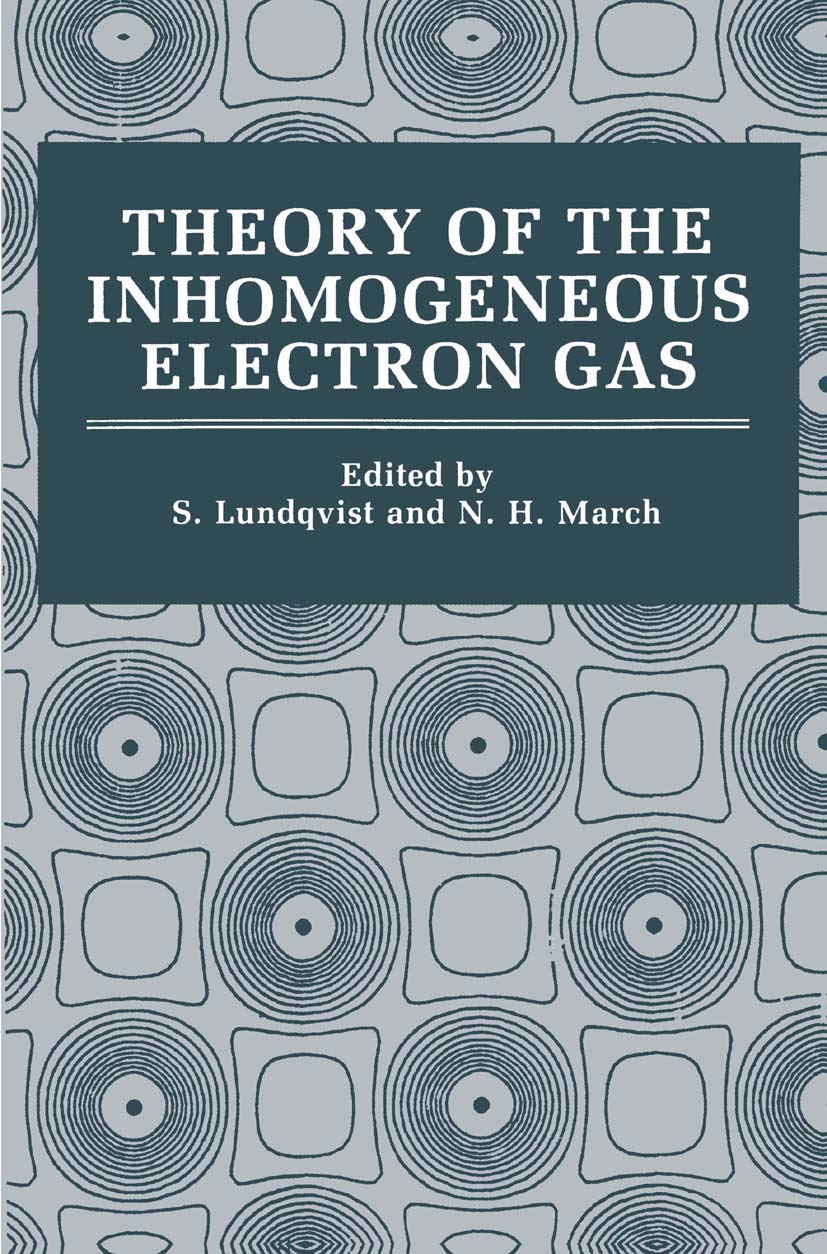
The theory of the inhomogeneous electron gas had its origin in the Thomas Fermi statistical theory, which is discussed in the first chapter of this book. This already leads to significant physical results for the binding energies of atomic ions, though because it leaves out shell structure the results of such a theory cannot reflect the richness of the Periodic Table. Therefore, for a long time, the earlier method proposed by Hartree, in which each electron is assigned its own personal wave function and energy, dominated atomic theory. The extension of the Hartree theory by Fock, to include exchange, had its parallel in the density description when Dirac showed how to incorporate exchange in the ThomasFermi theory. Considerably later, in 1951, Slater, in an important paper, showed how a result similar to but not identical with that of Dirac followed as a simplification of the HartreeFock method. It was Gombas and other workers who recognized that one could also incorporate electron correlation consistently into the ThomasFermiDirac theory by using uniform electron gas relations locally, and progress had been made along all these avenues by the 1950s.
⚠️ WARNING (California Proposition 65):
This product may contain chemicals known to the State of California to cause cancer,
birth defects, or other reproductive harm.
For MAP (Minimum Advertised Price) violations and Intellectual Property (IP) or Trademark concerns, please contact:
support@ergodebooks.com
⚠️ California Proposition 65 Warning: Some products sold on this website may expose you to chemicals known to the State of California to cause cancer, birth defects, or other reproductive harm. For more information, visit www.P65Warnings.ca.gov.