
Title
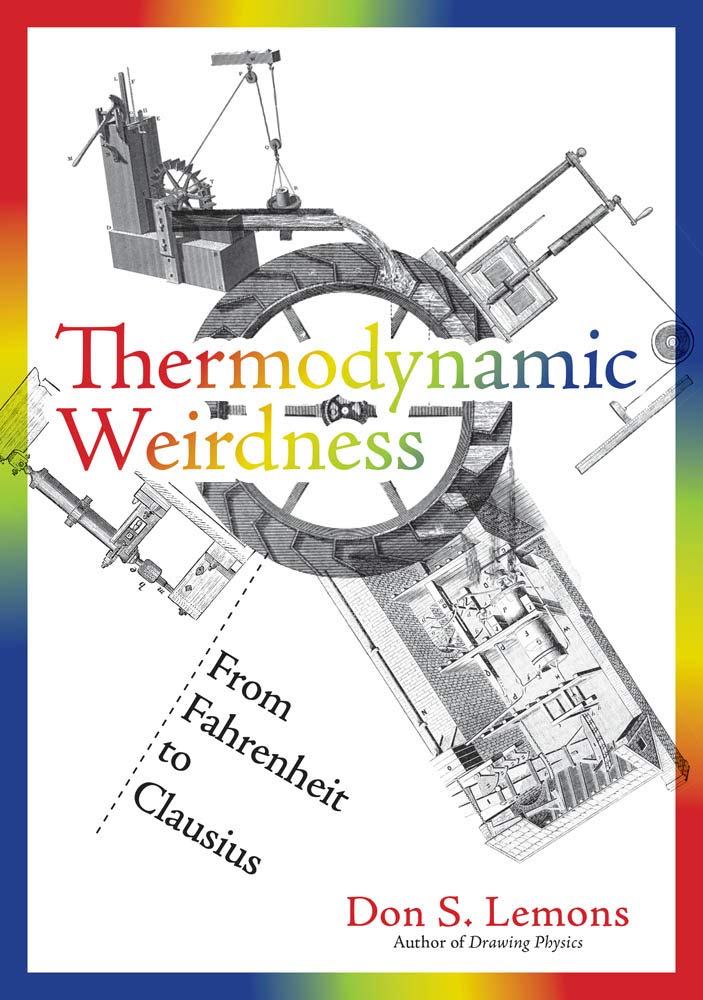
Thermodynamic Weirdness: From Fahrenheit to Clausius,Used
Sold by Ergodebooks, an authorized reseller.
Returns accepted within 30 days | support@ergodebooks.com
Shipping Information
- Free Standard Shipping — United States only
- Processing Time: 3–5 business days
- Estimated Delivery: 6–10 business days after dispatch
- Double-boxed, fully insured & discreetly packaged
- Tracking number sent via email once dispatched
Returns & Refund
Returns accepted within 30 days of delivery.
Damaged or Defective Item
Free return shipping + replacement or full refund
Wrong Item Received
Free return shipping + replacement or full refund
Change of Mind
Return shipping at customer's expense · 25% restocking fee applies
Payment Option

An account of the concepts and intellectual structure of classical thermodynamics that reveals the subject's simplicity and coherence.Students of physics, chemistry, and engineering are taught classical thermodynamics through its methodsa problems first approach that neglects the subject's concepts and intellectual structure. In Thermodynamic Weirdness, Don Lemons fills this gap, offering a nonmathematical account of the ideas of classical thermodynamics in all its nonNewtonian weirdness. By emphasizing the ideas and their relationship to one another, Lemons reveals the simplicity and coherence of classical thermodynamics.Lemons presents concepts in an order that is both chronological and logical, mapping the rise and fall of ideas in such a way that the ideas that were abandoned illuminate the ideas that took their place. Selections from primary sources, including writings by Daniel Fahrenheit, Antoine Lavoisier, James Joule, and others, appear at the end of most chapters. Lemons covers the invention of temperature; heat as a form of motion or as a material fluid; Carnot's analysis of heat engines; William Thomson (later Lord Kelvin) and his two definitions of absolute temperature; and energy as the mechanical equivalent of heat. He explains early versions of the first and second laws of thermodynamics; entropy and the law of entropy nondecrease; the differing views of Lord Kelvin and Rudolf Clausius on the fate of the universe; the zeroth and third laws of thermodynamics; and Einstein's assessment of classical thermodynamics as the only physical theory of universal content which I am convinced will never be overthrown.
⚠️ WARNING (California Proposition 65):
This product may contain chemicals known to the State of California to cause cancer, birth defects, or other reproductive harm.
For more information, please visit www.P65Warnings.ca.gov.
- Q: What is the page count of this book? A: This book has one hundred seventy-six pages. It's a hardcover publication by MIT Press.
- Q: What are the dimensions of 'Thermodynamic Weirdness'? A: The book measures six inches in length, one inch in width, and eight and a half inches in height.
- Q: Who is the author of this book? A: The author of 'Thermodynamic Weirdness' is Don S. Lemons. He presents concepts of classical thermodynamics in an engaging way.
- Q: What is the main subject of this book? A: The book focuses on classical thermodynamics. It explores the concepts and intellectual structure of thermodynamics.
- Q: Is this book suitable for beginners in thermodynamics? A: Yes, this book is suitable for beginners. It provides a non-mathematical account of classical thermodynamics.
- Q: What reading level is this book appropriate for? A: This book is appropriate for high school and college students. It is written for those studying physics, chemistry, and engineering.
- Q: How should I store this hardcover book? A: Store it upright on a shelf in a dry place. Avoid exposure to direct sunlight to preserve the binding.
- Q: Can this book be used as a reference for studies? A: Yes, this book can be used as a reference. It includes selections from primary sources relevant to thermodynamics.
- Q: Are there any special care instructions for the book? A: Keep the book clean and dry. Use a soft cloth to dust the cover and avoid bending the pages.
- Q: What topics are covered in this book? A: Topics include the invention of temperature, heat engines, and laws of thermodynamics. It thoroughly examines classical thermodynamics.
- Q: Is 'Thermodynamic Weirdness' a recommended read for engineers? A: Yes, it is recommended for engineers. The book clarifies complex concepts in thermodynamics relevant to engineering.
- Q: Does this book include any historical references? A: Yes, it includes historical references from figures like Daniel Fahrenheit and Lord Kelvin. These are presented at the end of most chapters.
- Q: What is the binding type of this book? A: The book is bound in hardcover. This ensures durability and a professional appearance for libraries and personal collections.
- Q: Is this book a part of a series? A: No, 'Thermodynamic Weirdness' is not part of a series. It stands alone as a comprehensive exploration of thermodynamics.
- Q: What makes this book different from traditional thermodynamics textbooks? A: This book emphasizes concepts over problem-solving. It offers a more coherent understanding of thermodynamics without heavy mathematics.