
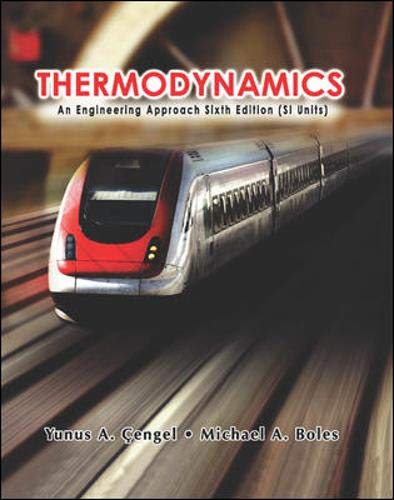
Title
Thermodynamics: An Engineering Approach Sixth Edition (SI Units),Used
Sold by Ergodebooks, an authorized reseller.
Returns accepted within 30 days | support@ergodebooks.com
Shipping Information
- Free Standard Shipping — United States only
- Processing Time: 3–5 business days
- Estimated Delivery: 6–10 business days after dispatch
- Double-boxed, fully insured & discreetly packaged
- Tracking number sent via email once dispatched
Returns & Refund
Returns accepted within 30 days of delivery.
Damaged or Defective Item
Free return shipping + replacement or full refund
Wrong Item Received
Free return shipping + replacement or full refund
Change of Mind
Return shipping at customer's expense · 25% restocking fee applies
Payment Option

This book moves students toward a clear understanding and a firm grasp of the basic principles of thermodynamics. It communicates directly with tomorrow's engineers in a simple yet precise manner that encourages creative thinking. This edition presents an early introduction to the First Law of Thermodynamics, and establishes a general understanding of energy, mechanisms of energy transfer, and the concept of energy balance, thermoeconomics, and conversion efficiency. It features over 700 new homework problems which further enhance the extensive and diverse homework problem sets, and physical intuition to help students develop a sense of the underlying physical mechanisms and a mastery of solving practical problems that an engineer is likely to face in the real world.The title includes a free Student Resources DVD containing Limited Academic Version of EES (Engineering Equation Solver) software with scripted solutions to selected text problems, Physical experiments in thermodynamics with videos and complete writeups of the experiments, as well as actual data, and an Interactive Thermodynamics Tutorial to reinforce student learning of thermodynamics concepts.
⚠️ WARNING (California Proposition 65):
This product may contain chemicals known to the State of California to cause cancer, birth defects, or other reproductive harm.
For more information, please visit www.P65Warnings.ca.gov.
- Q: What is the size of the book? A: The book measures approximately zero point seven nine inches in thickness, fifteen point thirty-five inches in width, and twenty-one point sixty-five inches in height.
- Q: How many pages does this book have? A: This book contains one thousand sixteen pages, providing extensive information on thermodynamics.
- Q: What type of binding does this book have? A: This book is available in paperback binding, making it more flexible and easier to handle.
- Q: Who are the authors of this book? A: The authors of this book are Yunus A. Cengel and Michael A. Boles, both recognized experts in the field of engineering.
- Q: What is the main focus of this book? A: This book focuses on the basic principles of thermodynamics, making it suitable for engineering students.
- Q: Does the book include any supplementary materials? A: Yes, the book comes with a free Student Resources DVD which includes software and interactive tutorials.
- Q: Is this book suitable for beginners? A: Yes, this book is designed for students and beginners, providing clear explanations of thermodynamics concepts.
- Q: How can I use this book effectively for studying? A: To use this book effectively, read the chapters thoroughly and work through the new homework problems provided.
- Q: What resources are included with the book for student learning? A: The included DVD features scripted solutions, physical experiments, and an interactive thermodynamics tutorial.
- Q: How should I care for this book? A: To care for this book, keep it in a dry place and avoid exposing it to water or excessive sunlight.
- Q: Is there a warranty or return policy for this book? A: Typically, books do not come with a warranty, but you may return it within the seller's specified return window.
- Q: What if the book arrives damaged? A: If the book arrives damaged, contact the seller immediately to discuss return or replacement options.
- Q: Can this book be used for self-study? A: Yes, this book is ideal for self-study, as it provides a clear introduction to thermodynamics.
- Q: Are there any online resources associated with this book? A: Yes, the book's DVD includes various online resources to enhance learning.
- Q: What level of education is this book intended for? A: This book is intended for undergraduate engineering students studying thermodynamics.
- Q: Does this book cover advanced thermodynamics topics? A: Yes, it covers both basic and advanced topics, including energy transfer mechanisms and thermoeconomics.