
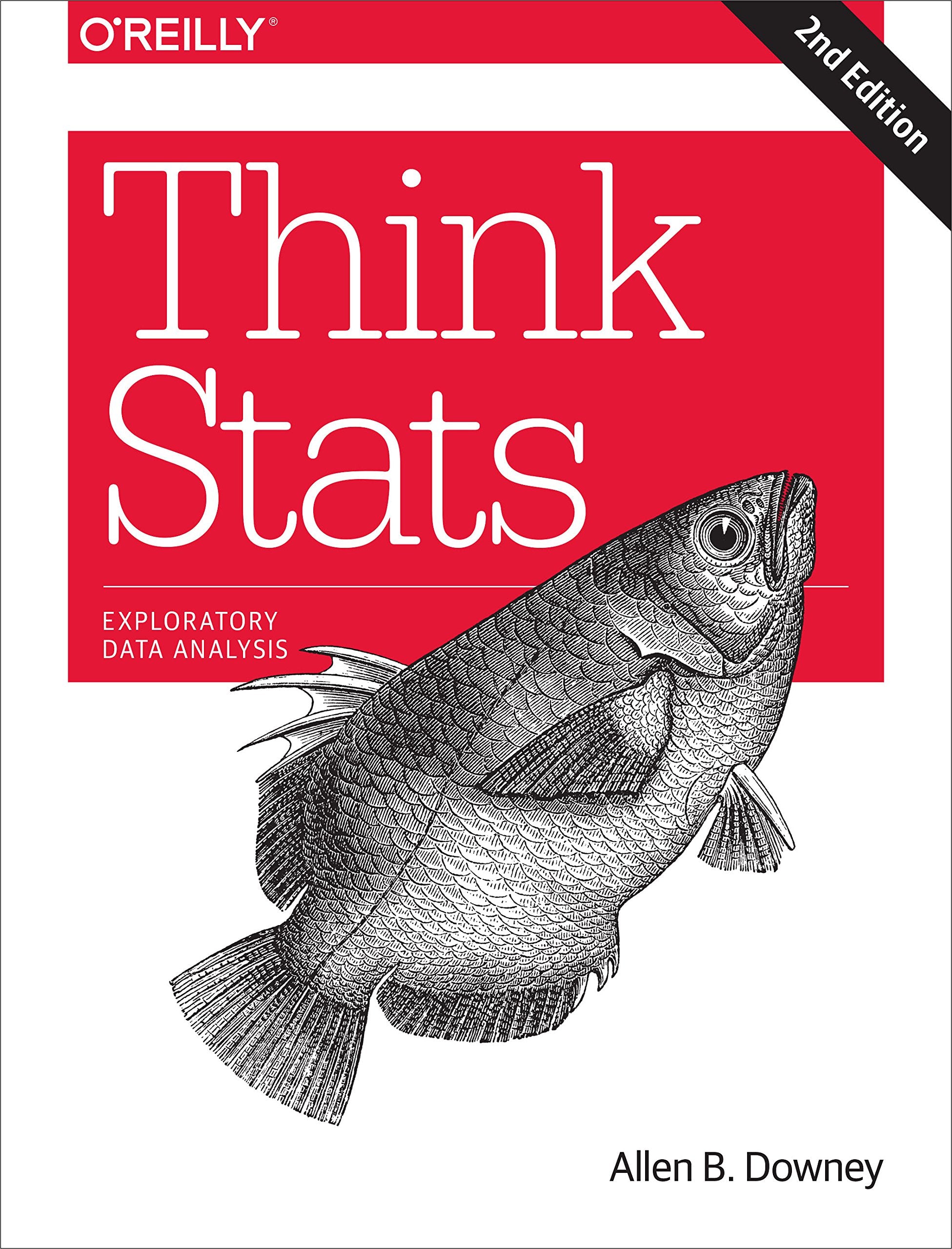
Title
Think Stats: Exploratory Data Analysis
Sold by Ergodebooks, an authorized reseller.
Returns accepted within 30 days | support@ergodebooks.com
Shipping Information
- Free Standard Shipping — United States only
- Processing Time: 3–5 business days
- Estimated Delivery: 6–10 business days after dispatch
- Double-boxed, fully insured & discreetly packaged
- Tracking number sent via email once dispatched
Returns & Refund
Returns accepted within 30 days of delivery.
Damaged or Defective Item
Free return shipping + replacement or full refund
Wrong Item Received
Free return shipping + replacement or full refund
Change of Mind
Return shipping at customer's expense · 25% restocking fee applies
Payment Option

If You Know How To Program, You Have The Skills To Turn Data Into Knowledge, Using Tools Of Probability And Statistics. This Concise Introduction Shows You How To Perform Statistical Analysis Computationally, Rather Than Mathematically, With Programs Written In Python.By Working With A Single Case Study Throughout This Thoroughly Revised Book, Youll Learn The Entire Process Of Exploratory Data Analysisfrom Collecting Data And Generating Statistics To Identifying Patterns And Testing Hypotheses. Youll Explore Distributions, Rules Of Probability, Visualization, And Many Other Tools And Concepts.New Chapters On Regression, Time Series Analysis, Survival Analysis, And Analytic Methods Will Enrich Your Discoveries. Develop An Understanding Of Probability And Statistics By Writing And Testing Code Run Experiments To Test Statistical Behavior, Such As Generating Samples From Several Distributions Use Simulations To Understand Concepts That Are Hard To Grasp Mathematically Import Data From Most Sources With Python, Rather Than Rely On Data Thats Cleaned And Formatted For Statistics Tools Use Statistical Inference To Answer Questions About Realworld Data
⚠️ WARNING (California Proposition 65):
This product may contain chemicals known to the State of California to cause cancer, birth defects, or other reproductive harm.
For more information, please visit www.P65Warnings.ca.gov.
- Q: What is the page count of 'Think Stats: Exploratory Data Analysis'? A: This book has two hundred twenty-three pages. It is a concise introduction to statistical analysis using Python.
- Q: What are the dimensions of the book? A: The book measures seven point zero one inches in length, zero point five one inches in width, and nine point one nine inches in height.
- Q: What type of binding does this book have? A: It has a paperback binding. This makes it lightweight and easy to handle.
- Q: How do I apply the concepts from this book? A: You can use the book to perform statistical analysis computationally with Python. It guides you through exploratory data analysis with practical examples.
- Q: Is this book suitable for beginners? A: Yes, it is suitable for beginners who know how to program. The book is designed as a concise introduction to statistical concepts.
- Q: Can I use this book for self-study? A: Yes, it is excellent for self-study. The clear explanations and practical examples make it easy to learn at your own pace.
- Q: How should I store this book to keep it in good condition? A: Store it in a cool, dry place away from direct sunlight. This will help preserve the binding and pages.
- Q: Are there any safety concerns with this book? A: There are no specific safety concerns with this book. It is a standard educational resource for data analysis.
- Q: How do I clean the book if it gets dirty? A: Wipe the cover gently with a damp cloth. Avoid using any cleaning agents that could damage the paper or binding.
- Q: What if I receive a damaged copy of the book? A: If you receive a damaged copy, contact the retailer for a return or exchange. Most retailers have policies for damaged goods.
- Q: Is this book a good resource for professionals? A: Yes, it is a valuable resource for professionals in data science and statistics. It covers advanced topics like regression and time series analysis.
- Q: How does this book compare to other statistics books? A: This book focuses on computational analysis with Python, which is different from many traditional statistics books that emphasize mathematical approaches.
- Q: Can this book help me with data visualization? A: Yes, it includes tools and concepts for data visualization, helping you understand your data better.
- Q: What programming language does this book use? A: The book uses Python for statistical analysis. It provides practical coding examples throughout.
- Q: Does this book cover real-world data analysis? A: Yes, it emphasizes using statistical inference to answer questions about real-world data. Practical applications are a key focus.