

Title
Thinking Like a Phage: The Genius of the Viruses That Infect Bacteria and Archaea,Used
Sold by Ergodebooks, an authorized reseller.
Returns accepted within 30 days | support@ergodebooks.com
Shipping Information
- Free Standard Shipping — United States only
- Processing Time: 3–5 business days
- Estimated Delivery: 6–10 business days after dispatch
- Double-boxed, fully insured & discreetly packaged
- Tracking number sent via email once dispatched
Returns & Refund
Returns accepted within 30 days of delivery.
Damaged or Defective Item
Free return shipping + replacement or full refund
Wrong Item Received
Free return shipping + replacement or full refund
Change of Mind
Return shipping at customer's expense · 25% restocking fee applies
Payment Option

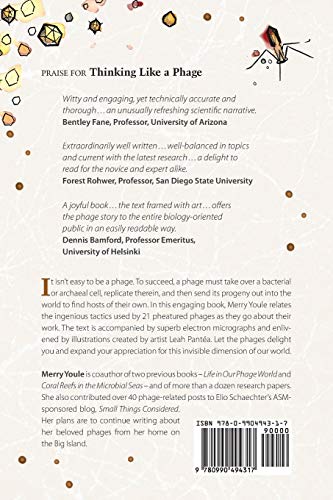
It isn't easy to be a phage. First, what is a phage? A phage is a virus that infects Bacteria. To succeed, a phage must encounter, recognize, and enter a particular type of bacterial cell, then coerce it to make more phages rather than more cells. Of course, the cell resists this hostile takeover in numerous ways, all of which the successful phage overcomes. The triumphant phage then proceeds with its replicative business. In this engaging book, Merry Youle relates some of the tactics used by 21 pheatured phages to outwit their host and successfully maintain their own lineage generation after generation.This ongoing contest of wits is a matter of life and death for both players. A phage chromosome arriving in its intended host cell is met by the cell's stateoftheart defenses. Unless it dodges or neutralizes every one, it will be chopped into a nutritious snack for the cell. If the phage survives, it then quickly diverts the cell's machinery to production of more phages, rather than more cells. Under skillful phage supervision, manufacture of phage components proceeds at top speed, with all parts produced when needed and in the quantities required. As the pieces come off the assembly line, they selfassemble into sophisticated transport packages, each carrying a phage chromosome and capable of delivering it into a new host cell. When a new crop of progeny is ready perhaps 25, 100, or more of them the phage ruptures the cell to free them all and send them out into the world in quest of hosts of their own. Overall, a balance is maintained so that both the phages and their hosts thrive.Many phages have the option to instead follow a different script. When they arrive in a host, they can opt to delay immediate hostile takeover and to instead form a coalition with the host for mutual benefit. In this case, as the cell grows and divides, the phage is replicated and inherited by both daughter cells. This can continue for many generations. However, if the cell encounters lifethreatening difficulties, the phage ends the alliance and switches to rapid replication. Cell rupture and release of the new generation follows quickly.Each step of the way presents challenges that test the ingenuity of the phages. In this book, tales of phage prowess are accompanied by pertinent electron micrographs; every chapter is enlivened by informative illustrations created by San Diego fine artist Leah Panta. The writing focuses on strategies and underlying principles, with a minimum of jargon. Since some knowledge of molecular biology is required to appreciate phage wizardry, a primer of the needed basics is provided for those unfamiliar with that subject. Thus, these phage adventures can be enjoyed by a wide audience.Despite being the most abundant life form, the phages being much smaller than even the microbes they infect elude our everyday perception. Thinking Like a Phage offers a tour of this unseen dimension of life on Earth. Whether you are an expert or new to the phage world, these vignettes drawn from phage life will intrigue you. Awareness of this vast, creative, yet invisible realm can enrich your appreciation for the living world of which we, as Homo sapiens, are only a small part.
⚠️ WARNING (California Proposition 65):
This product may contain chemicals known to the State of California to cause cancer, birth defects, or other reproductive harm.
For more information, please visit www.P65Warnings.ca.gov.
- Q: How many pages does the book 'Thinking Like a Phage' have? A: The book has three hundred ten pages. This length provides an in-depth exploration of phage biology and their interactions with bacteria.
- Q: What is the binding type of 'Thinking Like a Phage'? A: The book is available in paperback binding. This makes it lightweight and easy to handle for readers.
- Q: Who is the author of 'Thinking Like a Phage'? A: The author is Merry Youle. She presents complex scientific concepts in an engaging and accessible manner.
- Q: What is the recommended audience for 'Thinking Like a Phage'? A: The book is suitable for a general audience, including beginners and experts. It provides foundational knowledge in molecular biology.
- Q: Is 'Thinking Like a Phage' suitable for children? A: Yes, it can be suitable for older children with an interest in science. However, some knowledge of molecular biology is recommended.
- Q: How can I best engage with the content in 'Thinking Like a Phage'? A: Readers should start with the primer on molecular biology included in the book. This background will enhance understanding of phage strategies.
- Q: How do I care for my paperback copy of 'Thinking Like a Phage'? A: Keep the book in a dry place away from direct sunlight. This will prevent wear and fading over time.
- Q: Are there any safety concerns related to 'Thinking Like a Phage'? A: No, the book does not contain hazardous materials. It is a scientific text focused on microbiology.
- Q: What should I do if my copy of 'Thinking Like a Phage' arrives damaged? A: Contact the seller for a return or exchange. Most retailers have policies in place for damaged items.
- Q: How does 'Thinking Like a Phage' compare to other microbiology books? A: This book offers a unique narrative style focused on phages, unlike many textbooks that may be more technical.
- Q: Is there any specialized vocabulary in 'Thinking Like a Phage'? A: Yes, some jargon is used, but a primer on molecular biology is provided to assist readers.
- Q: What kind of illustrations can I expect in 'Thinking Like a Phage'? A: The book includes informative illustrations created by Leah Pantéa. These enhance the understanding of phage life cycles.
- Q: Does 'Thinking Like a Phage' cover both bacteria and archaea? A: Yes, the book discusses phages that infect both bacteria and archaea. This highlights the diversity of viral interactions.
- Q: Can 'Thinking Like a Phage' help with understanding the role of phages in ecosystems? A: Yes, it provides insights into the ecological balance between phages and their bacterial hosts.
- Q: Is 'Thinking Like a Phage' intended for academic study? A: While it is informative, it is more suitable for general interest than as a strict academic textbook.