
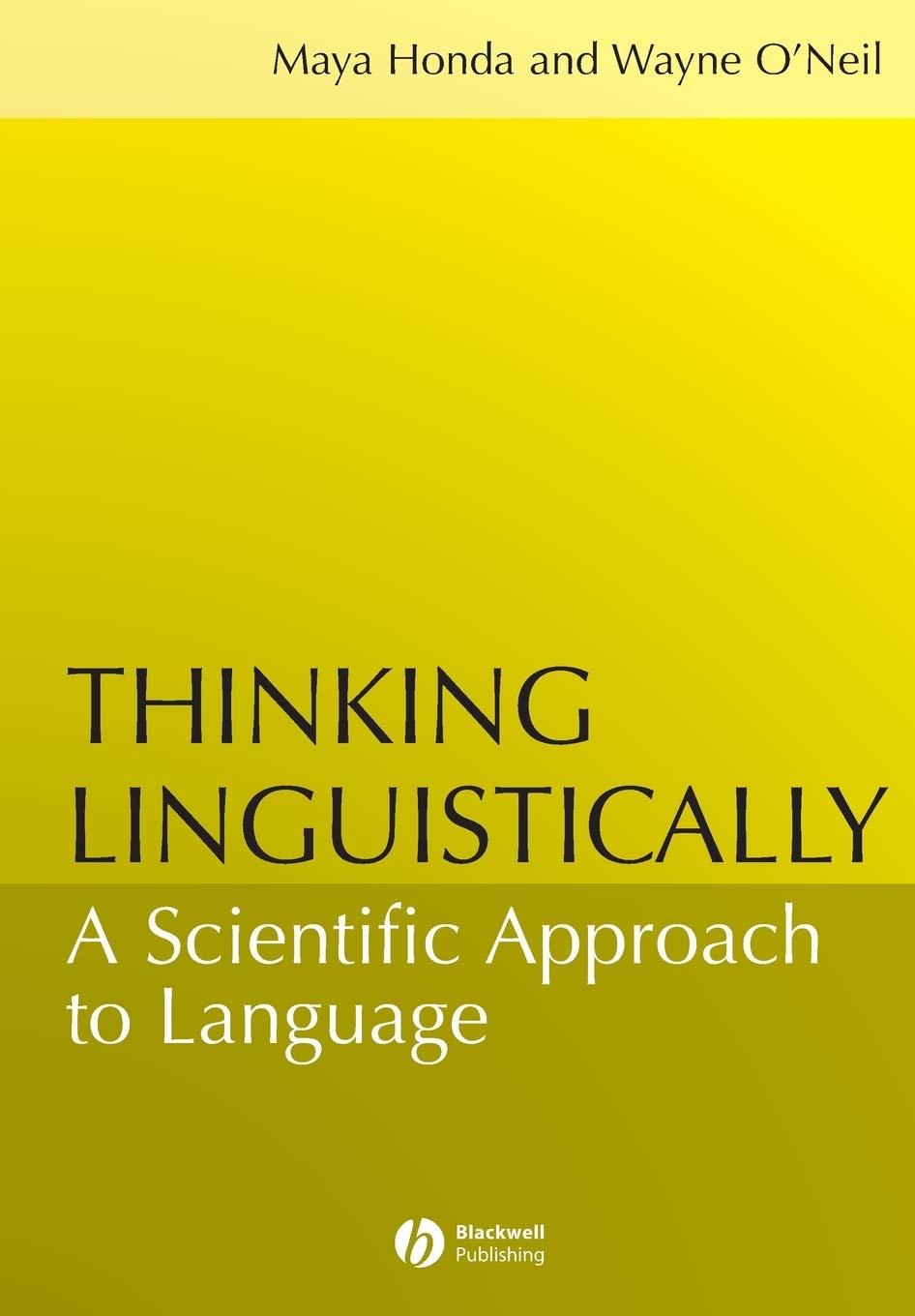
Title
Thinking Linguistically: A Scientific Approach to Language,New
Sold by Ergodebooks, an authorized reseller.
Returns accepted within 30 days | support@ergodebooks.com
Shipping Information
- Free Standard Shipping — United States only
- Processing Time: 3–5 business days
- Estimated Delivery: 6–10 business days after dispatch
- Double-boxed, fully insured & discreetly packaged
- Tracking number sent via email once dispatched
Returns & Refund
Returns accepted within 30 days of delivery.
Damaged or Defective Item
Free return shipping + replacement or full refund
Wrong Item Received
Free return shipping + replacement or full refund
Change of Mind
Return shipping at customer's expense · 25% restocking fee applies
Payment Option

Thinking Linguistically is a unique and clearly written introduction to the nature of linguistic analysis and issues in language acquisition. The book is for undergraduate and graduate students in linguistics, education, and psychology.Through twenty problem sets, based in languages not only from the Americas but from other continents as well, Thinking Linguistically: Initiates students to the linguists way of observing and analyzing data by making the methods and the process of inquiry visible and accessible. Engages students in analyzing the breadth and depth of two phenomena in a variety of languagesthe expression of noun phrase plurality and the formation of questions. Integrates analysis of these phenomena with results from first and second language acquisition research. Emphasizes the interface between phonology, morphology, syntax, and semantics. Exemplifies how linguistic analysis can be used for the teaching of critical thinking, problem solving, and the nature of scientific inquiry in general. Is ideal for future language teachers for understanding acquisition and linguistic phenomena
⚠️ WARNING (California Proposition 65):
This product may contain chemicals known to the State of California to cause cancer, birth defects, or other reproductive harm.
For more information, please visit www.P65Warnings.ca.gov.
- Q: How many pages are in 'Thinking Linguistically'? A: This book contains two hundred sixty-four pages. It's designed to provide a comprehensive introduction to linguistic analysis.
- Q: What is the binding type of this book? A: The binding type is paperback. This makes the book lightweight and easy to handle for students.
- Q: What are the dimensions of 'Thinking Linguistically'? A: The dimensions are six point eighty-one inches by zero point eighty-seven inches by nine point seventy inches. This size is standard for academic textbooks.
- Q: What is 'Thinking Linguistically' about? A: This book offers an introduction to linguistic analysis and language acquisition issues. It's suitable for undergraduate and graduate students.
- Q: Who is the author of 'Thinking Linguistically'? A: The author is Maya Honda. She focuses on making linguistic concepts accessible to learners.
- Q: What kind of exercises does the book include? A: It includes twenty problem sets. These sets encourage students to apply linguistic analysis across various languages.
- Q: Is 'Thinking Linguistically' suitable for beginners? A: Yes, the book is suitable for beginners. It serves as an introductory resource for students in linguistics and related fields.
- Q: Can this book help future language teachers? A: Yes, it is ideal for future language teachers. It helps them understand language acquisition and linguistic phenomena.
- Q: What topics are covered in the book? A: Topics include noun phrase plurality and question formation. The book integrates insights from first and second language acquisition research.
- Q: How can I use 'Thinking Linguistically' for study? A: You can use it as a primary textbook for courses in linguistics. It’s also helpful for independent study and analysis.
- Q: What is the condition of the used book? A: The used book is in good condition. It's suitable for readers looking for a quality second-hand resource.
- Q: Where is 'Thinking Linguistically' published? A: It is published by Wiley-Blackwell. The publisher is known for academic and educational resources.
- Q: What makes this book unique? A: Its unique approach lies in making linguistic analysis methods visible and accessible to students. It emphasizes critical thinking and scientific inquiry.
- Q: Does the book cover multiple languages? A: Yes, it covers languages from various continents. This broad approach enhances the learning experience for students.
- Q: Is there a focus on scientific inquiry in this book? A: Yes, the book emphasizes the nature of scientific inquiry. It integrates linguistic analysis with critical thinking skills.