
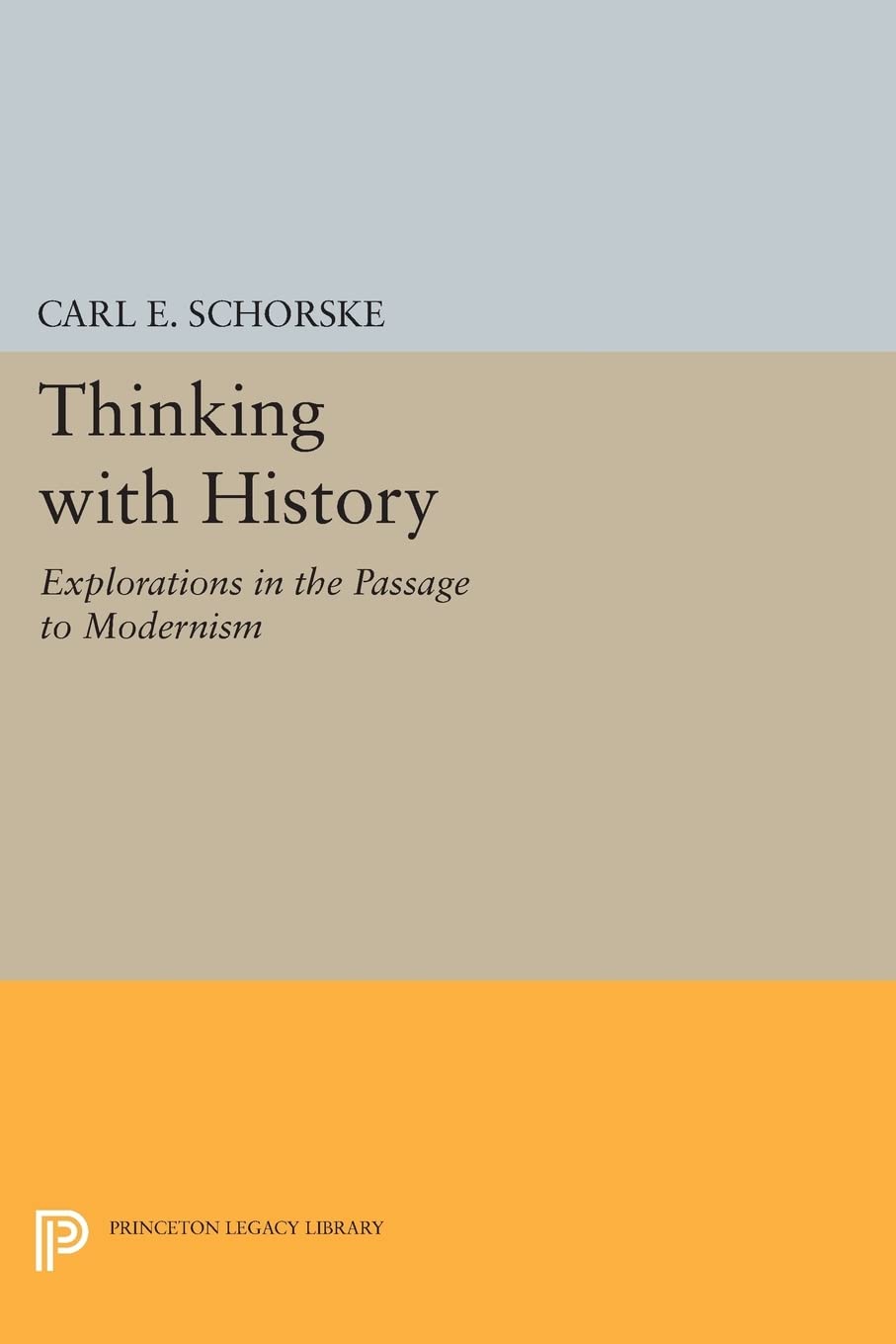
Title
Thinking With History: Explorations In The Passage To Modernism (Princeton Legacy Library),Used
Sold by Ergodebooks, an authorized reseller.
Returns accepted within 30 days | support@ergodebooks.com
Shipping Information
- Free Standard Shipping — United States only
- Processing Time: 3–5 business days
- Estimated Delivery: 6–10 business days after dispatch
- Double-boxed, fully insured & discreetly packaged
- Tracking number sent via email once dispatched
Returns & Refund
Returns accepted within 30 days of delivery.
Damaged or Defective Item
Free return shipping + replacement or full refund
Wrong Item Received
Free return shipping + replacement or full refund
Change of Mind
Return shipping at customer's expense · 25% restocking fee applies
Payment Option

In this book, the distinguished historian Carl Schorskeauthor of the Pulitzer Prizewinning FindeSicle Viennadraws together a series of essays that reveal the changing place of history in nineteenthand twentiethcentury cultures. In most intellectual and artistic fields, Schorske argues, twentiethcentury Europeans and Americans have come to do their thinking without history. Modern art, modern architecture, modern music, modern scienceall have defined themselves not as emerging from or even reacting against the past, but as detached from it in a new, autonomous cultural space. This is in stark contrast to the historicism of the nineteenth century, he argues, when ideas about the past pervaded most fields of thought from philosophy and politics to art, music, and literature. However, Schorske also shows that the nineteenth century's attachment to thinking with history and the modernist way of thinking without history are more than just antitheses. They are different ways of trying to address the problems of modernity, to give shape and meaning to European civilization in the era of industrial capitalism and mass politics.Schorske begins by reflecting on his own vocation as it was shaped by the historical changes he has seen sweep across political and academic culture. Then he offers a European sampler of ways in which nineteenthcentury European intellectuals used conceptions of the past to address the problems of their day: the city as community and artifact; the function of art; social dislocation. Narrowing his focus to FindeSicle Vienna in a second group of essays, he analyzes the emergence of ahistorical modernism in that city. Against the background of Austria's persistent, conflicting Baroque and Enlightenment traditions, Schorske examines three Viennese pioneers of modernismAdolf Loos, Gustav Mahler, and Sigmund Freudas they sought new orientation in their fields.In a concluding essay, Schorske turns his attention to thinking about history. In the context of a postmodern culture, when other disciplines that had once abandoned history are discovering new uses for it, he reflects on the nature and limits of history for the study of culture.Originally published in 1998.The Princeton Legacy Library uses the latest printondemand technology to again make available previously outofprint books from the distinguished backlist of Princeton University Press. These editions preserve the original texts of these important books while presenting them in durable paperback and hardcover editions. The goal of the Princeton Legacy Library is to vastly increase access to the rich scholarly heritage found in the thousands of books published by Princeton University Press since its founding in 1905.
⚠️ WARNING (California Proposition 65):
This product may contain chemicals known to the State of California to cause cancer, birth defects, or other reproductive harm.
For more information, please visit www.P65Warnings.ca.gov.