
Title
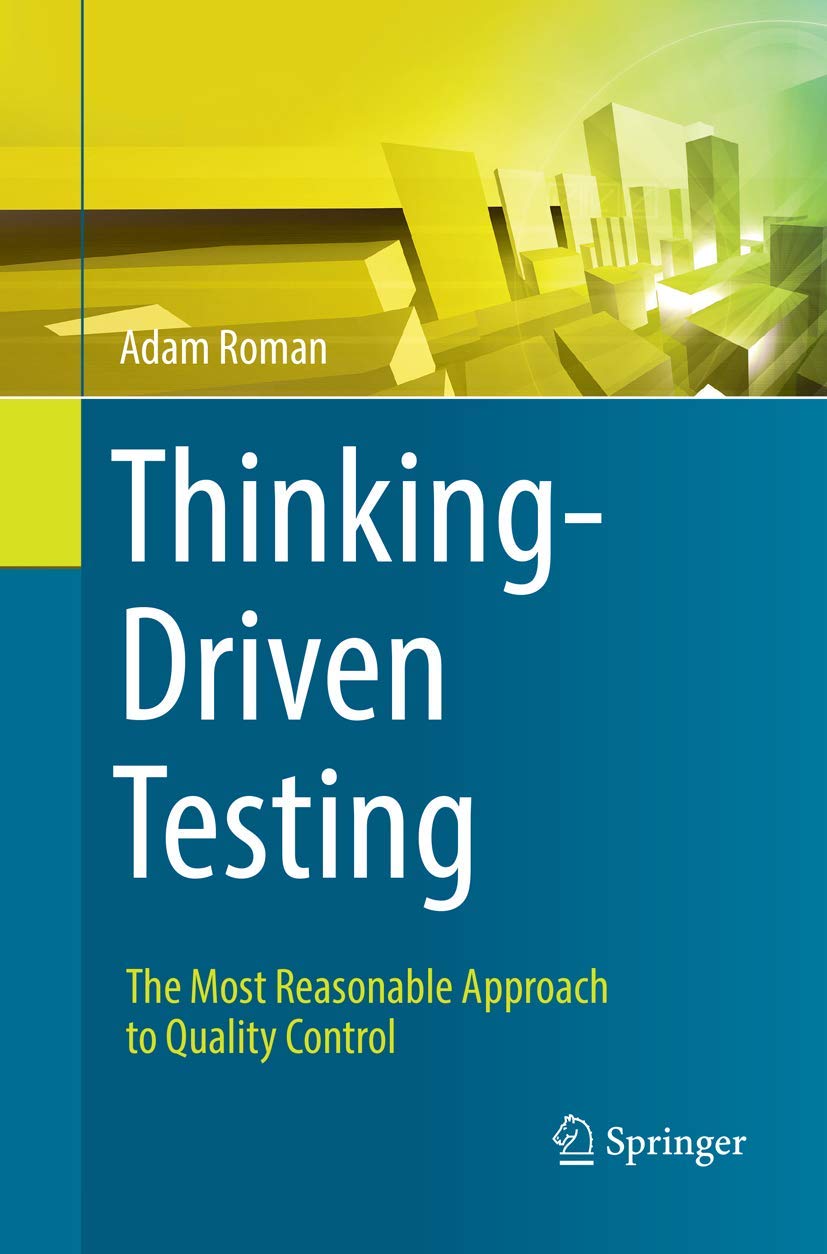
ThinkingDriven Testing: The Most Reasonable Approach to Quality Control,Used
Sold by Ergodebooks, an authorized reseller.
Returns accepted within 30 days | support@ergodebooks.com
Shipping Information
- Free Standard Shipping — United States only
- Processing Time: 3–5 business days
- Estimated Delivery: 6–10 business days after dispatch
- Double-boxed, fully insured & discreetly packaged
- Tracking number sent via email once dispatched
Returns & Refund
Returns accepted within 30 days of delivery.
Damaged or Defective Item
Free return shipping + replacement or full refund
Wrong Item Received
Free return shipping + replacement or full refund
Change of Mind
Return shipping at customer's expense · 25% restocking fee applies
Payment Option

This book presents a new paradigm of software testing by emphasizing the role of critical thinking, system thinking and rationality as the most important skills for the tester. It thus approaches software testing from a different perspective than in past literature, as the vast majority of books describe testing in the context of specific tools, automation, documentation, particular test design techniques or test management. In addition, the book proposes a novel metaapproach for designing effective test strategies, which is based on recent advances in psychology, economics, system sciences and logic.Chapter 1 starts by introducing the fundamental ideas underlying software testing. Chapter 2 then describes metastrategies in software testing, i.e. general approaches that can be adapted to many different situations that a software tester encounters. Next, Chapter 3 presents the concept of ThinkingDriven Testing (TDT). This approach utilizes the conceptsdiscussed in the two previous chapters and introduces the main ideas that underlie a reasonable and optimal approach to software testing. Chapter 4 builds on this basis and proposes a specific approach to testing, called TQED, that makes it possible to increase creativity in the context of delivering effective, optimal test ideas. Chapter 5 provides an overview of different types of testing techniques in order to understand the fundamental concepts of test design, while Chapter 6 details various pitfalls a tester may encounter and that can originate from a wide range of testing process areas. Lastly, Chapter 7 puts all this into practice, as it contains several exercises that will help testers develop a number of crucial skills: logical thinking and reasoning, thinking out of the box, creativity, counting and estimating, and analytical thinking.By promoting critical, rational and creative thinking, this book invites readers to reexamine common assumptions regarding software testing and shows them how to become professional testers who bring added value to their company.
⚠️ WARNING (California Proposition 65):
This product may contain chemicals known to the State of California to cause cancer, birth defects, or other reproductive harm.
For more information, please visit www.P65Warnings.ca.gov.