
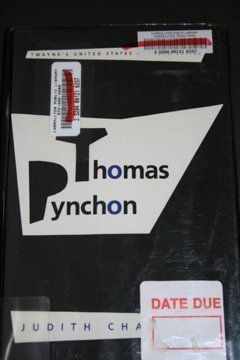
Title
Thomas Pynchon (Twayne'S United States Authors Series)
Sold by Ergodebooks, an authorized reseller.
Returns accepted within 30 days | support@ergodebooks.com
Shipping Information
- Free Standard Shipping — United States only
- Processing Time: 3–5 business days
- Estimated Delivery: 6–10 business days after dispatch
- Double-boxed, fully insured & discreetly packaged
- Tracking number sent via email once dispatched
Returns & Refund
Returns accepted within 30 days of delivery.
Damaged or Defective Item
Free return shipping + replacement or full refund
Wrong Item Received
Free return shipping + replacement or full refund
Change of Mind
Return shipping at customer's expense · 25% restocking fee applies
Payment Option

When In 1989 Thomas Pynchon Came Out With His Fourth Novel After A 17Year Hiatus From Publishing, It Was Perhaps Not Without A Hint Of Irony That The New York Times Book Review Turned To Salman Rushdie For Commentary. Here Was An Author Forced Into Exile (Literally To Save His Life) Reviewing The Work Of One Who Has Chosen His Own Exile (Perhaps To Guard His Gift) A Man Who Has Studiously Avoided Interviews And About Whom Little Is Known. The Horrific And Absurd Situation To Which Rushdie Found Himself Consigned Was Not Far From The Stuff Of Pynchon'S Fiction, Where Readers Enter A World In Which The Grotesqueries And Banalities Of Modern Life Are Inescapable By Conventional Means. With His Extravagant Imagination And Wild Sense Of Humor, Pynchon Maintains A Revered Place In Postwar American Literature: Many Believe That His 1963 Novel V. Anticipated Much Of The Most Advanced Philosophical And Literarycritical Reflection That Would Follow In The Next 20 Years.Judith Chambers'S Comprehensive Study Of This Enigmatic Writer Outlines A Definite Progression In His Work, Identifying His Early Short Stories As More Aesthetic Than His Later Work. With V. And The Crying Of Lot 49 (1966), She Argues, Pynchon'S Writing Became More Existential And Ironic In That The Reader Is Much More An Intellectual Participant In Recovering Meaning.By Gravity'S Rainbow (1973) Pynchon'S Style Was Most Decidedly Experiential, According To Chambers Experiential In That The Novel'S Truths Are Contained Not Just In Its Content But In Its Structure And Language, Which Leads Readers Away From Analysis And Toward A Kind Of Suffering And Risk That Become The Basis Of The Novel'S Affirmation. Chambers Places Vineland (1989) Even Farther Along On The Road Away From An Aesthetic Or Intellectual Style. By Avoiding Spellbinding Prose, Pynchon In Vineland Forces Readers To Experience A World In Which Heartfelt Language Is Almost Pounded Flat And Yet Some People Do Find The Courage To Act A Courage Motivated By The Simple Values Of Kindness And Love. And, Adds Chambers, Pynchon Does So Without A Trace Of Mawkishness.Throughout This Study Chambers Explores The Theory Of Language And Thought That Pynchon Developed In His Writing, Looking Specifically At His Meaning Of Decline By Applying The Theories Of Philosophers And Writers As Radical As He Robert Graves, Martin Heidegger, Walter Benjamin, And John D. Caputo. The Fundamental Question For Pynchon, Chambers Contends, Is One Of Hope; This Weaver Of Dark, Labyrinthine Tales Asks Whether We Can Have Ethics In A Postmodern World. Pynchon Answers This Question In His Novels By Creating What Caputo Has Termed A Cold Hermeneutics An Amalgam Of Heidegger And Jacques Derrida A Form Of Radical Thinking That Avoids Transcendental Justification.Ultimately, Chambers Finds That With His Eclectic, Poetic Texts Pynchon Destroys The Illusions Of Truth And Uses The Very Remnants Of This Destruction To Develop A Style That Restores The Mysterious Poetic Faculty To Thinking. However Pynchon Is Labeled In This Posteverything Era Of Critical Inquiry, His Embrace Of Radical And Experiential Fiction As The Appropriate Idiom For Depicting Twentiethcentury American Life Has Changed The Way A Generation Of Writers Has Approached Their Craft.
⚠️ WARNING (California Proposition 65):
This product may contain chemicals known to the State of California to cause cancer, birth defects, or other reproductive harm.
For more information, please visit www.P65Warnings.ca.gov.
- Q: What is the page count of this book? A: This book contains two hundred twenty-nine pages. It provides a comprehensive study of Thomas Pynchon's literary contributions.
- Q: What is the binding type of this book? A: This book is hardcover. The durable hardcover format is suitable for long-term use and preservation.
- Q: What are the dimensions of the book? A: The book measures six inches in length, one inch in width, and nine point zero two inches in height. These dimensions make it a manageable size for reading.
- Q: Who is the author of this book? A: The author of this book is Judith Chambers. She provides an insightful analysis of Thomas Pynchon's work.
- Q: What genre does this book belong to? A: This book is categorized under Criticism and Theory. It specifically explores literary analysis related to Thomas Pynchon's writings.
- Q: How do I read this book effectively? A: To read this book effectively, take notes on key themes and concepts. This will enhance your understanding of Pynchon's complex narratives.
- Q: Is this book suitable for beginners in literary analysis? A: Yes, this book is suitable for beginners. Judith Chambers explains Pynchon's work in a way that is accessible to those new to literary criticism.
- Q: What should I consider when reading this book? A: Consider the historical and cultural context of Pynchon's work. Understanding these elements can deepen your appreciation of the text.
- Q: How should I store this book to keep it in good condition? A: Store this book upright on a shelf in a cool, dry place. Avoid exposure to direct sunlight to prevent fading of the cover.
- Q: How can I clean this book if it gets dirty? A: To clean this book, gently wipe the cover with a dry cloth. Avoid using water or cleaning solutions to protect the material.
- Q: Is there a return policy for this book? A: Yes, there is a return policy. You can return the book within a specified period if it is in its original condition.
- Q: What if the book arrives damaged? A: If the book arrives damaged, contact customer support immediately for assistance with a replacement or refund.
- Q: How does this book compare to other literary critiques of Pynchon? A: This book offers a unique perspective by focusing on the evolution of Pynchon's style. It distinguishes itself by applying philosophical theories to his work.
- Q: What audience is this book intended for? A: This book is intended for students, educators, and enthusiasts of American literature. It is particularly beneficial for those studying postwar American writers.
- Q: Can this book help improve my literary analysis skills? A: Yes, this book can help improve your literary analysis skills. It provides in-depth commentary on Pynchon's complex themes and narrative style.