

Title
Thought and Choice in Chess,Used
Sold by Ergodebooks, an authorized reseller.
Returns accepted within 30 days | support@ergodebooks.com
Shipping Information
- Free Standard Shipping — United States only
- Processing Time: 3–5 business days
- Estimated Delivery: 6–10 business days after dispatch
- Double-boxed, fully insured & discreetly packaged
- Tracking number sent via email once dispatched
Returns & Refund
Returns accepted within 30 days of delivery.
Damaged or Defective Item
Free return shipping + replacement or full refund
Wrong Item Received
Free return shipping + replacement or full refund
Change of Mind
Return shipping at customer's expense · 25% restocking fee applies
Payment Option

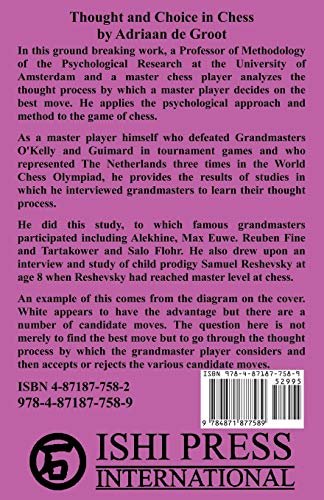
What does a chess master think when he prepares his next move? How are his thoughts organized? Which methods and strategies does he use by solving his problem of choice? To answer these questions, the author did a study, to which famous chess masters participated (Alekhine, Max Euwe, Reuben Fine, Tartakower and Flohr). This book is still useful for everybody who studies cognition and artificial intelligence. The studies involve participants of all chess backgrounds, from amateurs to masters. They investigate the cognitive requirements and the thought processes involved in moving a chess piece. The participants were usually required to solve a given chess problem correctly under the supervision of an experimenter and represent their thoughtprocesses vocally so that they could be recorded. De Groot found that much of what is important in choosing a move occurs during the first few seconds of exposure to a new position. Four stages in the task of choosing the next move were noted. The first stage was the 'orientation phase', in which the subject assessed the situation and determined a general idea of what to do next. The second stage, the 'exploration phase' was manifested by looking at some branches of the game tree. The third stage, or 'investigation phase' resulted in the subject choosing a probable best move. Finally, in the fourth stage, the 'proof phase', saw the subject confirming with him/herself that the results of the investigation were valid. De Groot concurred with Alfred Binet that visual memory and visual perception are important and that problemsolving ability is of paramount importance. Memory is particularly important, according to de Groot (1965), in that there are no 'new' moves in chess and so those from personal experience or from the experience of others can be committed to memory.
⚠️ WARNING (California Proposition 65):
This product may contain chemicals known to the State of California to cause cancer, birth defects, or other reproductive harm.
For more information, please visit www.P65Warnings.ca.gov.